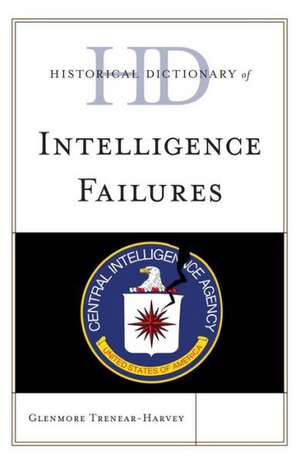
Historical Dictionary of Intelligence Failures: Historical Dictionaries of Intelligence and Counterintelligence
Autor Glenmore S. Trenear-Harveyen Limba Engleză Hardback – 20 noi 2014
Din seria Historical Dictionaries of Intelligence and Counterintelligence
- 61%
 Preț: 474.98 lei
 - 34%
 Preț: 793.76 lei
 - 35%
 Preț: 665.69 lei
 - 34%
 Preț: 793.68 lei
 - 35%
 Preț: 850.24 lei
 - 35%
 Preț: 1183.37 lei
 - 34%
 Preț: 680.14 lei
 - 37%
 Preț: 820.76 lei
 - 35%
 Preț: 782.81 lei
 - 34%
 Preț: 1033.70 lei
 - 36%
 Preț: 1004.38 lei
 - 37%
 Preț: 1000.69 lei
 - 37%
 Preț: 761.26 lei
 - 38%
 Preț: 693.47 lei
 - 36%
 Preț: 657.90 lei
Preț: 677.38 lei
Preț vechi: 1021.72 lei
-34%
Puncte Express: 1016
Carte tipărită la comandă
Livrare economică 05-19 iunie
Specificații
ISBN-13: 9781442232730
ISBN-10: 1442232730
Pagini: 324
Ilustrații: black & white illustrations
Dimensiuni: 162 x 234 x 28 mm
Greutate: 0.59 kg
Editura: Bloomsbury Publishing
Colecția Rowman & Littlefield
Seria Historical Dictionaries of Intelligence and Counterintelligence
Locul publicării:New York, United States
ISBN-10: 1442232730
Pagini: 324
Ilustrații: black & white illustrations
Dimensiuni: 162 x 234 x 28 mm
Greutate: 0.59 kg
Editura: Bloomsbury Publishing
Colecția Rowman & Littlefield
Seria Historical Dictionaries of Intelligence and Counterintelligence
Locul publicării:New York, United States
Recenzii
Harvey, editor in chief of World Intelligence Review and author of The Historical Dictionary of Air Intelligence, provides readers with an excellent counterpoint to the many incidents of successful intelligence operations with this new work focusing on the opposite. Part of the publisher's series on 'Historical Dictionaries of Intelligence and Counterintelligence,' this volume is important for understanding the scope of 'intelligence failure,' which the author defines as a situation in which intelligence about a particular event is available but is not collected or is mishandled during some part of the assessment cycle. The volume presents an A-Z dictionary organization with an excellent bibliography, a chronology, well over 100 cross-referenced entries, and a list of acronyms and abbreviations. An appendix provides a heavily redacted CIA document titled 'Misreading Intentions.' The range of topics is cosmopolitan: the Soviet invasion of Afghanistan, Operation Barbarossa, the bombing of the Chinese embassy in Belgrade, the Detroit Bomber, Dien Bien Phu, Irangate, the attempt on the life of Pope John Paul II, Vasili Mitrokhin, the Tet Offensive, and the Arab Spring. This title is well worth owning and makes a wonderful companion to others in the series, especially the Historical Dictionary of United States Intelligence, by Michael Turner. Summing Up: Highly recommended. All academic audiences; general readers and professionals/practitioners.
This dictionary will be of assistance to those studying twentieth-century history and contemporary international affairs, by lifting the veil on many clandestine episodes of the past hundred years which, though unheard of at the time, must have swayed the course of world affairs and continue to do so.
This dictionary will be of assistance to those studying twentieth-century history and contemporary international affairs, by lifting the veil on many clandestine episodes of the past hundred years which, though unheard of at the time, must have swayed the course of world affairs and continue to do so.