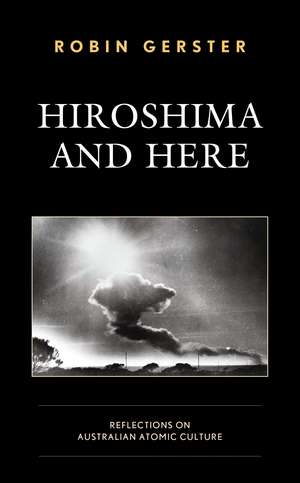
Hiroshima and Here: Reflections on Australian Atomic Culture
Autor Monash Universityen Limba Engleză Hardback – 2 sep 2020
Preț: 614.26 lei
Preț vechi: 911.00 lei
-33%
Puncte Express: 921
Carte tipărită la comandă
Livrare economică 17 noiembrie-01 decembrie
Livrare prin curier în România Termenul estimat este afișat lângă disponibilitate.
Transport gratuit pentru acest produs Plată online sau ramburs, în funcție de opțiunile comenzii.
Retur gratuit în 14 zile Comandă securizată și suport în română.
Specificații
ISBN-13: 9781498587594
ISBN-10: 1498587593
Pagini: 264
Ilustrații: 11 b/w illustrations;
Dimensiuni: 161 x 229 x 20 mm
Greutate: 0.49 kg
Editura: Bloomsbury Publishing
Colecția Lexington Books
Locul publicării:New York, United States
ISBN-10: 1498587593
Pagini: 264
Ilustrații: 11 b/w illustrations;
Dimensiuni: 161 x 229 x 20 mm
Greutate: 0.49 kg
Editura: Bloomsbury Publishing
Colecția Lexington Books
Locul publicării:New York, United States
Cuprins
Introduction: Exile on Uranium Street
Part I: The Aftermath
Chapter 1: Hiroshima around the Corner: Payback and Portent
Chapter 2: Going to Ground Zero: Australians in Occupied Japan
Part II: Australia's Place in the Nuclear Empire
Chapter 3: Our Atomic Home: the 1950s
Chapter 4: The Nuclear Blues: Since the 1960s
Part III: Commemoration and Prophecy
Chapter 5: Hiroshima Revisited: Remembering and Representing "the Bomb"
Chapter 6: Doom Town: Imagining the Nuclear Destruction of Australian Cities
Conclusion: Apocalypse, and Other Ends
Part I: The Aftermath
Chapter 1: Hiroshima around the Corner: Payback and Portent
Chapter 2: Going to Ground Zero: Australians in Occupied Japan
Part II: Australia's Place in the Nuclear Empire
Chapter 3: Our Atomic Home: the 1950s
Chapter 4: The Nuclear Blues: Since the 1960s
Part III: Commemoration and Prophecy
Chapter 5: Hiroshima Revisited: Remembering and Representing "the Bomb"
Chapter 6: Doom Town: Imagining the Nuclear Destruction of Australian Cities
Conclusion: Apocalypse, and Other Ends
Recenzii
When the first atomic bomb was dropped on Hiroshima in 1945, it awakened many Australians to the realization that what had occurred in Japan could happen at home. Gerster has produced an engaging, informative account of the effect of atomic warfare and nuclear power on Australian culture. Gerster particularly emphasizes topical Australian creative and documentary works, beginning in 1945 with reports from the postwar Australian forces in occupied Japan and continuing to the COVID-19 pandemic. Two recurring themes are the long-lasting concern over nuclear destruction held by many Australians and the precarious, frequently dismissive attitude of various authorities toward the effect of uranium mining and nuclear testing on indigenous peoples. Well documented, the book relies on a wide range of primary and secondary sources, plus the author's personal experiences while visiting sites in Japan, Australia, and the US. Readers who want to explore any individual theme in depth can turn to the references to relevant articles, books, films, and other media throughout the text. This book will be a welcome resource for classes or programs focusing on nuclear-age cultural studies. Highly recommended.
Gerster deftly tracks the murky and contradictory path of 'atomic Australia' through embodied, imaginary, and political culture. Gerster unearths a uranium-like vein woven beneath the continent's veneer, braiding it to the history and ecology of the whole world.
In a major contribution to nuclear studies, Robin Gerster controversially demonstrates the deep ties between Hiroshima and Australia. Gerster's rich and thought provoking volume draws on years of engagement with Australia's nuclear history. . . . (to) examine the fascinatingly complex cultural response of Australia to the nuclear world.
Unique in its range and coverage, Hiroshima and Here sets the gold standard for exploring Australia's complex Atomic Age experience. A comprehensive, interdisciplinary study of Australia's nuclear episteme, Gerster's narrative effortlessly melds ethnographic observation, dark tourism, personal anecdote and incisive analysis across the spectrum of radiological impacts intersecting Australia's nuclear trajectory and shifting geopolitics past, present and future.
Gerster deftly tracks the murky and contradictory path of 'atomic Australia' through embodied, imaginary, and political culture. Gerster unearths a uranium-like vein woven beneath the continent's veneer, braiding it to the history and ecology of the whole world.
In a major contribution to nuclear studies, Robin Gerster controversially demonstrates the deep ties between Hiroshima and Australia. Gerster's rich and thought provoking volume draws on years of engagement with Australia's nuclear history. . . . (to) examine the fascinatingly complex cultural response of Australia to the nuclear world.
Unique in its range and coverage, Hiroshima and Here sets the gold standard for exploring Australia's complex Atomic Age experience. A comprehensive, interdisciplinary study of Australia's nuclear episteme, Gerster's narrative effortlessly melds ethnographic observation, dark tourism, personal anecdote and incisive analysis across the spectrum of radiological impacts intersecting Australia's nuclear trajectory and shifting geopolitics past, present and future.