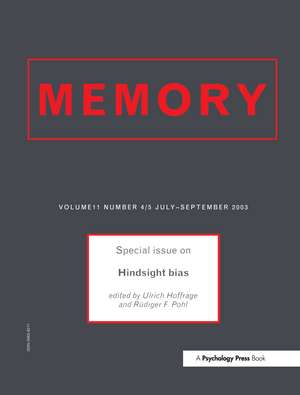
Hindsight Bias: A Special Issue of Memory: Special Issues of Memory
Editat de Ulrich Hoffrage, Rüdiger Pohlen Limba Engleză Paperback – 7 aug 2003

Preț: 387.16 lei
Puncte Express: 581
Carte disponibilă
Livrare economică 09-23 noiembrie
Livrare express 23-29 octombrie pentru 34.73 lei
Livrare prin curier în România Termenul estimat este afișat lângă disponibilitate.
Transport gratuit de la 400.00 lei Plată online sau ramburs, în funcție de opțiunile comenzii.
Retur gratuit în 14 zile Comandă securizată și suport în română.
Specificații
ISBN-13: 9781841699387
ISBN-10: 1841699381
Pagini: 176
Dimensiuni: 210 x 280 x 15 mm
Greutate: 0.44 kg
Ediția:New.
Editura: Taylor & Francis
Colecția Psychology Press
Seria Special Issues of Memory
Locul publicării:Oxford, United Kingdom
ISBN-10: 1841699381
Pagini: 176
Dimensiuni: 210 x 280 x 15 mm
Greutate: 0.44 kg
Ediția:New.
Editura: Taylor & Francis
Colecția Psychology Press
Seria Special Issues of Memory
Locul publicării:Oxford, United Kingdom
V-ar putea interesa
-
 The Making Of MemorySteven RosePreț: 124.38 lei
 -
 Memory: A Very Short IntroductionJonathan K. FosterPreț: 70.32 lei
 -
 Simple Heuristics in a Social WorldRalph Hertwig-32%Preț: 957.75 lei1415.52 lei
 -
 Episodic Memory: New Directions in ResearchAlan Baddeley-31%Preț: 506.73 lei733.45 lei
 -
 -28%Preț: 519.97 lei725.50 lei
 -
 Working Memory, Thought, and ActionAlan Baddeley-28%Preț: 508.06 lei710.27 lei
 -
 Memory in CultureA. ErllPreț: 218.06 lei
 -
 Working Memory and Academic LearningMilton J Dehn-8%Preț: 435.32 lei473.17 lei
 -
 Understanding Autobiographical MemoryDorthe BerntsenPreț: 399.86 lei
 -
 -27%Preț: 68.42 lei93.17 lei
 -
 -18%Preț: 704.62 lei859.28 lei
 -
 Essentials of Human Memory (Classic Edition)Alan Baddeley-19%Preț: 505.62 lei624.22 lei
 -
 The Psychology of Eyewitness IdentificationJames Michael Lampinen-18%Preț: 1117.23 lei1362.47 lei
Cuprins
U. Hoffrage, R.F. Pohl, Introduction. R.F. Pohl, M. Eisenhauer, O. Hardt, SARA - A Cognitive Process Model to Simulate the Anchoring Effect and Hindsight Bias. R. Hertwig, C. Fanselow, U. Hoffrage, Hindsight Bias: How Knowledge and Heuristics Affect Our Reconstruction of the Past. O. Hardt, R.F. Pohl, Hindsight Bias as a Function of Anchor Distance and Anchor Plausibility. S. Schwarz, D. Stahlberg, Strength of the Hindsight Bias as a Consequence of Meta-cognitions. L. Werth, F. Strack, An Inferential Approach to the Knew-it-all-along Phenomenon. M.V. Pezzo, Surprise, Defence, or Making Sense: What Removes the Hindsight Bias? M.M. Mark, R. Reiter, K.M. Eyssell, L.L. Cohen, S. Mellor, "I Couldn't Have Seen it Coming": The Impact of Negative Self-relevant Outcomes on Retrospections about Foreseeability. B. Renner, Hindsight Bias after Receiving Self-relevant Health-risk Information: A Motivational Perspective. H. Blank, V. Fischer, E. Erdfelder, Hindsight Bias in Political Elections. J. Musch, Personality Differences in Hindsight Bias.
Recenzii
'This collection of articles represents a great contribution towards the literature on hindsight bias and towards our understanding of the origin of this phenomenon, while opening many interesting new paths for research.' - Gaelle Villejoubert, Applied Cognitive Psychology
Descriere
With hindsight, we tend to exaggerate what we had known with foresight. This special issue of Memory explores this phenomenon.