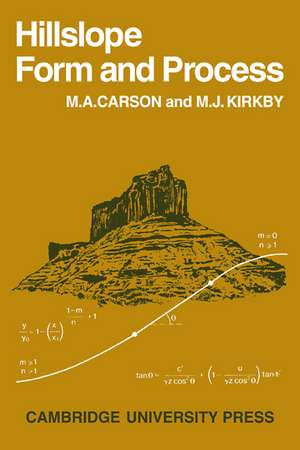
Hillslope Form and Process
Autor Carson, M. A. Carson, M. J. Kirkbyen Limba Engleză Paperback – 31 dec 2008
Preț: 426.13 lei
Puncte Express: 639
Carte tipărită la comandă
Livrare economică 03-17 decembrie
Livrare prin curier în România Termenul estimat este afișat lângă disponibilitate.
Transport gratuit pentru acest produs Plată online sau ramburs, în funcție de opțiunile comenzii.
Retur gratuit în 14 zile Comandă securizată și suport în română.
Specificații
ISBN-13: 9780521109116
ISBN-10: 0521109116
Pagini: 484
Dimensiuni: 152 x 229 x 28 mm
Greutate: 0.78 kg
Editura: Cambridge University Press
Locul publicării:Cambridge, United Kingdom
ISBN-10: 0521109116
Pagini: 484
Dimensiuni: 152 x 229 x 28 mm
Greutate: 0.78 kg
Editura: Cambridge University Press
Locul publicării:Cambridge, United Kingdom
V-ar putea interesa
-
 Landscapes and Geomorphology: A Very Short IntroductionAndrew Goudie-20%Preț: 56.77 lei70.88 lei
 -
 Limestones and Caves of WalesTrevor D. FordPreț: 441.49 lei
 -
 GeomorphologyRobert Sanderson-19%Preț: 628.54 lei775.97 lei
 -
 Natural HazardsEdward Bryant-19%Preț: 499.69 lei616.90 lei
 -
 Wind as a Geomorphic AgentMatti Seppälä-14%Preț: 1311.00 lei1524.42 lei
 -
 The Coast of AustraliaAndrew D. Short-19%Preț: 442.35 lei546.11 lei
 -
 Introduction to Coastal Processes and GeomorphologyRobin Davidson-Arnott-7%Preț: 364.67 lei391.30 lei
 -
 LandslidesJohn Clague-14%Preț: 1199.55 lei1394.83 lei
 -
 Handbook of Erosion ModellingR P C Morgan-23%Preț: 934.33 lei1213.42 lei
 -
 Introduction to Coastal Processes and GeomorphologyGerd Masselink-8%Preț: 632.34 lei687.33 lei
 -
 Tectonic GeomorphologyDouglas W Burbank-8%Preț: 638.98 lei694.55 lei
 -
 The Earth's Land SurfaceKenneth J. Gregory-15%Preț: 438.05 lei515.35 lei
Cuprins
Preface; Introduction; 1. Geomorphic systems and models; 2. Starting points: systems of reference; Part I. Force and Resistance: 3. Force: sources of energy for debris transport; 4. Resistance; Part II. Process: The Interaction of Force and Resistance: 5. Process: introduction; 6. Instability processes in rock masses; 7. Instability in soil masses; 8. Surface water erosion; 9. Sub-surface water erosion; 10. Soil creep; part III. Form: comparison of Real Forms with Process-Response Models: 11. Humid temperate areas; 12. The periglacial landscape; 13. Semi-arid and arid landscapes; 14. Tropical landforms; Part IV. Synthesis: 15. Slope profiles; 16. Slopes in drainage basins; Appendices.
Descriere
This book looks at hillslopes and studies process mechanisms and rates that have become sufficiently numerous to allow a systematic study of them.