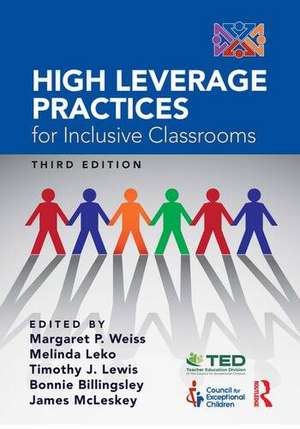
High Leverage Practices for Inclusive Classrooms
Editat de Margaret P. Weiss, Melinda Leko, Timothy J. Lewis, Bonnie Billingsley, James McLeskeyen Limba Engleză Paperback – dec 2026
In this third edition, chapters have been fully updated to reflect changes in the field since its original publication and feature all new examples illustrating the use of HLPs and incorporating culturally responsive practices. This edition also includes a new section on how HLPs are best used to support multiple groups of educational personnel.
Focused primarily on Tiers 1 and 2—or work that mostly occurs with students with mild to moderate disabilities in general education classrooms—this powerful, research-based resource provides rich, practical information highly suitable for teachers, and additionally useful for teacher educators and teacher preparation programs.
Preț: 249.42 lei
Preț vechi: 282.66 lei
-12% Precomandă
Puncte Express: 374
Carte nepublicată încă
Livrare prin curier în România Precomanda se expediază când titlul devine disponibil.
Transport gratuit de la 400.00 lei Plată online sau ramburs, în funcție de opțiunile comenzii.
Retur gratuit în 14 zile Comandă securizată și suport în română.
Doresc să fiu notificat când acest titlu va fi disponibil:
Se trimite...
Specificații
ISBN-13: 9781041037002
ISBN-10: 1041037007
Pagini: 408
Ilustrații: 104
Dimensiuni: 178 x 254 mm
Ediția:3
Editura: Taylor & Francis
Colecția Routledge
Locul publicării:Oxford, United Kingdom
ISBN-10: 1041037007
Pagini: 408
Ilustrații: 104
Dimensiuni: 178 x 254 mm
Ediția:3
Editura: Taylor & Francis
Colecția Routledge
Locul publicării:Oxford, United Kingdom
Public țintă
Professional Practice & DevelopmentCuprins
Section 1: Collaboration High Leverage Practices 1. High Leverage Practice 1: Collaborating with colleagues to increase student success 2. High Leverage Practice 2: Lead effective meetings with professionals and families 3. High Leverage Practice 3: Collaborate with families to support student learning and secure needed services Section 2: Assessment High Leverage Practices 4. High Leverage Practice 4: Using multiple sources of information to develop a comprehensive understanding of a student’s strengths and needs 5. High Leverage Practice 5: Interpreting and communicating assessment information with stakeholders to collaboratively design and implement educational programs 6. High Leverage Practice 6: Using student assessment data, analyzing instructional practices, and making necessary adjustments that improve student outcomes Section 3: Social/Emotional/Behavioral High Leverage Practices 7. High Leverage Practice 7: Consistent, organized, respectful learning environment 8. High Leverage Practice 8: Using feedback to improve student outcomes 9. High Leverage Practice 9: Teaching social skills 10. High Leverage Practice 10: Conducting functional behavior assessments to develop individualized behavior support plans Section 4: Instruction High Leverage Practices 11. High Leverage Practice 11: Identify and prioritize long- and short-term goals 12. High Leverage Practice 12: Systematically design instruction toward a specific goal 13. High Leverage Practice 13: Adapt curriculum tasks and materials for specific learning goals 14. High Leverage Practice 14: Teaching cognitive and metacognitive strategies to support learning and independence 15. High Leverage Practice 15: Provide scaffolded supports 16. High Leverage Practice 16: Use explicit instruction 17. High Leverage Practice 17: Using flexible grouping 18. High Leverage Practice 18: Use strategies to promote active student engagement 19. High Leverage Practice 19: Using assistive and instructional technologies 20. High Leverage Practice 20: Provide intensive intervention using data-based individualization 21. High Leverage Practice 21: Teach students to maintain and generalize new learning across time and settings 22. High Leverage Practice 22: Providing Positive and constructive feedback Section 5: Using High Leverage Practices in Professional Learning 23. Using High Leverage Practices with Preservice Teachers 24. Using High Leverage Practices with Inservice Teachers 25. Using High Leverage Practices to establish and enact a school vision
Notă biografică
Margaret P. Weiss is Professor in the Division of Special Education and disAbility Research at George Mason University.
Melinda Leko is Professor and Director at the School of Special Education, School Psychology, and Early Childhood Studies at the University of Florida.
Timothy J. Lewis is Curators’ Distinguished Professor of Special Education, Director of the University of Missouri Center for School-wide Positive Behavior Support, and Co-director of the Center on Positive Behavioral Interventions and Supports (PBIS).
Bonnie Billingsley is Professor of Teaching and Learning at Virginia Tech. She teaches in both the teacher preparation and doctoral programs at Virginia Tech.
James McLeskey is Emeritus Professor of Special Education at the University of Florida
Melinda Leko is Professor and Director at the School of Special Education, School Psychology, and Early Childhood Studies at the University of Florida.
Timothy J. Lewis is Curators’ Distinguished Professor of Special Education, Director of the University of Missouri Center for School-wide Positive Behavior Support, and Co-director of the Center on Positive Behavioral Interventions and Supports (PBIS).
Bonnie Billingsley is Professor of Teaching and Learning at Virginia Tech. She teaches in both the teacher preparation and doctoral programs at Virginia Tech.
James McLeskey is Emeritus Professor of Special Education at the University of Florida
Descriere
High Leverage Practices for Inclusive Classrooms offers a set of practices that are integral to the support of student learning, and that can be systematically taught, learned, and implemented by those entering the teaching profession.