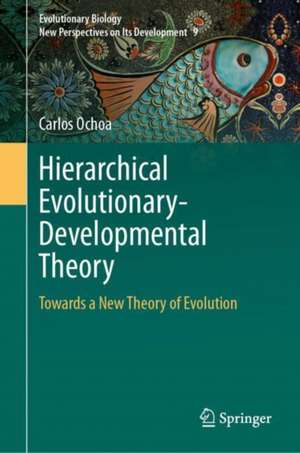
Hierarchical Evolutionary-Developmental Theory: Evolutionary Biology - New Perspectives on Its Development, cartea 9
Autor Carlos Ochoaen Limba Engleză Hardback – 23 mai 2025


Preț: 1048.10 lei
Preț vechi: 1278.17 lei
-18%
Puncte Express: 1572
Carte tipărită la comandă
Livrare economică 08-22 decembrie
Livrare prin curier în România Termenul estimat este afișat lângă disponibilitate.
Transport gratuit pentru acest produs Plată online sau ramburs, în funcție de opțiunile comenzii.
Retur gratuit în 14 zile Comandă securizată și suport în română.
Specificații
ISBN-13: 9783031887222
ISBN-10: 3031887220
Pagini: 424
Dimensiuni: 160 x 241 x 29 mm
Greutate: 0.75 kg
Editura: Springer
Colecția Evolutionary Biology - New Perspectives on Its Development
Seria Evolutionary Biology - New Perspectives on Its Development
ISBN-10: 3031887220
Pagini: 424
Dimensiuni: 160 x 241 x 29 mm
Greutate: 0.75 kg
Editura: Springer
Colecția Evolutionary Biology - New Perspectives on Its Development
Seria Evolutionary Biology - New Perspectives on Its Development
Notă biografică
Carlos Ochoa is the author of the books "Forma versus función: historia de la homología y la analogía," "El Jano de la morfología: de la homología a la homoplasia," and "El eclipse del antidarwinismo: la historia detrás de la síntesis moderna." Additionally, he has contributed chapters to the books "Natural Selection: Revisiting its Explanatory Role in Evolutionary Biology," edited by Richard G. Delisle, and "Unity and Disunity in Evolutionary Biology: Deconstructing Darwinism," edited by Richard G. Delisle, Maurizio Esposito, and David Ceccarelli. Currently, he teaches "Evolution" at the Faculty of Sciences, UNAM, and is a researcher recognized by the National System of Researchers (SNII) under SECIHTI in Mexico. He specializes in the history, teaching, and theoretical foundations of Evolutionary Developmental Biology (Evo-Devo).
Descriere
This book introduces a new evolutionary model called “Hierarchical Evolutionary-Developmental Theory” or “H-Evo-Devo Theory.” This theory proposes that the organism’s internal properties reflect entities that are highly integrated in developmental terms that evolve hierarchically.