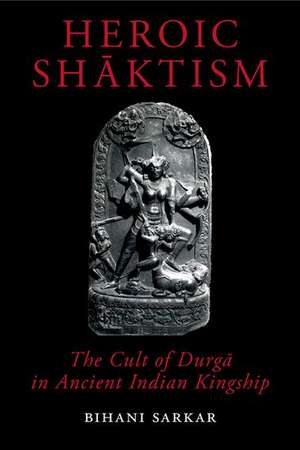
Heroic Shāktism: The Cult of Durgā in Ancient Indian Kingship: British Academy Monographs Series
Autor Bihani Sarkaren Limba Engleză Hardback – 26 oct 2017



Preț: 508.09 lei
Preț vechi: 762.86 lei
-33%
Puncte Express: 762
Carte indisponibilă temporar
Livrare prin curier în România Termenul estimat este afișat lângă disponibilitate.
Transport gratuit pentru acest produs Plată online sau ramburs, în funcție de opțiunile comenzii.
Retur gratuit în 14 zile Comandă securizată și suport în română.
Specificații
ISBN-13: 9780197266106
ISBN-10: 019726610X
Pagini: 310
Ilustrații: 3 maps and 3 black and white illustrations
Dimensiuni: 168 x 242 x 25 mm
Greutate: 0.65 kg
Editura: OUP OXFORD
Colecția OUP Oxford
Seria British Academy Monographs Series
Locul publicării:Oxford, United Kingdom
ISBN-10: 019726610X
Pagini: 310
Ilustrații: 3 maps and 3 black and white illustrations
Dimensiuni: 168 x 242 x 25 mm
Greutate: 0.65 kg
Editura: OUP OXFORD
Colecția OUP Oxford
Seria British Academy Monographs Series
Locul publicării:Oxford, United Kingdom
V-ar putea interesa
-
 The Founding of Israeli Democracy, 1948-1967Peter Y. Medding-31%Preț: 1105.43 lei1609.80 lei
 -
 China without Mao: The Search for a New OrderImmanuel C. Y. Hsü-15%Preț: 125.42 lei147.75 lei
 -
 Authority without Power: Law and the Japanese ParadoxJohn Owen Haley-24%Preț: 530.86 lei700.84 lei
 -
 The Rise of Modern ChinaImmanuel C. Y. Hsü-27%Preț: 901.40 lei1234.80 lei
 -
 -28%Preț: 408.70 lei567.96 lei
 -
 -33%Preț: 1374.15 lei2048.75 lei
 -
 -33%Preț: 2347.74 lei3499.42 lei
 -
 -33%Preț: 1293.86 lei1929.59 lei
 -
 -31%Preț: 548.52 lei791.43 lei
 -
 The Other MilkJia-Chen FuPreț: 250.26 lei
 -
 Excavating the Power of Memory in JapanGlenn D HookPreț: 454.78 lei
 -
 Preț: 456.57 lei
 -
 Preț: 475.76 lei
 -
 The Ryukyu KingdomMamoru AkaminePreț: 200.63 lei
 -
 Imagining the Public in Modern South AsiaBrannon IngramPreț: 459.87 lei
 -
 Preț: 438.51 lei
 -
 Preț: 216.81 lei
 -
 The JET Program and the US–Japan Relationship: Goodwill GoldmineEmily T. Metzgar-27%Preț: 284.87 lei389.71 lei
 -
 -27%Preț: 261.74 lei358.92 lei
 -
 -22%Preț: 324.21 lei418.04 lei
 -
 -36%Preț: 731.12 lei1149.74 lei
 -
 Modern East AsiaMary Hanneman-23%Preț: 810.67 lei1052.81 lei
 -
 -8%Preț: 461.72 lei501.86 lei
 -
 Framing the MahabharataSaikat K BosePreț: 221.61 lei
Recenzii
This book's eclecticism offers something to every scholar interested in the goddess tradition... Sarkar's book considerably enhances our historical ability to recognise the goddesses at the heart of both households and state-formations in the early subcontinent.
a paradigm-shifting work that forces scholars of South Asian religions, history, and goddess traditions rethink the role of royal goddesses and kings' devotion in the broader shifts of the political process. It is essential for anyone interested in religion and kingship in Gupta/post-Gupta India.
[an] interesting and absorbing book ... the result of 10 years of research, is the first detailed historical study of the evolution of the cult of Durgā and the role it played in shaping civilizational ideals in India.
Heroic Shāktism is a paradigm-shifting work that forces scholars of South Asian religions, history, and goddess traditions rethink the role of royal goddesses and kings' devotion in the broader shifts of the political process. It is essential for anyone interested in religion and kingship in Gupta/post-Gupta India. Portions might be useful for advanced undergraduate readers, but it is primarily geared toward specialists.
a paradigm-shifting work that forces scholars of South Asian religions, history, and goddess traditions rethink the role of royal goddesses and kings' devotion in the broader shifts of the political process. It is essential for anyone interested in religion and kingship in Gupta/post-Gupta India.
[an] interesting and absorbing book ... the result of 10 years of research, is the first detailed historical study of the evolution of the cult of Durgā and the role it played in shaping civilizational ideals in India.
Heroic Shāktism is a paradigm-shifting work that forces scholars of South Asian religions, history, and goddess traditions rethink the role of royal goddesses and kings' devotion in the broader shifts of the political process. It is essential for anyone interested in religion and kingship in Gupta/post-Gupta India. Portions might be useful for advanced undergraduate readers, but it is primarily geared toward specialists.
Notă biografică
Bihani Sarkar undertook a D.Phil in Sanskrit at Wolfson College under the supervision of Prof. Alexis Sanderson (All Souls). After her doctorate in 2011 she was awarded a Nachwuchsinitiative Postdoctoral Fellowship by Hamburg University, Germany and then a British Academy Postdoctoral Fellowship at the Oriental Institute, Oxford University in 2014. She has written on the Navarātra and its history, on dualisms in Durgā's conception in classical kāvya and on the interdependence between conceptions in Indian philosophy and aspects of Durgā's mythological depiction in the classical period. She has also written about classical Sanskrit literature, for example, about the ethics of poetic practice in 13th century Gujarat and the interplay between poetic licence and minding narrative conventions in the classical period. She is currently working on the depiction and history of the tragic in classical Sanskrit literature.