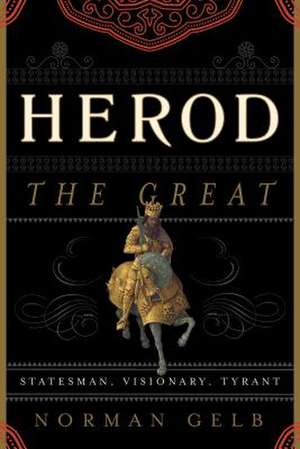
Herod the Great: Statesman, Visionary, Tyrant
Autor Norman Gelben Limba Engleză Paperback – 30 oct 2017
| Toate formatele și edițiile | Preț | Express |
|---|---|---|
| Paperback (1) | 209.73 lei 6-8 săpt. | |
| Bloomsbury Publishing – 30 oct 2017 | 209.73 lei 6-8 săpt. | |
| Hardback (1) | 322.67 lei 6-8 săpt. | |
| Bloomsbury Publishing – 21 feb 2013 | 322.67 lei 6-8 săpt. |
Preț: 209.73 lei
Preț vechi: 266.46 lei
-21%
Puncte Express: 315
Preț estimativ în valută:
37.12€ • 43.38$ • 32.23£
37.12€ • 43.38$ • 32.23£
Carte tipărită la comandă
Livrare economică 20 februarie-06 martie
Preluare comenzi: 021 569.72.76
Specificații
ISBN-13: 9780810895256
ISBN-10: 0810895250
Pagini: 1
Dimensiuni: 152 x 229 x 17 mm
Greutate: 0.34 kg
Editura: Bloomsbury Publishing
Colecția Rowman & Littlefield Publishers
Locul publicării:New York, United States
ISBN-10: 0810895250
Pagini: 1
Dimensiuni: 152 x 229 x 17 mm
Greutate: 0.34 kg
Editura: Bloomsbury Publishing
Colecția Rowman & Littlefield Publishers
Locul publicării:New York, United States
Recenzii
In 2010, historian Gelb (Dunkirk: The Complete Story in the First Step in the Defeat of Hitler) switched subjects, moving from World War II to the line of Jewish kings, examining the 52 monarchs who ruled until 70 CE. He offers an in-depth analysis of one of those kings, Herod the Great, appointed king of Judea by the Romans in 37 BCE, holding the office for more than 30 years until he died. Most of what we know about Herod is from the historian Josephus, who was born forty years after Herod died. Josephus and other ancient chroniclers depicted Herod as cold, calculating, cruel, and brutal. He mistrusted most of his ten wives and sons, executing at least one of the wives and a number of the sons, fearing that they were trying to replace him. Despite Herod's dark streak and mental instability, Gelb tries to revamp the monarch's image, stressing the cities and structures he built, including his reconstruction of the Temple, and asserting that 'his positive achievements may be considered to have outweighed his brutality and tyrannical rule.' This is an exemplary illustration of revisionist history.
Herod was an outsider who came to power when appointed King of Judea (he reigned from 37 BCE to his death in 4 BCE) during a tumultuous time for the Roman Empire. He held onto power through political schemes and assassinations, not unlike the rest of the Roman elite. He was such a divisive figure that an unbiased and straightforward biography is difficult to achieve-whether Herod was as bad as his historical reputation indicates has been debated for centuries. Historian Gelb's (Kings of the Jews: Exploring the Origins of the Jewish Nation) subtitle summarizes his take on Herod: Herod's statesmanship and vision outweigh his tyranny. Gelb takes pains to place Herod's actions in historical context by starting the narrative well before Herod's birth and ending well after his death. While the book is by no means an apology for Herod, Gelb tends to favor arguments that show Herod in a more positive light. The author does not rigorously question the early sources. VERDICT This is an excellent choice for nonspecialists who want a straightforward biography of Herod, particularly those who are interested in Roman or biblical history.
Herod wasn't called great because he was such a swell guy. In fact, history has treated him quite roughly and justifiably so. According to the New Testament, he ordered the murder of young boys to make sure there would be no Jewish messiah. And he played a part in the graphic story of John the Baptist's head landing on a platter. Killing beloved relatives was also part of his repertoire. But Gelb, who has written extensively on Jewish history, aims for a more rounded portrait of the Jewish king. While not disputing any of the charges, he also focuses on a different part of Herod's legacy: his ability to transform and rebuild Judea. In a highly readable fashion, he traces Herod's rise to power, his ability to appease the winning side in the high-stakes politics of Rome, the importance of his public-works programs, his political machinations (which often ended in murder), and the reasons his actions often irritated and incited the Jewish population. This account not only delivers a full portrait of a historically important figure but also offers much about the political and religious history of the time.
This book is more than a biography of Herod; it tells the history of the Greco-Roman world in classical antiquity and the emergence of early Christianity. Gelb attempts at presenting a balanced picture of Herod, who is known largely for his cruelty (he killed members of his own family!); yet, the Idumean who was appointed by the Romans as King of Judaea had many facets to his personality. Gelb examines Herod's cruelty and paranoia, his genius as a builder and architect, his cunning and cleverness as a diplomat and his able work as an administrator. The book actually goes beyond Herod's reign to the reign of his great grandson, Marcus Julius Agrippa: 'the last king of the Herodian dynasty and the last king of the Jews though he never became king of Judaea.' There is a bibliography, notes and an index. The book will be enjoyed by anyone who likes to read about classical antiquity. Herod the Great is especially recommended for anyone traveling to Israel because a vast majority of the ancient tourist sites that you visit where originally constructed by Herod-Tower of David Citadel, Masada, Caesarea, etc.
This book accurately portrays the turbulent life and times of King Herod the Great in a highly readable and engaging manner. Fast-paced and clearly written, it will appeal to a broad audience.
Herod was an outsider who came to power when appointed King of Judea (he reigned from 37 BCE to his death in 4 BCE) during a tumultuous time for the Roman Empire. He held onto power through political schemes and assassinations, not unlike the rest of the Roman elite. He was such a divisive figure that an unbiased and straightforward biography is difficult to achieve-whether Herod was as bad as his historical reputation indicates has been debated for centuries. Historian Gelb's (Kings of the Jews: Exploring the Origins of the Jewish Nation) subtitle summarizes his take on Herod: Herod's statesmanship and vision outweigh his tyranny. Gelb takes pains to place Herod's actions in historical context by starting the narrative well before Herod's birth and ending well after his death. While the book is by no means an apology for Herod, Gelb tends to favor arguments that show Herod in a more positive light. The author does not rigorously question the early sources. VERDICT This is an excellent choice for nonspecialists who want a straightforward biography of Herod, particularly those who are interested in Roman or biblical history.
Herod wasn't called great because he was such a swell guy. In fact, history has treated him quite roughly and justifiably so. According to the New Testament, he ordered the murder of young boys to make sure there would be no Jewish messiah. And he played a part in the graphic story of John the Baptist's head landing on a platter. Killing beloved relatives was also part of his repertoire. But Gelb, who has written extensively on Jewish history, aims for a more rounded portrait of the Jewish king. While not disputing any of the charges, he also focuses on a different part of Herod's legacy: his ability to transform and rebuild Judea. In a highly readable fashion, he traces Herod's rise to power, his ability to appease the winning side in the high-stakes politics of Rome, the importance of his public-works programs, his political machinations (which often ended in murder), and the reasons his actions often irritated and incited the Jewish population. This account not only delivers a full portrait of a historically important figure but also offers much about the political and religious history of the time.
This book is more than a biography of Herod; it tells the history of the Greco-Roman world in classical antiquity and the emergence of early Christianity. Gelb attempts at presenting a balanced picture of Herod, who is known largely for his cruelty (he killed members of his own family!); yet, the Idumean who was appointed by the Romans as King of Judaea had many facets to his personality. Gelb examines Herod's cruelty and paranoia, his genius as a builder and architect, his cunning and cleverness as a diplomat and his able work as an administrator. The book actually goes beyond Herod's reign to the reign of his great grandson, Marcus Julius Agrippa: 'the last king of the Herodian dynasty and the last king of the Jews though he never became king of Judaea.' There is a bibliography, notes and an index. The book will be enjoyed by anyone who likes to read about classical antiquity. Herod the Great is especially recommended for anyone traveling to Israel because a vast majority of the ancient tourist sites that you visit where originally constructed by Herod-Tower of David Citadel, Masada, Caesarea, etc.
This book accurately portrays the turbulent life and times of King Herod the Great in a highly readable and engaging manner. Fast-paced and clearly written, it will appeal to a broad audience.