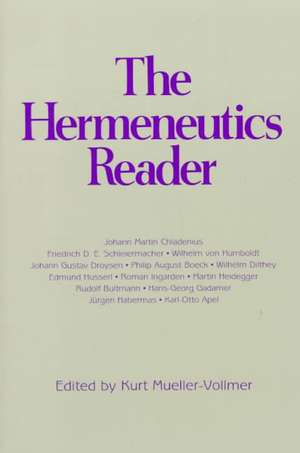
Hermeneutics Reader: Texts of the German Tradition from the Enlightenment to the Present
Editat de Kurt Mueller-Vollmeren Limba Engleză Paperback – apr 1998
Remarcăm în Hermeneutics Reader o arhitectură pedagogică riguroasă, menită să ofere o bază solidă cercetătorilor din domeniul științelor umaniste. Materialul este organizat cronologic și tematic, pornind de la rădăcinile hermeneuticii raționaliste reprezentate de Johann Martin Chladenius, trecând prin fundamentele teoriei generale ale lui Friedrich Schleiermacher și ajungând la hermeneutica filologică și a științelor spiritului. Această structură permite cititorului să urmărească evoluția conceptului de interpretare nu doar ca metodă tehnică, ci ca mod fundamental de raportare la limbaj și istorie.
Apreciem în mod deosebit studiul introductiv extins, de 57 de pagini, semnat de Kurt Mueller-Vollmer, care funcționează ca o hartă critică a teoriei hermeneutice de la Iluminism încoace. Această lucrare completează perspectiva oferită de Understanding Hermeneutics de Lawrence Kennedy Schmidt, adăugând o profunzime istorică și texte sursă esențiale pe care un manual introductiv doar le rezumă. În contextul operei sale, volumul de față se ancorează în preocupările autorului pentru transferul cultural și teoria limbajului, vizibile și în Translating Literatures, Translating Cultures, dar aici accentul cade pe geneza filosofică a înțelegerii în tradiția germană. Progresia textelor selectate, de la gramatică la critica istorică, indică o acoperire exhaustivă a disciplinelor care au definit modernitatea intelectuală europeană.
Preț: 334.54 lei
Carte tipărită la comandă
Livrare economică 07-21 decembrie
Specificații
ISBN-10: 0826404022
Pagini: 392
Dimensiuni: 146 x 226 x 24 mm
Greutate: 0.59 kg
Ediția:Revised
Editura: Bloomsbury Publishing
Colecția Continuum
Locul publicării:New York, United States
V-ar putea interesa
-
 Frege's TheoremRichard G. HeckPreț: 274.43 lei
 -
 The Oxford Handbook of WittgensteinOskari Kuusela-18%Preț: 325.13 lei398.49 lei
 -
 Wittgenstein and Natural ReligionGordon Graham-27%Preț: 520.43 lei717.42 lei
 -
 British Ethical Theorists from Sidgwick to EwingThomas Hurka-28%Preț: 429.88 lei598.67 lei
 -
 Carl SchmittReinhard Mehring-19%Preț: 475.05 lei586.48 lei
 -
 Before TomorrowCatherine MalabouPreț: 157.39 lei
 -
 Freedom to FailPeter TrawnyPreț: 145.42 lei
 -
 Heidegger and Philosophical Atheology: A Neo-Scholastic CritiqueDr Peter S. DillardPreț: 280.11 lei
 -
 Heidegger and Happiness: Dwelling on Fitting and BeingDr Matthew KingPreț: 279.69 lei
 -
 Lines of Flight: For Another World of PossibilitiesFelix Guattari-37%Preț: 277.37 lei439.92 lei
 -
 Michel Meyer's Problematology: Questioning and SocietyDr Nick Turnbull-14%Preț: 799.76 lei929.95 lei
 -
 Jean-Luc Nancy: Justice, Legality and WorldBenjamin HutchensPreț: 277.68 lei
 -
 Bertrand Russell's Bundle Theory of ParticularsGülberk Koç Maclean-25%Preț: 847.41 lei1122.71 lei
 -
 Die PerserAischylosPreț: 36.59 lei
 -
 -24%Preț: 212.70 lei279.19 lei
 -
 Ricoeur and the Negation of HappinessDr Alison Scott-Baumann-14%Preț: 237.73 lei277.17 lei
 -
 Die Geburt der Philosophie im Garten der LüsteWilhelm SchmidPreț: 101.91 lei
 -
 Die SchutzflehendenAischylosPreț: 58.51 lei
 -
 Die sieben TragödienAischylosPreț: 143.26 lei
De ce să citești această carte
Recomandăm această antologie studenților și cercetătorilor care doresc un contact direct cu textele fundamentale ale tradiției germane. Spre deosebire de alte introduceri, volumul oferă acces la surse primare traduse și comentate, facilitând o înțelegere profundă a modului în care interpretarea textelor a devenit fundamentul științelor sociale și umaniste. Este un instrument de lucru esențial pentru cursuri de filosofie, filologie sau istoria ideilor.
Despre autor
Kurt Mueller-Vollmer este profesor emerit de studii germane și științe umaniste la Universitatea Stanford. Cariera sa s-a concentrat pe intersecția dintre filosofie, literatură și lingvistică, fiind un expert recunoscut în romantismul german și în opera lui Wilhelm von Humboldt. Expertiza sa în hermeneutică este dublată de cercetări extinse asupra transferului cultural și a teoriei traducerii, oferind acestui volum o perspectivă critică avizată asupra modului în care ideile circulă și sunt reinterpretate în spațiul academic transatlantic.
Descriere
Kurt Mueller-Vollmer is Emeritus Professor of German Studies and Humanities at Stanford University
Cuprins
Introduction: Language, Mind, Artifact: An outline of Hermeneutic Theory Since the Enlightenment
1. Reason and Understanding: Rationalist Hermeneutics
Johann Martin Chladenius
On the Concept of Interpretation
On the Interpretation of Historical Books and Accounts
2. Foundations: General Theory and Art of Interpretation
Friedrich D. E. Schleiermacher
General Hermeneutics
Grammatical and Technical Interpretation
3. Foundations: Language, Understanding, and the Historical World
Wilhelm von Humboldt
The Nature and Conformation of Language
On the Task of the Historian
Johann Gustav Droysen
History and the Historical Method
The Investigation of Origins
The Modes of Interpretation
4. Philological Hermeneutics
Philip August Boeckh
Formal Theory of Philology
Theory of Hermeneutics
Theory of Criticism
5. The Hermeneutics of the Human Sciences
Wilhelm Dilthey
Awareness, Reality: Time
The Understanding of Other Persons and Their Life-Expressions
6. The Phenomenological Theory of Meaning and of Meaning-Apprehension
Edmund Husserl
Essential Distinction
Towards a Characterization of the Acts which Confer Meaning
Roman Ingarden
On the Cognition of the Literary Work of Art
7. Phenomenology and Fundamental Ontology: The Discourse of Meaning
Martin Heidegger
Being-there as Understanding
Understanding and Interpretation
Assertion as a Derivative Mode of Interpretation
Being-there and Discourse Language
8. Hermeneutics and Theology
Rudolf Bultmann
Is Exegesis without Presuppositions Possible?
The Problem of Demythologizing
9. The Historicity of Understanding
Hans-Georg Gadamer
The Discrediting of Prejudice by the Enlightenment
The Rehabilitation of Authority and Tradition
The Principle of Effective History
Rhetoric, Hermeneutics, and the Critique of Ideology
10. Hermeneutics and the Social Sciences
Jürgen Habermas
On Hermeneutics' Claim to Universality
11. Perspectives for a General Hermeneutic Theory
Karl-Otto Apel
Scientistics, Hermeneutics, Critique of Ideology: An Outline of a Theory of Science from an Epistemological-Anthropological Point of View
Bibliography
Acknowledgements
Index
Recenzii
"An extremely valuable collection of readings for anyone interested in hermeneutic theory....Complementing the excellence of the selections is a 57-page introductory essay by the editor, describing the key contributions of each author to hermeneutic theory. It is a sound, well-informed, and critically sharp treatment of the entire tradition."--The European Studies Journal