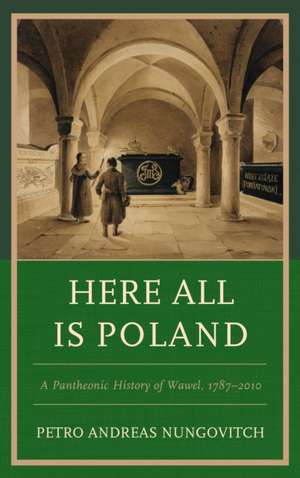
Here All Is Poland: A Pantheonic History of Wawel, 1787–2010
Autor Petro Andreas Nungovitchen Limba Engleză Paperback – 6 aug 2020
The decision to bury Lech and Maria Kaczynski in Poland's highest national pantheon sparked an emotional debate about its symbolic appropriateness and underscored the question of how such burial decisions are actually made. It also raised a whole host of questions about the historical significance and pantheonic function of Wawel-the "bedrock of sacred memory for the Polish nation," as Stanislaw Staszic put it in the early nineteenth century-in modern Polish consciousness. Until now, these questions have received surprisingly little attention beyond Polish historians of Krakow. Here All Is Poland excavates and builds upon the extant scholarly discourse of Wawel to plot the evolution of a pantheonic funeral tradition over two hundred years, thus providing a context and a clue for interpreting the historical significance of the 2010 burial.
Preț: 310.73 lei
Preț vechi: 409.21 lei
-24%
Puncte Express: 466
Carte tipărită la comandă
Livrare economică 01-15 decembrie
Livrare prin curier în România Termenul estimat este afișat lângă disponibilitate.
Transport gratuit de la 400.00 lei Plată online sau ramburs, în funcție de opțiunile comenzii.
Retur gratuit în 14 zile Comandă securizată și suport în română.
Specificații
ISBN-13: 9781498569149
ISBN-10: 1498569145
Pagini: 315
Ilustrații: 5 colour illustrations; 19 colour photos; 2 tables;
Dimensiuni: 153 x 231 x 26 mm
Greutate: 0.51 kg
Editura: Bloomsbury Publishing
Colecția Lexington Books
Locul publicării:New York, United States
ISBN-10: 1498569145
Pagini: 315
Ilustrații: 5 colour illustrations; 19 colour photos; 2 tables;
Dimensiuni: 153 x 231 x 26 mm
Greutate: 0.51 kg
Editura: Bloomsbury Publishing
Colecția Lexington Books
Locul publicării:New York, United States
Cuprins
Chapter 1: Wawel at the End of the Polish-Lithuanian Commonwealth (1787-1809)
Chapter 2: From Royal Necropolis to National Pantheon (1815-20)
Chapter 3: Texts and Contexts: Wawel, Krakow, and Poland in Ambrozy Grabowski's Historical Description (1822-66)
Chapter 4: The Return of Kazimierz the Great and the Renovation of the Royal Graves (1869-80)
Chapter 5: The Reclamation and Recovery of Wawel Hill (1879-1905)
Chapter 6: Stanislaw Wyspianski's Liberation (1903)
Chapter 7: King-Spirits and Kings: Wawel between the World Wars (1914-45)
Chapter 8: Wawel under Communism (1945-89)
Chapter 9: From Katyn to Smolensk: Commemorating National Tragedy on Wawel (1990-2010)
Chapter 2: From Royal Necropolis to National Pantheon (1815-20)
Chapter 3: Texts and Contexts: Wawel, Krakow, and Poland in Ambrozy Grabowski's Historical Description (1822-66)
Chapter 4: The Return of Kazimierz the Great and the Renovation of the Royal Graves (1869-80)
Chapter 5: The Reclamation and Recovery of Wawel Hill (1879-1905)
Chapter 6: Stanislaw Wyspianski's Liberation (1903)
Chapter 7: King-Spirits and Kings: Wawel between the World Wars (1914-45)
Chapter 8: Wawel under Communism (1945-89)
Chapter 9: From Katyn to Smolensk: Commemorating National Tragedy on Wawel (1990-2010)
Recenzii
Here All Is Poland: A Pantheonic History of Wawel, 1787-2010, marks an important contribution to the scholarship on the history of modern Polish identities and national myth-making, and it provides us with rich examples of how Polish national memories are imagined, constructed, and contested. This is a very readable and richly detailed book.
Petro Andreas Nungovitch's Here All Is Poland: A Pantheonic History of Wawel, 1787-2010 is a welcome contribution to the list of scholarly studies of Polish nationhood from the Partitions to the present. This elegantly written and detailed study brings the unfolding history of "Wawel's pantheonic burial tradition" as well as existing Polish-language scholarship on Wawel to an English language audience.
This volume gives a detailed account of the ways in which the tombs beneath Wawel Cathedral have become a pantheon of legendary heroes of Poland in the period under discussion.
The Wawel Cathedral has long since transcended its original function as a burial site for Polish monarchs and become a living monument to the preservation of national heroes of all kinds, including military leaders, literary bards, and statesmen. Yet, as Petro Andreas Nungovitch demonstrates, the process of 'Wawelization' has always involved fractious, antagonistic campaigns to implant particular symbols on the bedrock of sacred Polish memory, as seen most recently with the interment of President Lech Kaczynski and his wife beneath the cathedral in 2010. Nungovitch offers a valuable guide to the shifting sands of Polish martyrology and a reminder of the multiplicity of narratives at play in Polish national history.
Petro Nungovitch has illuminated the history of one of Europe's most fascinating cultural landmarks: the Polish pantheon of national heroes entombed in the crypts of the Wawel Cathedral in Cracow. This is the first serious scholarly study in English to focus on this important subject, which is crucial for thinking about the history of nationalism and the history of memory and commemoration, in Poland above all, but also in modern Europe more generally. This book should be read by anyone interested in the history of Eastern Europe, the dynamics of historical memory, or the construction of modern nationalism.
Petro Andreas Nungovitch's Here All Is Poland: A Pantheonic History of Wawel, 1787-2010 is a welcome contribution to the list of scholarly studies of Polish nationhood from the Partitions to the present. This elegantly written and detailed study brings the unfolding history of "Wawel's pantheonic burial tradition" as well as existing Polish-language scholarship on Wawel to an English language audience.
This volume gives a detailed account of the ways in which the tombs beneath Wawel Cathedral have become a pantheon of legendary heroes of Poland in the period under discussion.
The Wawel Cathedral has long since transcended its original function as a burial site for Polish monarchs and become a living monument to the preservation of national heroes of all kinds, including military leaders, literary bards, and statesmen. Yet, as Petro Andreas Nungovitch demonstrates, the process of 'Wawelization' has always involved fractious, antagonistic campaigns to implant particular symbols on the bedrock of sacred Polish memory, as seen most recently with the interment of President Lech Kaczynski and his wife beneath the cathedral in 2010. Nungovitch offers a valuable guide to the shifting sands of Polish martyrology and a reminder of the multiplicity of narratives at play in Polish national history.
Petro Nungovitch has illuminated the history of one of Europe's most fascinating cultural landmarks: the Polish pantheon of national heroes entombed in the crypts of the Wawel Cathedral in Cracow. This is the first serious scholarly study in English to focus on this important subject, which is crucial for thinking about the history of nationalism and the history of memory and commemoration, in Poland above all, but also in modern Europe more generally. This book should be read by anyone interested in the history of Eastern Europe, the dynamics of historical memory, or the construction of modern nationalism.