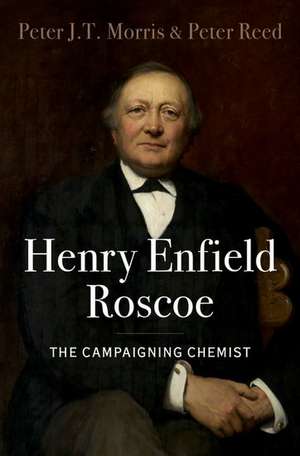
Henry Enfield Roscoe: The Campaigning Chemist
Autor Peter J.T. Morris, Peter Reeden Limba Engleză Hardback – 30 sep 2024
Preț: 271.27 lei
Preț vechi: 308.71 lei
-12%
Puncte Express: 407
Carte disponibilă
Livrare economică 23-28 octombrie
Livrare express 08-14 octombrie pentru 80.34 lei
Livrare prin curier în România Termenul estimat este afișat lângă disponibilitate.
Transport gratuit de la 400.00 lei Plată online sau ramburs, în funcție de opțiunile comenzii.
Retur gratuit în 14 zile Comandă securizată și suport în română.
Specificații
ISBN-13: 9780190844257
ISBN-10: 0190844256
Pagini: 352
Dimensiuni: 165 x 241 x 28 mm
Greutate: 0.64 kg
Editura: Oxford University Press
Colecția OUP USA
Locul publicării:New York, United States
ISBN-10: 0190844256
Pagini: 352
Dimensiuni: 165 x 241 x 28 mm
Greutate: 0.64 kg
Editura: Oxford University Press
Colecția OUP USA
Locul publicării:New York, United States
Recenzii
Arguably, Sir Henry Roscoe wrote the most entertaining chemists' autobiography ever published. Now, in this important and very readable biography, the authors peer behind the details of the autobiography to reveal hidden details of the life of this Victorian inorganic chemist, writer, educationist, Anglo-German enthusiast, politician, and catalyst of the later scientific industrialisation of Manchester. - William Brock, former Director of the Victorian Studies Centre at the University of Leicester
More than a century after Henry Roscoe's death, we at last have the scholarly biography that this gifted, multi-faceted man deserves. Morris and Reed reveal a Roscoe whose achievements endured in textbooks and lectures, academic institution-building in Manchester and London, and the fruits of a relentless advocacy of technical education, as much as in his scientific research. The result is an insightful, deftly contextualized study, representing biographical writing at its very best. - Robert Fox, Professor Emeritus of the History of Science at the University of Oxford
Sir Henry Roscoe was a chemist by training, but became the Liberal MP for South Manchester. The authors of this fascinating, readable, and well-researched book seek to rescue Roscoe from his undeserved obscurity. This is a must-read book for anyone connected with the University of Manchester or chemistry. - Dr Brian Iddon, organic chemist and former Labour MP for Bolton, South East
Peter Morris and Peter Reed have done us all a great service. Thanks to their meticulous work, Henry Roscoe is now rescued from undeserved oblivion. At the start of the nineteenth century, John Dalton put Manchester on the chemical map, Roscoe then created the strong program of teaching, research and industrial engagement that came to characterize chemical instruction in Manchester. We are indebted to the authors for establishing in rich detail exactly how this was done. - Arnold Thackray, Joseph Priestley Professor Emeritus at the University of Pennsylvania
The authors have ably served a wide potential readership of not only historians and chemists, but also of educationalists and those interested in Victorian politics, Manchester, itsindustry and its university. This is an eminently readable and insightful book which at last restores to prominence "The Campaigning Chemist".
This is a finely crafted and detailed account of the role of Henry Enfield Roscoe (1833-1915) as chemist, educator, administrator, consultant, and Parliamentarian who worked as a central figure within influential networks in Victorian England. Morris and Reed deftly and expertly present Roscoe as an indefatigable campaigner for chemical and technical education, universities and scientific institutions, and progressive liberal agendas and values. This biography is a valuable addition not only to our knowledge of nineteenth-century British chemical history, but also to our understanding of the scientist as a public citizen.
The Campaigning Chemist provides an important window into British scientists' efforts to both reform chemical education and revitalize the relationship between science and industry in the late-nineteenth century. With its extensive bibliography, Morris and Reed's book will be a useful reference for students and scholars interested in learning more about late-nineteenth-century British chemistry.
Co-authoring biographies is relatively uncommon, yet in the case of Roscoe it was a particularly astute decision. Only through the combined expertise of scholars from different sub-fields of the history of chemistry - expertise that would be difficult for any individual to possess - could the full scope of Roscoe's multifaceted career be adequately captured. The result is a richly contextualized account of a broad scientific life. Despite its densely detailed style, the book remains engaging and accessible to a wide range of audiences. To truly grasp the entanglement of science and politics, figures like Roscoe must become more visible in historical literature.
More than a century after Henry Roscoe's death, we at last have the scholarly biography that this gifted, multi-faceted man deserves. Morris and Reed reveal a Roscoe whose achievements endured in textbooks and lectures, academic institution-building in Manchester and London, and the fruits of a relentless advocacy of technical education, as much as in his scientific research. The result is an insightful, deftly contextualized study, representing biographical writing at its very best. - Robert Fox, Professor Emeritus of the History of Science at the University of Oxford
Sir Henry Roscoe was a chemist by training, but became the Liberal MP for South Manchester. The authors of this fascinating, readable, and well-researched book seek to rescue Roscoe from his undeserved obscurity. This is a must-read book for anyone connected with the University of Manchester or chemistry. - Dr Brian Iddon, organic chemist and former Labour MP for Bolton, South East
Peter Morris and Peter Reed have done us all a great service. Thanks to their meticulous work, Henry Roscoe is now rescued from undeserved oblivion. At the start of the nineteenth century, John Dalton put Manchester on the chemical map, Roscoe then created the strong program of teaching, research and industrial engagement that came to characterize chemical instruction in Manchester. We are indebted to the authors for establishing in rich detail exactly how this was done. - Arnold Thackray, Joseph Priestley Professor Emeritus at the University of Pennsylvania
The authors have ably served a wide potential readership of not only historians and chemists, but also of educationalists and those interested in Victorian politics, Manchester, itsindustry and its university. This is an eminently readable and insightful book which at last restores to prominence "The Campaigning Chemist".
This is a finely crafted and detailed account of the role of Henry Enfield Roscoe (1833-1915) as chemist, educator, administrator, consultant, and Parliamentarian who worked as a central figure within influential networks in Victorian England. Morris and Reed deftly and expertly present Roscoe as an indefatigable campaigner for chemical and technical education, universities and scientific institutions, and progressive liberal agendas and values. This biography is a valuable addition not only to our knowledge of nineteenth-century British chemical history, but also to our understanding of the scientist as a public citizen.
The Campaigning Chemist provides an important window into British scientists' efforts to both reform chemical education and revitalize the relationship between science and industry in the late-nineteenth century. With its extensive bibliography, Morris and Reed's book will be a useful reference for students and scholars interested in learning more about late-nineteenth-century British chemistry.
Co-authoring biographies is relatively uncommon, yet in the case of Roscoe it was a particularly astute decision. Only through the combined expertise of scholars from different sub-fields of the history of chemistry - expertise that would be difficult for any individual to possess - could the full scope of Roscoe's multifaceted career be adequately captured. The result is a richly contextualized account of a broad scientific life. Despite its densely detailed style, the book remains engaging and accessible to a wide range of audiences. To truly grasp the entanglement of science and politics, figures like Roscoe must become more visible in historical literature.
Notă biografică
Peter J.T. Morris took a chemistry degree at Oxford and then a D.Phil. on the development of synthetic rubber by the German combine IG Farben. After working in the History of Chemistry Research Group at the Open University with Colin Russell and at the Centre for the History of Chemistry at the University of Pennsylvania with Arnold Thackray, he oversaw the chemistry collections at the Science Museum in London for 24 years before retiring in 2015. He was given the Edelstein Award of the American Chemical Society in 2006 and the Wheeler Award by the Royal Society of Chemistry's Historical Group in 2013. Peter Reed gained a BSc degree at the University of London and a Postgraduate Certificate in Education at the University of Leicester. He was Head of Chemistry at the Grammar School, Henley on Thames, before spending twenty-three years working for the museums in Liverpool. He retired in 1998 as Head of the Development Office for National Museums and Galleries of Merseyside, and thenundertook consultancy work for the Canadian company ARIUS-3D, the European Commission and EUCLID (Liverpool), and was project manager for the Carpet Museum in Kidderminster.
Cuprins
- Figures and Tables
- Preface
- Acknowledgements
- Abbreviations Used
- 1. Who Was Henry Enfield Roscoe?
- 2. Of Lancastrian Stock and the Formative Years
- 3. Finding His Niche
- 4. Seeing the Light
- 5. From Instability to Stability
- 6. Creating a Civic University
- 7. Flying the Flag for Chemistry in Cottonopolis
- 8. Academia Driving Economic Progress
- 9. Securing Britain's Economic Future
- 10. A Chemist in the House
- 11. An Active Retirement
- 12. Roscoe's Legacy
- Bibliography of Henry E. Roscoe's Publications
- Bibliography
- Index