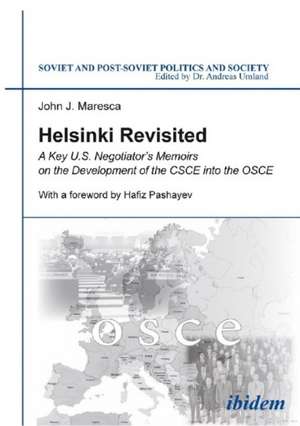
Helsinki Revisited: A Key U.S. Negotiator’s Memoirs on the Development of the CSCE into the OSCE
Autor John J Maresca Andreas Umland Cuvânt înainte de Hafiz Pashayeven Limba Engleză Paperback – mar 2016
Preț: 120.14 lei
Preț vechi: 145.64 lei
-18%
Puncte Express: 180
Carte disponibilă
Livrare economică 17 noiembrie-01 decembrie
Livrare prin curier în România Termenul estimat este afișat lângă disponibilitate.
Transport gratuit de la 400.00 lei Plată online sau ramburs, în funcție de opțiunile comenzii.
Retur gratuit în 14 zile Comandă securizată și suport în română.
Specificații
ISBN-13: 9783838208527
ISBN-10: 3838208528
Pagini: 210
Ilustrații: ,
Dimensiuni: 148 x 210 x 20 mm
Greutate: 0.3 kg
Editura: Ibidem
Colecția ibidem
Locul publicării:Hannover, Germany
ISBN-10: 3838208528
Pagini: 210
Ilustrații: ,
Dimensiuni: 148 x 210 x 20 mm
Greutate: 0.3 kg
Editura: Ibidem
Colecția ibidem
Locul publicării:Hannover, Germany
V-ar putea interesa
-
 U.S. Assistance to Egypt: Background & EvolutionMarian Cortez-27%Preț: 1023.68 lei1395.88 lei
 -
 -27%Preț: 1022.73 lei1395.26 lei
 -
 Congressional Members: Salary & Service TrendsClyde Chapman-27%Preț: 532.63 lei725.90 lei
 -
 NoNonsense ISIS and Syria: The New War on Global TerrorPhyllis Bennis-30%Preț: 44.24 lei63.49 lei
 -
 -17%Preț: 214.19 lei258.01 lei
 -
 -18%Preț: 152.54 lei185.65 lei
 -
 Explaining Russian Foreign Policy Behavior: Theory and PracticeAlexander Sergunin-18%Preț: 153.29 lei186.08 lei
 -
 -23%Preț: 164.90 lei214.69 lei
 -
 -23%Preț: 166.00 lei215.38 lei
 -
 -17%Preț: 179.99 lei215.90 lei
Recenzii
"This book is written as a memoir, and contains new information and many fascinating insights about the development of the CSCE and its evolution into the OSCE. But it also contains some very astute analyses of current events, based on the history of the issues, which surround them. It is, in fact, a commentary on the current situations in these regions, based on the way these situations developed.A must-read for anyone who is interested in the recent history and the current and future state of affairs in Europe, including the Caucasus, Central Asia, and what Russians call their ´Near Abroad.´"—Hafiz Pashayev, Rector ADA University, Baku, Azerbaijan
"Maresca skilfully captures the reader’s attention when he shares his deep understanding and insights into the dynamics of US foreign policy-making at the interface of domestic and international constraints—of which the CSCE negotiation process is an example. The book not only provides a very personal narrative full of lively anecdotes, but also gives an account of diplomacy and the skill of diplomatic negotiation."—Stefan Gänzle, Europe-Asia Studies, 1/2017
„Das Buch bietet eine lebendige Darstellung der Entwicklungen im Kontext von KSZE und OSZE, zu denen auch Maresca einen wichtigen Beitrag geleistet hat. […] Diese sehr persönlich gehaltenen, aber zugleich zuverlässigen Erinnerungen sind so interessant, dass man sie nach Beginn der Lektüre nicht mehr aus der Hand legt.“—Jahrbücher für Geschichte Osteuropas. jgo.e-reviews 7 (2017), 4
“Neben den spannenden Anekdoten sind die Memoiren besonders gehaltvoll, wenn sie Rückschlüsse auf die Feinheiten der diplomatischen Arbeit, die schwierige geopolitische Situation in Europa und denvoraussetzungsvollen Wandel der Sowjetunion zu einem demokratischen undkapitalistischen Staat erlauben. Dann wird ersichtlich, wie wichtig die KSZE für einVerständnis des heutigen Europa ist und welche Rolle die OSZE auch in aktuellenKonflikten wie dem in der Ukraine einnehmen kann.”—Anke Rösener, Portal für Politikwissenschaft
"Maresca skilfully captures the reader’s attention when he shares his deep understanding and insights into the dynamics of US foreign policy-making at the interface of domestic and international constraints—of which the CSCE negotiation process is an example. The book not only provides a very personal narrative full of lively anecdotes, but also gives an account of diplomacy and the skill of diplomatic negotiation."—Stefan Gänzle, Europe-Asia Studies, 1/2017
„Das Buch bietet eine lebendige Darstellung der Entwicklungen im Kontext von KSZE und OSZE, zu denen auch Maresca einen wichtigen Beitrag geleistet hat. […] Diese sehr persönlich gehaltenen, aber zugleich zuverlässigen Erinnerungen sind so interessant, dass man sie nach Beginn der Lektüre nicht mehr aus der Hand legt.“—Jahrbücher für Geschichte Osteuropas. jgo.e-reviews 7 (2017), 4
“Neben den spannenden Anekdoten sind die Memoiren besonders gehaltvoll, wenn sie Rückschlüsse auf die Feinheiten der diplomatischen Arbeit, die schwierige geopolitische Situation in Europa und denvoraussetzungsvollen Wandel der Sowjetunion zu einem demokratischen undkapitalistischen Staat erlauben. Dann wird ersichtlich, wie wichtig die KSZE für einVerständnis des heutigen Europa ist und welche Rolle die OSZE auch in aktuellenKonflikten wie dem in der Ukraine einnehmen kann.”—Anke Rösener, Portal für Politikwissenschaft