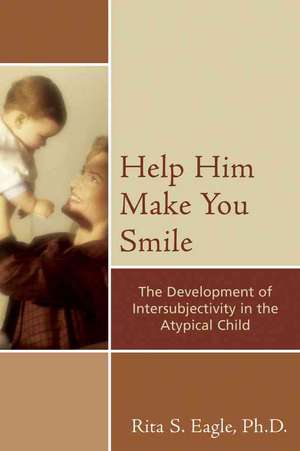
Help Him Make You Smile: The Development of Intersubjectivity in the Atypical Child: Psychological Issues
Autor Rita S. Eagleen Limba Engleză Paperback – 14 mar 2007
Din seria Psychological Issues
- 33%
 Preț: 341.25 lei
 - 28%
 Preț: 365.51 lei
 - 24%
 Preț: 351.39 lei
 -
 Preț: 478.88 lei
 -
 Preț: 344.40 lei
 -
 Preț: 416.53 lei
 -
 Preț: 454.82 lei
 - 15%
 Preț: 425.65 lei
 -
 Preț: 504.79 lei
 - 15%
 Preț: 416.31 lei
 -
 Preț: 411.72 lei
 - 5%
 Preț: 391.13 lei
 -
 Preț: 347.24 lei
 -
 Preț: 333.50 lei
 -
 Preț: 362.15 lei
 -
 Preț: 323.32 lei
 - 5%
 Preț: 308.71 lei
 - 5%
 Preț: 307.16 lei
 -
 Preț: 313.67 lei
 -
 Preț: 333.26 lei
 -
 Preț: 320.25 lei
Preț: 345.23 lei
Preț vechi: 509.19 lei
-32%
Puncte Express: 518
Carte tipărită la comandă
Livrare economică 30 noiembrie-14 decembrie
Livrare prin curier în România Termenul estimat este afișat lângă disponibilitate.
Transport gratuit de la 400.00 lei Plată online sau ramburs, în funcție de opțiunile comenzii.
Retur gratuit în 14 zile Comandă securizată și suport în română.
Specificații
ISBN-13: 9780765704979
ISBN-10: 0765704978
Pagini: 336
Dimensiuni: 148 x 226 x 22 mm
Greutate: 0.5 kg
Ediția:New.
Editura: Bloomsbury Publishing
Colecția Jason Aronson Inc
Seria Psychological Issues
Locul publicării:New York, United States
ISBN-10: 0765704978
Pagini: 336
Dimensiuni: 148 x 226 x 22 mm
Greutate: 0.5 kg
Ediția:New.
Editura: Bloomsbury Publishing
Colecția Jason Aronson Inc
Seria Psychological Issues
Locul publicării:New York, United States
V-ar putea interesa
-
 A Mandate for Playful Learning in Preschool: Presenting the EvidenceKathy Hirsh-Pasek-23%Preț: 275.69 lei358.00 lei
 -
 -28%Preț: 498.79 lei696.79 lei
 -
 Preț: 324.22 lei
 -
 The Development of Emotional Intelligence: A Case StudyNadja ReisslandPreț: 438.82 lei
 -
 Patterns of Artistic Development in ChildrenConstance MilbrathPreț: 350.23 lei
 -
 Preț: 498.91 lei
 -
 Others in MindPhilippe RochatPreț: 337.83 lei
Cuprins
Chapter 1 Introduction 1: Intersubjectivity
Chapter 2 Introduction 2: Intersubjectivity and the Atypical Child
Part 3 The Diary
Chapter 4 Diary Preface
Chapter 5 The Diary
Part 6 Theory and Practice
Chapter 7 Triple Your Pleasure
Chapter 8 Development of Self
Chapter 9 Intersubjectivity
Chapter 10 "Theory of Mind"
Chapter 11 Increments and Leaps
Chapter 12 Interventions: Fostering the Emergence of Self and Intersubjectivity in the Atypical Child
Chapter 13 Parent-Child Interaction with Children with Disorders Affecting Self and Self-Other Relationships
Chapter 14 Help Him Make You Smile
Part 15 Years Later
Chapter 16 Introduction to Part III: Same But Different
Chapter 17 Benjamin Today
Chapter 18 Benjaminisms
Chapter 2 Introduction 2: Intersubjectivity and the Atypical Child
Part 3 The Diary
Chapter 4 Diary Preface
Chapter 5 The Diary
Part 6 Theory and Practice
Chapter 7 Triple Your Pleasure
Chapter 8 Development of Self
Chapter 9 Intersubjectivity
Chapter 10 "Theory of Mind"
Chapter 11 Increments and Leaps
Chapter 12 Interventions: Fostering the Emergence of Self and Intersubjectivity in the Atypical Child
Chapter 13 Parent-Child Interaction with Children with Disorders Affecting Self and Self-Other Relationships
Chapter 14 Help Him Make You Smile
Part 15 Years Later
Chapter 16 Introduction to Part III: Same But Different
Chapter 17 Benjamin Today
Chapter 18 Benjaminisms
Recenzii
The book is fascinating... It is an interesting and readable tale of the growth of a severely, perhaps autistic, neurologically impaired child... The book has value for the professional and for parent?caretakers of these children in its suggestions for interventions and for providing a view of a possible, optimistic, although limited outcome. Eagle's message is a positive one that is appropriately captured in the title of the book: Help Him Make You Smile.
As a clinical psychologist who has worked with children with autism and has knowledge of the academic literature in relevant domains of psychology, as well as a parent drawing on experience of intimate involvement with Benjamin, Rita Eagle is well qualified to integrate detailed and personal descriptions of her son's development with reflections upon the sources of his difficulties, and more specifically of the handicaps to and progress in his development. From this perspective, she provides an accessiblecritical review of psychological theories of autism, as well as an informed evaluation of therapeutic interventions-with novel suggestions from her own experience. The book is an impressive achievement. The author is balanced and generous in her citations of the works of others, and at the same time has an individual voice and an engaging skepticism concerning theoretical accounts (including her own) that seek to encompass qualities of atypical development manifest in the behavior and experience of her own child and in others with developmental disorders. Her account is thoughtful, insightful, original, challenging and fresh; even when considering views somewhat at odds with her own, she attempts to share what is positive and enlightening. In summary,
Dr. Eagle's account of her son Benjamin's development from birth to a happy, satisfied adulthood is one of the few books that combine the insights of a parent with the disciplined observations and conclusions of a qualified professional. Her story is not one of cure, miraculous or otherwise, but of another kind of triumph-of active love and persistence. It should help many families and enlighten many professionals.
Dr. Eagle has provided a masterful and unique contribution to our awareness and understanding of the emergence of self and intersubjectivity. The distillation of her observations and experiences as the mother of an atypical child, developmental psychologist and psychotherapist working with children and young adults with special needs over several decades, has resulted in a framework of understanding that provides greater clarity in a conceptually difficult area. Her insights have implications for early intervention in supporting atypically developing children as well as for the psychological support and prevention of emotional disturbances in adults with special needs. I will be recommending this book highly, as core reading, to my students and colleagues working with persons with developmental and learning disabilities across the life span.
This is an amazing account, both for its perceptiveness and honesty and for the descriptions of Benjamin's development and his mother's disclosure of her own experiences, feelings and reflections.
This is an extraordinary book, on so many levels. The story that it tells of a boy born with developmental disabilities is gripping, moving, at times amusing and at times painfully poignant. But most of all, the story of Benjamin's development is deeply inspiring. It is also the story of a parent who comes, not just to cherish her son, but to grow in so many ways as a result of having Benjamin in her life. Finally, it is the work of an exceptionally talented developmental psychologist who is constantly struggling with her field as she seeks to understand and help both her son and her science. One comes away with a deeper appreciation of the richness and the limitations of our current theories about the nature and importance of intersubjectivity. This is a book that is destined to become a classic, read and re-read by everyone who is interested in how a mind develops.
Rita Eagle has splendid qualifications to write about the subtle and varied growth of intersubjectivity. A student of psychology early interested in autism, guided in professional training as a clinical psychologist by Margaret Mahler and Fred Pine, she has been a clinical practitioner and researcher in care for children with autism, and a devoted mother of three. She shares the discovery of demanding but rich and rewarding companionship with a son who needed special sensitivity on her part, to enable them to "connect" emotionally, by helping him "to make her smile". This beautifully written book has much to teach all of us who try to make a scientific account of the growth of a child's mind, or who claim to have advice for the care of any child whose own person-ness and need for others is not easily explained or diagnosed. Its Benjaminisms reveal hidden gifts.
Rarely does a book come fom a very exceptional clinician that has such an eloquent blend of personal observation and clinical and scholarly depth....Surely every patient or professional reading this book will find much in their own experience to add-and much to admire in Dr. Eagle's honest, moving volume.
This book is about applying theory to the child you'd meet in your office: the child who is not a textbook case, not only of typicality but also of atypicality. Dr. Eagle has brought to this book a rare perspective. Her description of her struggles, despite being an experienced parent and expert in precisely this field, with parenting a child who 'makes you float away in your thoughts when you're with him, just float away and withdraw' can be helpful and supportive to parents who are trying to articulate what they recognize as a difference in their child, and to do the best for their child. This book will appeal mainly to child psychiatrists, child psychologists, and developmental pediatricians.
As a clinical psychologist who has worked with children with autism and has knowledge of the academic literature in relevant domains of psychology, as well as a parent drawing on experience of intimate involvement with Benjamin, Rita Eagle is well qualified to integrate detailed and personal descriptions of her son's development with reflections upon the sources of his difficulties, and more specifically of the handicaps to and progress in his development. From this perspective, she provides an accessiblecritical review of psychological theories of autism, as well as an informed evaluation of therapeutic interventions-with novel suggestions from her own experience. The book is an impressive achievement. The author is balanced and generous in her citations of the works of others, and at the same time has an individual voice and an engaging skepticism concerning theoretical accounts (including her own) that seek to encompass qualities of atypical development manifest in the behavior and experience of her own child and in others with developmental disorders. Her account is thoughtful, insightful, original, challenging and fresh; even when considering views somewhat at odds with her own, she attempts to share what is positive and enlightening. In summary,
Dr. Eagle's account of her son Benjamin's development from birth to a happy, satisfied adulthood is one of the few books that combine the insights of a parent with the disciplined observations and conclusions of a qualified professional. Her story is not one of cure, miraculous or otherwise, but of another kind of triumph-of active love and persistence. It should help many families and enlighten many professionals.
Dr. Eagle has provided a masterful and unique contribution to our awareness and understanding of the emergence of self and intersubjectivity. The distillation of her observations and experiences as the mother of an atypical child, developmental psychologist and psychotherapist working with children and young adults with special needs over several decades, has resulted in a framework of understanding that provides greater clarity in a conceptually difficult area. Her insights have implications for early intervention in supporting atypically developing children as well as for the psychological support and prevention of emotional disturbances in adults with special needs. I will be recommending this book highly, as core reading, to my students and colleagues working with persons with developmental and learning disabilities across the life span.
This is an amazing account, both for its perceptiveness and honesty and for the descriptions of Benjamin's development and his mother's disclosure of her own experiences, feelings and reflections.
This is an extraordinary book, on so many levels. The story that it tells of a boy born with developmental disabilities is gripping, moving, at times amusing and at times painfully poignant. But most of all, the story of Benjamin's development is deeply inspiring. It is also the story of a parent who comes, not just to cherish her son, but to grow in so many ways as a result of having Benjamin in her life. Finally, it is the work of an exceptionally talented developmental psychologist who is constantly struggling with her field as she seeks to understand and help both her son and her science. One comes away with a deeper appreciation of the richness and the limitations of our current theories about the nature and importance of intersubjectivity. This is a book that is destined to become a classic, read and re-read by everyone who is interested in how a mind develops.
Rita Eagle has splendid qualifications to write about the subtle and varied growth of intersubjectivity. A student of psychology early interested in autism, guided in professional training as a clinical psychologist by Margaret Mahler and Fred Pine, she has been a clinical practitioner and researcher in care for children with autism, and a devoted mother of three. She shares the discovery of demanding but rich and rewarding companionship with a son who needed special sensitivity on her part, to enable them to "connect" emotionally, by helping him "to make her smile". This beautifully written book has much to teach all of us who try to make a scientific account of the growth of a child's mind, or who claim to have advice for the care of any child whose own person-ness and need for others is not easily explained or diagnosed. Its Benjaminisms reveal hidden gifts.
Rarely does a book come fom a very exceptional clinician that has such an eloquent blend of personal observation and clinical and scholarly depth....Surely every patient or professional reading this book will find much in their own experience to add-and much to admire in Dr. Eagle's honest, moving volume.
This book is about applying theory to the child you'd meet in your office: the child who is not a textbook case, not only of typicality but also of atypicality. Dr. Eagle has brought to this book a rare perspective. Her description of her struggles, despite being an experienced parent and expert in precisely this field, with parenting a child who 'makes you float away in your thoughts when you're with him, just float away and withdraw' can be helpful and supportive to parents who are trying to articulate what they recognize as a difference in their child, and to do the best for their child. This book will appeal mainly to child psychiatrists, child psychologists, and developmental pediatricians.