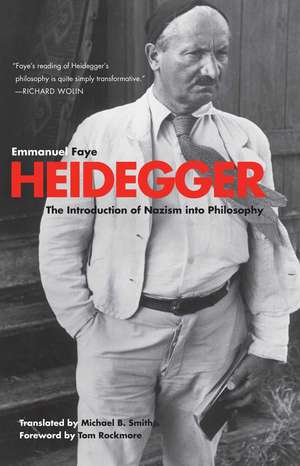
Heidegger: The Introduction of Nazism into Philosophy in Light of the Unpublished Seminars of 1933-1935
Autor Emmanuel Faye Traducere de Michael B Smith Cuvânt înainte de Tom Rockmoreen Limba Engleză Paperback – 31 mai 2011
In this provocative book, Faye uses excerpts from unpublished seminars to show that Heidegger’s philosophical writings are fatally compromised by an adherence to National Socialist ideas. In other documents, Faye finds expressions of racism and exterminatory anti-Semitism.
Faye disputes the view of Heidegger as a naïve, temporarily disoriented academician and instead shows him to have been a self-appointed “spiritual guide” for Nazism whose intentionality was clear. Contrary to what some have written, Heidegger’s Nazism became even more radical after 1935, as Faye demonstrates. He revisits Heidegger’s masterwork, Being and Time, and concludes that in it Heidegger does not present a philosophy of individual existence but rather a doctrine of radical self-sacrifice, where individualization is allowed only for the purpose of heroism in warfare. Faye’s book was highly controversial when originally published in France in 2005. Now available in Michael B. Smith’s fluid English translation, it is bound to awaken controversy in the English-speaking world.
Preț: 452.84 lei
Puncte Express: 679
Preț estimativ în valută:
80.05€ • 95.45$ • 69.43£
80.05€ • 95.45$ • 69.43£
Carte tipărită la comandă
Livrare economică 16-30 martie
Specificații
ISBN-13: 9780300172072
ISBN-10: 0300172079
Pagini: 464
Ilustrații: 5 b-w illus.
Dimensiuni: 149 x 232 x 28 mm
Greutate: 0.71 kg
Editura: Yale University Press
Colecția Yale University Press
ISBN-10: 0300172079
Pagini: 464
Ilustrații: 5 b-w illus.
Dimensiuni: 149 x 232 x 28 mm
Greutate: 0.71 kg
Editura: Yale University Press
Colecția Yale University Press
Recenzii
“By highlighting the links between Heidegger’s politics and his philosophy, and going where other experts have so manifestly been unprepared to go, Faye has done both history and philosophy a valuable service.”—Martin Cohen, Times Higher Education
“Emmanuel Faye has produced a well-researched and painstakingly documented indictment of Heidegger's work and life, making good use of the work of his predecessors in addition to his own original research.”—Michael Maidan, Philosophy in Review
Bronze medal winner of the 2009 Book of the Year Award in the Philosophy category, presented by ForeWord magazine
“Is it possible for a great philosopher to become a devoted Nazi? In his absorbing and challenging study Emmanuel Faye grasps the complexity of Martin Heidegger the man and the magnitude of his achievement."—Elie Wiesel
“Faye’s reading of Heidegger’s philosophy is quite simply transformative. Through a meticulous perusal of new sources—letters, heretofore unpublished seminars and lecture courses—he demonstrates that, during the 1920s and 1930s, right-wing ideological concerns were absolutely central to Heidegger’s Existenzphilosophie. Upon completing Faye’s study, it will be impossible to read Heidegger again naively, i.e., in a narrowly text-immanent manner.”—Richard Wolin, author of Heidegger’s Children and Distinguished Professor of History and Political Science, CUNY Graduate Center
“Emmanuel Faye incontestably shows that Heidegger’s Nazism was not fleeting, casual or accidental, but central to his philosophical enterprise. Faye’s book challenges us to draw the ethical consequences from this fact.”—Robert E. Norton, University of Notre Dame
“The book is not a pamphlet but the outcome of several years of extensive and serious research. . . . Faye has unquestionably succeeded in collecting and laying out for the reader the documents of Heidegger’s deep involvement with National Socialism.”—Robin Celikates, H-Net Reviews in the Humanities & Social Sciences
“All scholars and admirers of Martin Heidegger’s œuvre should read the voluminous book on Heidegger’s infusion of Nazism into philosophy published by Emmanuel Faye. Having studied this tome, even French Heideggerians will no longer be able to deny the embarrassing depth and persistence of Heidegger’s philosophical involvement with Hitler’s National Socialism.”—Herman Philipse, Dialogue, Canadian Philosophical Review
“Emmanuel Faye has produced a well-researched and painstakingly documented indictment of Heidegger's work and life, making good use of the work of his predecessors in addition to his own original research.”—Michael Maidan, Philosophy in Review
Bronze medal winner of the 2009 Book of the Year Award in the Philosophy category, presented by ForeWord magazine
“Is it possible for a great philosopher to become a devoted Nazi? In his absorbing and challenging study Emmanuel Faye grasps the complexity of Martin Heidegger the man and the magnitude of his achievement."—Elie Wiesel
“Faye’s reading of Heidegger’s philosophy is quite simply transformative. Through a meticulous perusal of new sources—letters, heretofore unpublished seminars and lecture courses—he demonstrates that, during the 1920s and 1930s, right-wing ideological concerns were absolutely central to Heidegger’s Existenzphilosophie. Upon completing Faye’s study, it will be impossible to read Heidegger again naively, i.e., in a narrowly text-immanent manner.”—Richard Wolin, author of Heidegger’s Children and Distinguished Professor of History and Political Science, CUNY Graduate Center
“Emmanuel Faye incontestably shows that Heidegger’s Nazism was not fleeting, casual or accidental, but central to his philosophical enterprise. Faye’s book challenges us to draw the ethical consequences from this fact.”—Robert E. Norton, University of Notre Dame
“The book is not a pamphlet but the outcome of several years of extensive and serious research. . . . Faye has unquestionably succeeded in collecting and laying out for the reader the documents of Heidegger’s deep involvement with National Socialism.”—Robin Celikates, H-Net Reviews in the Humanities & Social Sciences
“All scholars and admirers of Martin Heidegger’s œuvre should read the voluminous book on Heidegger’s infusion of Nazism into philosophy published by Emmanuel Faye. Having studied this tome, even French Heideggerians will no longer be able to deny the embarrassing depth and persistence of Heidegger’s philosophical involvement with Hitler’s National Socialism.”—Herman Philipse, Dialogue, Canadian Philosophical Review
Notă biografică
Emmanuel Faye is associate professor at the University Paris Ouest–Nanterre La Défense and an authority on Descartes. Michael B. Smith is professor emeritus of French and philosophy at Berry College and the translator of numerous philosophical works into English.