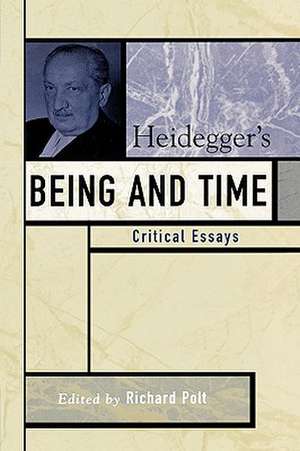
Heidegger's Being and Time: Critical Essays: Critical Essays on the Classics Series
Editat de Richard Polt Contribuţii de Jean Grondin, Karin de Boer, Graeme Nicholson, Charles Guignon, William McNeill, Günter Figal, Steven Crowell, Hubert L. Dreyfus, Daniel O. Dahlstrom, Jeffrey Andrew Bara, Theodore Kisiel, Dieter Thomäen Limba Engleză Paperback – 15 sep 2005
Din seria Critical Essays on the Classics Series
- 21%
 Preț: 367.49 lei
 - 22%
 Preț: 362.66 lei
 - 24%
 Preț: 274.78 lei
 - 23%
 Preț: 277.28 lei
 - 20%
 Preț: 370.10 lei
 - 23%
 Preț: 279.15 lei
 - 19%
 Preț: 321.53 lei
 - 23%
 Preț: 279.94 lei
 - 23%
 Preț: 272.37 lei
 - 20%
 Preț: 319.72 lei
 - 31%
 Preț: 696.36 lei
 - 28%
 Preț: 397.65 lei
 - 20%
 Preț: 311.45 lei
 - 24%
 Preț: 276.58 lei
 - 23%
 Preț: 279.15 lei
 - 21%
 Preț: 380.75 lei
Preț: 179.21 lei
Preț vechi: 238.96 lei
-25%
Puncte Express: 269
Carte tipărită la comandă
Livrare economică 28 noiembrie-12 decembrie
Livrare prin curier în România Termenul estimat este afișat lângă disponibilitate.
Transport gratuit de la 400.00 lei Plată online sau ramburs, în funcție de opțiunile comenzii.
Retur gratuit în 14 zile Comandă securizată și suport în română.
Specificații
ISBN-13: 9780742542419
ISBN-10: 0742542416
Pagini: 247
Dimensiuni: 155 x 231 x 15 mm
Greutate: 0.34 kg
Editura: Bloomsbury Publishing
Colecția Rowman & Littlefield
Seria Critical Essays on the Classics Series
Locul publicării:New York, United States
ISBN-10: 0742542416
Pagini: 247
Dimensiuni: 155 x 231 x 15 mm
Greutate: 0.34 kg
Editura: Bloomsbury Publishing
Colecția Rowman & Littlefield
Seria Critical Essays on the Classics Series
Locul publicării:New York, United States
V-ar putea interesa
-
 A Christmas CornucopiaMark Forsyth-19%Preț: 75.00 lei92.90 lei
 -
 The Metaphysical Foundations of LogicMartin HeideggerPreț: 199.50 lei
 -
 Basic Questions of Philosophy – Selected "Problems" of "Logic"Martin HeideggerPreț: 299.49 lei
 -
 Preț: 263.79 lei
 -
 Phenomenological Interpretation of Kant`s Critique of Pure ReasonMartin HeideggerPreț: 329.18 lei
 -
 The Handbook of Clinically Tested Herbal Remedies, Volumes 1 & 2Marilyn Barrett-5%Preț: 628.17 lei661.23 lei
 -
 HeideggerProfessor Richard PoltPreț: 224.35 lei
 -
 Black's Student Veterinary DictionaryEdward Boden, MBE, HonAssocRCVS, MRPharmS-43%Preț: 140.76 lei245.98 lei
 -
 Washington ItselfE. J. ApplewhitePreț: 178.42 lei
 -
 Heidegger: An IntroductionRichard PoltPreț: 408.71 lei
Cuprins
Chapter 1 Acknowledgments
Chapter 2 Introduction
Chapter 3 Why Reawaken the Question of Being?
Chapter 4 The Temporality of Thinking: Heidegger's Method, from Thinking in the Light of Time: Heidegger's Encounter with Hegel
Chapter 5 The Constitution of Our Being
Chapter 6 Heidegger's Anti-Dualism: Beyond Mind and Matter
Chapter 7 The Genesis of Theory, from The Glance of the Eye: Heidegger, Aristotle, and the Ends of Theory
Chapter 8 Being-with, Dasein-with, and the "They" as the Basic Concept of Unfreedom, from Martin Heidegger: Phänomenologie der Freiheit
Chapter 9 Subjectivity: Locating the First-Person in Being and Time
Chapter 10 Can There Be a Better Source of Meaning than Everyday Practices? Reinterpreting Division I of Being and Time in the Light of Division II
Chapter 11 Genuine Timeliness, from Heidegger's Concept of Truth
Chapter 12 Historical Meaning in the Fundamental Ontology of Being and Time, from Martin Heidegger and the Problem of Historical Meaning
Chapter 13 The Demise of Being and Time: 1927-1930
Chapter 14 Being and Time in Retrospect: Heidegger's Self-Critique
Chapter 15 Selected Bibliography
Chapter 16 Index
Chapter 17 About the Authors
Chapter 2 Introduction
Chapter 3 Why Reawaken the Question of Being?
Chapter 4 The Temporality of Thinking: Heidegger's Method, from Thinking in the Light of Time: Heidegger's Encounter with Hegel
Chapter 5 The Constitution of Our Being
Chapter 6 Heidegger's Anti-Dualism: Beyond Mind and Matter
Chapter 7 The Genesis of Theory, from The Glance of the Eye: Heidegger, Aristotle, and the Ends of Theory
Chapter 8 Being-with, Dasein-with, and the "They" as the Basic Concept of Unfreedom, from Martin Heidegger: Phänomenologie der Freiheit
Chapter 9 Subjectivity: Locating the First-Person in Being and Time
Chapter 10 Can There Be a Better Source of Meaning than Everyday Practices? Reinterpreting Division I of Being and Time in the Light of Division II
Chapter 11 Genuine Timeliness, from Heidegger's Concept of Truth
Chapter 12 Historical Meaning in the Fundamental Ontology of Being and Time, from Martin Heidegger and the Problem of Historical Meaning
Chapter 13 The Demise of Being and Time: 1927-1930
Chapter 14 Being and Time in Retrospect: Heidegger's Self-Critique
Chapter 15 Selected Bibliography
Chapter 16 Index
Chapter 17 About the Authors
Recenzii
Richard Polt has assembled a collection of insightful and provocative articles from the world's leading Heidegger-scholars. This eclectic volume brings Heidegger's magnum opus, Being and Time, into a critical forum where his most pivotal discussions of temporality, being, and human existence can be appropriated in new ways. Undoubtably, the student of Heidegger will find this volume to be extremely helpful for probing the depth of his thinking and experiencing how Being and Time continues to be influential.
The inclusion of a wide variety of perspectives and especially the first appearance in translation of essays by Grondin, Figal and Thomä, makes this volume an attractive option for class adoption.
Richard Polt has gathered here a distinguished international body of Heidegger commentators who together throw important light on what is arguably the single most important work of European philosophy in the Twentieth Century. Ranging over matters both historical and problematic, in voices that are both continental and Anglo-American, Polt has put together what will long stand as an invaluable and indispensable guide to Being and Time.
An anthology of the first order-twelve highly qualified approaches to the interpretation of Heidegger's master work, all 'critical' in the best sense of the word, de-fining its limits and then either clarifying them or suggesting ways to extend them. Richard Polt's introduction, with its succinct résumé of the Heidegger text and carefully nuanced summary of each contribution to the reading of it, weaves the collection into a polychromatic whole.
The inclusion of a wide variety of perspectives and especially the first appearance in translation of essays by Grondin, Figal and Thomä, makes this volume an attractive option for class adoption.
Richard Polt has gathered here a distinguished international body of Heidegger commentators who together throw important light on what is arguably the single most important work of European philosophy in the Twentieth Century. Ranging over matters both historical and problematic, in voices that are both continental and Anglo-American, Polt has put together what will long stand as an invaluable and indispensable guide to Being and Time.
An anthology of the first order-twelve highly qualified approaches to the interpretation of Heidegger's master work, all 'critical' in the best sense of the word, de-fining its limits and then either clarifying them or suggesting ways to extend them. Richard Polt's introduction, with its succinct résumé of the Heidegger text and carefully nuanced summary of each contribution to the reading of it, weaves the collection into a polychromatic whole.