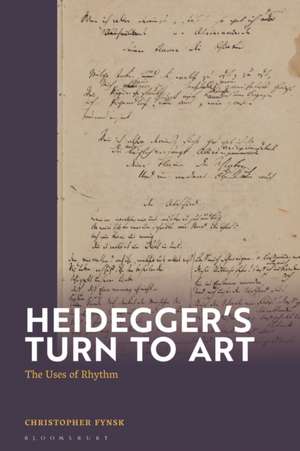
Heidegger's Turn To Art: The Uses of Rhythm
Autor Christopher Fynsken Limba Engleză Hardback – 23 ian 2025
Following the development of Heidegger's thoughts on rhythm, this book focuses especially on the critical moment of Heidegger's turn to art in the mid-1930s and his reading of Friedrich Hölderlin's river hymns. This not only allows for a new reading of his monumental essay "The Origin of the Work of Art", but also a sustained analysis of his engagement with Hölderlin and Aristotle. Importantly, it further reveals the centrality of rhythm to Heidegger's thought and its relation to his other ideas. Indeed Fynsk connects rhythm to Heidegger's theorization of usage, "der Brauch", and in turn the role of usage to his reflections on the relation between being and human being.
Drawing on a wide range of art, from cave paintings to Francis Bacon, this is a significant and insightful study of the ontology of rhythm in Heidegger and beyond.
Preț: 527.57 lei
Preț vechi: 613.45 lei
-14%
Puncte Express: 791
Carte tipărită la comandă
Livrare economică 04-18 decembrie
Livrare prin curier în România Termenul estimat este afișat lângă disponibilitate.
Transport gratuit pentru acest produs Plată online sau ramburs, în funcție de opțiunile comenzii.
Retur gratuit în 14 zile Comandă securizată și suport în română.
Specificații
ISBN-13: 9781350410039
ISBN-10: 1350410039
Pagini: 256
Dimensiuni: 164 x 238 x 18 mm
Greutate: 0.48 kg
Editura: Bloomsbury Publishing
Colecția Bloomsbury Academic
Locul publicării:London, United Kingdom
ISBN-10: 1350410039
Pagini: 256
Dimensiuni: 164 x 238 x 18 mm
Greutate: 0.48 kg
Editura: Bloomsbury Publishing
Colecția Bloomsbury Academic
Locul publicării:London, United Kingdom
Cuprins
Introduction: The Rhythms of Usage
Chapter One: Rhythmic Transport
Chapter Two: The Rhythmic Figure
Chapter Three: Usage and Relation
Chapter Four: The Uses of Craft
Appendix: Aristotle's Poetics, Hölderlin's Remarks
In the Guise of a Conclusion
Chapter One: Rhythmic Transport
Chapter Two: The Rhythmic Figure
Chapter Three: Usage and Relation
Chapter Four: The Uses of Craft
Appendix: Aristotle's Poetics, Hölderlin's Remarks
In the Guise of a Conclusion