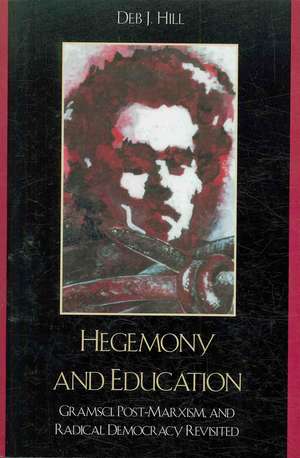
Hegemony and Education: Gramsci, Post-Marxism, and Radical Democracy Revisited
Autor Deb J. Hillen Limba Engleză Paperback – 9 iun 2008
Author Deb J. Hill argues that it was precisely the impress of capitalism's economic and extra-economic aspect upon humanity's own cognitive and moral capacity-upon its relational and valuational capacity-that Gramsci's writings attempted to articulate. In this respect, Gramsci differentiated himself in Marxist circles by the depth of his insights into Marx's historical materialist method and the practical reasoning that this methodology simultaneously engendered. As Hegemony and Education reveals, Gramsci's entire written legacy reflects his historical materialist allegiance: the problem of "education" as no less than the educative-formative problem of practical reasoning.
Preț: 346.24 lei
Preț vechi: 484.34 lei
-29%
Puncte Express: 519
Carte tipărită la comandă
Livrare economică 19 noiembrie-03 decembrie
Livrare prin curier în România Termenul estimat este afișat lângă disponibilitate.
Transport gratuit de la 400.00 lei Plată online sau ramburs, în funcție de opțiunile comenzii.
Retur gratuit în 14 zile Comandă securizată și suport în română.
Specificații
ISBN-13: 9780739121672
ISBN-10: 0739121677
Pagini: 283
Dimensiuni: 153 x 229 x 23 mm
Greutate: 0.45 kg
Editura: Bloomsbury Publishing
Colecția Lexington Books
Locul publicării:New York, United States
ISBN-10: 0739121677
Pagini: 283
Dimensiuni: 153 x 229 x 23 mm
Greutate: 0.45 kg
Editura: Bloomsbury Publishing
Colecția Lexington Books
Locul publicării:New York, United States
V-ar putea interesa
-
 Philosophy and Ideology in Hume's Political ThoughtDavid Miller-33%Preț: 786.30 lei1170.52 lei
 -
 Oxford Studies in Philosophy of Law: Volume 1Leslie Green-13%Preț: 266.19 lei304.95 lei
 -
 Us Before MeP. IllingworthPreț: 318.34 lei
 -
 Global Political PhilosophyM. RissePreț: 394.58 lei
 -
 The Silence of AnimalsJohn Gray-32%Preț: 62.02 lei90.90 lei
 -
 Elements of LegislationNeil DuxburyPreț: 280.55 lei
 -
 The Rule of Law and the Measure of PropertyJeremy WaldronPreț: 247.72 lei
 -
 The Order of Public ReasonGerald GausPreț: 382.71 lei
 -
 A Companion to Contemporary Political PhilosophyRobert E GoodinPreț: 369.23 lei
 -
 Dead Man WorkingCarl CederstromPreț: 75.87 lei
Cuprins
Chapter 1 Introduction: "New Times," Turbulent Times
Chapter 2 Chapter 1: Locating Hegemony Against the Tide of Contemporary Struggle
Chapter 3 Chapter 2: Bourgeois Politics and the Poverty of the Public "Creative Spirit" in Italy: A Cognitive and Moral Problem Revealed (1910-1917)
Chapter 4 Chapter 3: Integral Politics as the Politics of the "Common Good:" The Problem of Citizenship as the Problem of Authoring the "Active" State (1917-1918)
Chapter 5 Chapter 4: Labor, Leadership and Production: Combating Minimal Ideas (1919-1926)
Chapter 6 Chapter 5: Educating Cognitive and Moral Defiance: Historicism and the Dialectic as a Form of Literacy (1926-1937)
Chapter 7 Chapter 6: Beyond Democracy as a Limiting Idea: Proletarian Hegemony as Neohumanistic Reform
Chapter 2 Chapter 1: Locating Hegemony Against the Tide of Contemporary Struggle
Chapter 3 Chapter 2: Bourgeois Politics and the Poverty of the Public "Creative Spirit" in Italy: A Cognitive and Moral Problem Revealed (1910-1917)
Chapter 4 Chapter 3: Integral Politics as the Politics of the "Common Good:" The Problem of Citizenship as the Problem of Authoring the "Active" State (1917-1918)
Chapter 5 Chapter 4: Labor, Leadership and Production: Combating Minimal Ideas (1919-1926)
Chapter 6 Chapter 5: Educating Cognitive and Moral Defiance: Historicism and the Dialectic as a Form of Literacy (1926-1937)
Chapter 7 Chapter 6: Beyond Democracy as a Limiting Idea: Proletarian Hegemony as Neohumanistic Reform
Recenzii
Hill's book offers both a trenchant critique of post-Marxism and a persuasive re-reading of Gramsci's democratic approach, with particular focus on his pre-prison writings. She shows with clarity and insight how Gramsci relates his analyses of culture, everyday life and history to his economic analysis of capitalism in a manner that leads to his particular political perspective, his critique of representation and his organizational concerns. By doing this, Hill has made Gramsci more valuable for contemporary politics.
Accepting the challenge posed by the gabs in much of 'traditional' Marxism, Deb J. Hill engages with the principal exponents of post-Marxism, mounting a sustained critique of decentred, detotalized structures and subjects from a Gramscian Marxist position. She puts Gramsci's central conception of hegemony to fruitful use, going against post-modernist interpretations by reinstating the essential class-based core of the notion. Particularly praiseworthy is the intelligent use she makes of Gramsci's pre-prison journalism. She skillfully draws on Gramsci's journalistic production to highlight his argument on education as providing an essential base, not only for questions of authentic citizenship, then as now a burning question, but also for 'counter-capitalist struggle' and movements. This book will provide a forum of debate from Gramscians and non-Gramscians, Marxists and non-Marxists alike..
This study provides readers with a compelling and sharp critique of the principal positions of post-Marxism....Recommended.
Deb Hill's new book is a welcome addition to the burgeoning literature on the uses and abuses of Gramsci. Her philological approach to both his early works and the Prison Notebooks leads into a trenchant and convincing critique of the voguish post-marxism that claims to take off from Gramsci. Hill exposes the uses of Gramsci-who today has surpassed even Machiavelli to be the most translated Italian theorist-by such luminaries as Laclau, Mouffe, and Mercer as either ill-founded and pretentious or, where she thinks they have a point, as merely restating what is better explained by Gramsci himself. She ripostes with an impassioned defense of Gramsci's own views and of the marxism behind them, to which he always remained loyal.
Accepting the challenge posed by the gabs in much of 'traditional' Marxism, Deb J. Hill engages with the principal exponents of post-Marxism, mounting a sustained critique of decentred, detotalized structures and subjects from a Gramscian Marxist position. She puts Gramsci's central conception of hegemony to fruitful use, going against post-modernist interpretations by reinstating the essential class-based core of the notion. Particularly praiseworthy is the intelligent use she makes of Gramsci's pre-prison journalism. She skillfully draws on Gramsci's journalistic production to highlight his argument on education as providing an essential base, not only for questions of authentic citizenship, then as now a burning question, but also for 'counter-capitalist struggle' and movements. This book will provide a forum of debate from Gramscians and non-Gramscians, Marxists and non-Marxists alike..
This study provides readers with a compelling and sharp critique of the principal positions of post-Marxism....Recommended.
Deb Hill's new book is a welcome addition to the burgeoning literature on the uses and abuses of Gramsci. Her philological approach to both his early works and the Prison Notebooks leads into a trenchant and convincing critique of the voguish post-marxism that claims to take off from Gramsci. Hill exposes the uses of Gramsci-who today has surpassed even Machiavelli to be the most translated Italian theorist-by such luminaries as Laclau, Mouffe, and Mercer as either ill-founded and pretentious or, where she thinks they have a point, as merely restating what is better explained by Gramsci himself. She ripostes with an impassioned defense of Gramsci's own views and of the marxism behind them, to which he always remained loyal.