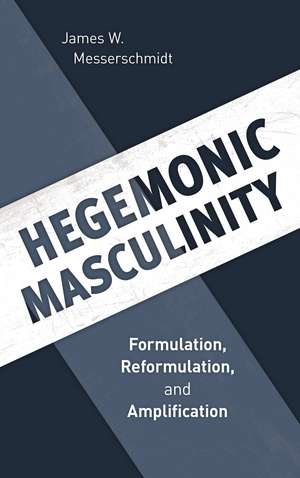
Hegemonic Masculinity: Formulation, Reformulation, and Amplification
Autor James W. Messerschmidten Limba Engleză Hardback – 11 apr 2018
Hegemonic Masculinity describes the development of the concept, the actual formulation and initial applications of the concept, the eventual reformulation and subsequent applications of that reformulation, and finally, the amplification of the reformulated concept of hegemonic masculinity. The book also includes a chapter theorizing why and how hegemonic masculinities are constructed, and the concluding chapter chronicles the prospects for social change toward more egalitarian gender relations. Hegemonic Masculinity: Formulation, Reformulation, and Amplification brings together for the first time in one volume the history of the concept as well as a discussion and examination of some of the most important research accomplished on hegemonic masculinity over the last thirty years.
| Toate formatele și edițiile | Preț | Express |
|---|---|---|
| Paperback (1) | 208.79 lei 6-8 săpt. | |
| Bloomsbury Publishing – 9 apr 2018 | 208.79 lei 6-8 săpt. | |
| Hardback (1) | 503.63 lei 6-8 săpt. | |
| Bloomsbury Publishing – 11 apr 2018 | 503.63 lei 6-8 săpt. |
Preț: 503.63 lei
Preț vechi: 701.25 lei
-28%
Puncte Express: 755
Preț estimativ în valută:
89.13€ • 104.17$ • 77.38£
89.13€ • 104.17$ • 77.38£
Carte tipărită la comandă
Livrare economică 20 februarie-06 martie
Preluare comenzi: 021 569.72.76
Specificații
ISBN-13: 9781538114032
ISBN-10: 1538114038
Pagini: 184
Dimensiuni: 160 x 239 x 20 mm
Greutate: 0.32 kg
Editura: Bloomsbury Publishing
Colecția Rowman & Littlefield Publishers
Locul publicării:New York, United States
ISBN-10: 1538114038
Pagini: 184
Dimensiuni: 160 x 239 x 20 mm
Greutate: 0.32 kg
Editura: Bloomsbury Publishing
Colecția Rowman & Littlefield Publishers
Locul publicării:New York, United States
Cuprins
Preface
I.Backstory
II. Formulation
III. Reformulation
IV. Amplification
V. Theory
VI. Prospects
References
About the Author
I.Backstory
II. Formulation
III. Reformulation
IV. Amplification
V. Theory
VI. Prospects
References
About the Author
Recenzii
Few concepts in gender studies are as used-and misunderstood-as 'hegemonic masculinity.' This book is more than just a useful primer but a careful theoretical exegesis of the term and its conceptual and cultural contexts.
Like many powerful concepts, hegemonic masculinity has been deployed variously as a sharp tool that clarifies the workings of the social world, as a fuzzy term that means whatever an author wants it to mean, and as a simplistic foil against which a writer attempts to assert some other idea. James Messerschmidt-long a leading scholar in the field-contributes a clear road map to understanding the origins, development and continuing importance of the concept. Hegemonic Masculinity is a welcome and valuable contribution to the maturation of gender theory in the social sciences.
James Messerschmidt provides a comprehensive and insightful discussion and analysis of the socio-historical trajectory of the concept of hegemonic masculinity. This book is, without question, the most comprehensive, clarifying, and in depth treatment of the concept hegemonic masculinity to date. Going beyond summary, Messerschmidt's meta-analysis of the large body of theoretical and empirical work on hegemonic masculinity extends as much as it clarifies the meaning, applicability, and importance of the concept. This book should-and I believe will-become a standard and required text for anyone interested in gender and social inequality.
James W. Messerschmidt's Hegemonic Masculinity is a tour de force, masterfully placing the concept of 'hegemonic masculinity' and its changing development in historical and contemporary context. Messerschmidt skillfully examines new and diverse research on hegemonic masculinity over the past thirty years, confirming the continued significance of Connell's original emphasis on the legitimation of unequal gender relations, yet he simultaneously shows that a renovated concept is necessary to understand the omnipresence of hegemonic masculinities today-locally, regionally, and globally. A significant and momentous work that all students and scholars interested in confronting gender inequality must read!
Hegemonic Masculinity is a comprehensive and informative overview of the history, critique, reformulation, and current theory of this core concept. It is sure to become a classic text in gender studies-an indispensable introduction for new students and a reliable resource for established scholars. I highly recommend it.
Like many powerful concepts, hegemonic masculinity has been deployed variously as a sharp tool that clarifies the workings of the social world, as a fuzzy term that means whatever an author wants it to mean, and as a simplistic foil against which a writer attempts to assert some other idea. James Messerschmidt-long a leading scholar in the field-contributes a clear road map to understanding the origins, development and continuing importance of the concept. Hegemonic Masculinity is a welcome and valuable contribution to the maturation of gender theory in the social sciences.
James Messerschmidt provides a comprehensive and insightful discussion and analysis of the socio-historical trajectory of the concept of hegemonic masculinity. This book is, without question, the most comprehensive, clarifying, and in depth treatment of the concept hegemonic masculinity to date. Going beyond summary, Messerschmidt's meta-analysis of the large body of theoretical and empirical work on hegemonic masculinity extends as much as it clarifies the meaning, applicability, and importance of the concept. This book should-and I believe will-become a standard and required text for anyone interested in gender and social inequality.
James W. Messerschmidt's Hegemonic Masculinity is a tour de force, masterfully placing the concept of 'hegemonic masculinity' and its changing development in historical and contemporary context. Messerschmidt skillfully examines new and diverse research on hegemonic masculinity over the past thirty years, confirming the continued significance of Connell's original emphasis on the legitimation of unequal gender relations, yet he simultaneously shows that a renovated concept is necessary to understand the omnipresence of hegemonic masculinities today-locally, regionally, and globally. A significant and momentous work that all students and scholars interested in confronting gender inequality must read!
Hegemonic Masculinity is a comprehensive and informative overview of the history, critique, reformulation, and current theory of this core concept. It is sure to become a classic text in gender studies-an indispensable introduction for new students and a reliable resource for established scholars. I highly recommend it.