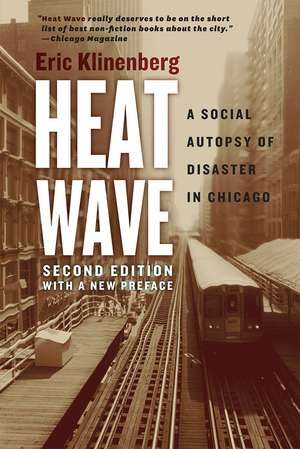
Heat Wave: A Social Autopsy of Disaster in Chicago
Autor Eric Klinenbergen Limba Engleză Paperback – 6 mai 2015
Considerăm că utilitatea practică a lucrării Heat Wave rezidă în capacitatea sa de a transforma un fenomen meteorologic extrem într-o diagnoză sociologică precisă a vulnerabilității urbane. Eric Klinenberg nu se rezumă la a documenta temperaturile record din 1995, ci efectuează o „autopsie socială” a orașului Chicago, investigând de ce peste 700 de persoane au murit în izolare. Cartea demonstrează cum politicile publice, abandonul instituțional al cartierelor sărace și izolarea vârstnicilor au transformat o criză climatică într-un dezastru uman de proporții.
Această a doua ediție aduce în discuție relevanța curriculumului actual prin noua prefață a autorului, care ancorează evenimentele din 1995 în contextul actual al schimbărilor climatice globale, pledând pentru o infrastructură rezistentă. Structura cărții urmărește o progresie logică: de la „producția socială a izolării” în primul capitol, la analiza serviciilor municipale și a modului în care mass-media a reprezentat catastrofa. Găsim aici o documentare riguroasă, susținută de 12 tabele și 7 figuri, care explică de ce mortalitatea a variat drastic între cartiere cu demografii similare, dar cu structuri sociale diferite.
Lucrarea completează perspectiva oferită de The Summer of Death de Geoff Williams; în timp ce Williams se concentrează pe o narațiune istorică a valului de căldură din 1936, Klinenberg oferă o analiză structurală a „organelor” metropolei moderne. De asemenea, Heat Wave se distinge de A Plague on Your Houses prin focalizarea specifică pe intersecția dintre ecologia urbană și răspunsul politic în momente de criză acută. În contextul operei sale, volumul prefigurează temele din Going Solo și Palaces for the People, unde Klinenberg explorează izolarea socială și importanța infrastructurii sociale pentru siguranța și sănătatea comunităților.
Preț: 145.44 lei
Carte disponibilă
Livrare economică 09-23 noiembrie
Livrare express 24-30 octombrie pentru 65.07 lei
Specificații
ISBN-10: 022627618X
Pagini: 320
Ilustrații: 35 halftones, 3 maps, 7 figures, 12 tables
Dimensiuni: 152 x 229 x 30 mm
Greutate: 0.48 kg
Ediția:Second Edition
Editura: University of Chicago Press
Colecția University of Chicago Press
V-ar putea interesa
-
 Antidemocracy in AmericaEric KlinenbergPreț: 146.88 lei
 -
 Preț: 79.03 lei
 -
 Hurricane Katrina and the Redefinition of LandscapeDeMond Shondell Miller-16%Preț: 343.17 lei409.11 lei
 -
 -32%Preț: 360.62 lei531.79 lei
 -
 Response to Disaster: Fact Versus Fiction and Its PerpetuationHenry W. Fischer III-25%Preț: 348.96 lei462.46 lei
 -
 Fighting for Air: The Battle to Control America's MediaEric KlinenbergPreț: 137.27 lei
 -
 Sports in the Aftermath of Tragedy: From Kennedy to KatrinaMichael H. Gavin-35%Preț: 562.53 lei862.95 lei
 -
 -11%Preț: 514.67 lei578.29 lei
 -
 -20%Preț: 1174.47 lei1468.09 lei
 -
 -18%Preț: 1152.14 lei1405.04 lei
 -
 -20%Preț: 1189.07 lei1486.33 lei
 -
 The Sociology of Katrina: Perspectives on a Modern CatastropheDavid L. Brunsma-19%Preț: 323.37 lei398.92 lei
 -
 Gender, Heterosexuality, and Youth Violence: The Struggle for RecognitionJames W. Messerschmidt-24%Preț: 254.06 lei335.29 lei
 -
 -23%Preț: 1067.60 lei1380.94 lei
 -
 Enduring Geohazards in the CaribbeanSerwan M. J. BabanPreț: 374.19 lei
De ce să citești această carte
Această carte este esențială pentru studenții și profesioniștii din sociologie, urbanism și politici publice. Cititorul câștigă o înțelegere profundă a modului în care inegalitatea socială devine letală în timpul dezastrelor naturale. Este o lectură fundamentală pentru a înțelege de ce reziliența unui oraș nu depinde doar de serviciile de urgență, ci de soliditatea țesutului social și a spațiilor publice care previn izolarea extremă.
Despre autor
Eric Klinenberg este profesor de sociologie și director al Institutului pentru Cunoaștere Publică din cadrul New York University. Este un cercetător recunoscut pentru analizele sale asupra vieții urbane contemporane, publicând lucrări de referință precum Going Solo și Palaces for the People. Expertiza sa depășește sfera academică, fiind un contributor constant pentru publicații de prestigiu precum The New Yorker și The New York Times Magazine. În Heat Wave, Klinenberg utilizează metodele cercetării de teren și ale arhivei pentru a expune fracturile sociale ascunse ale metropolelor americane.
Descriere scurtă
On Thursday, July 13, 1995, Chicagoans awoke to a blistering day in which the temperature would reach 106 degrees. The heat index, which measures how the temperature actually feels on the body, would hit 126 degrees by the time the day was over. Meteorologists had been warning residents about a two-day heat wave, but these temperatures did not end that soon. When the heat wave broke a week later, city streets had buckled; the records for electrical use were shattered; and power grids had failed, leaving residents without electricity for up to two days. And by July 20, over seven hundred people had perished-more than twice the number that died in the Chicago Fire of 1871, twenty times the number of those struck by Hurricane Andrew in 1992—in the great Chicago heat wave, one of the deadliest in American history.
Heat waves in the United States kill more people during a typical year than all other natural disasters combined. Until now, no one could explain either the overwhelming number or the heartbreaking manner of the deaths resulting from the 1995 Chicago heat wave. Meteorologists and medical scientists have been unable to account for the scale of the trauma, and political officials have puzzled over the sources of the city's vulnerability. In Heat Wave, Eric Klinenberg takes us inside the anatomy of the metropolis to conduct what he calls a "social autopsy," examining the social, political, and institutional organs of the city that made this urban disaster so much worse than it ought to have been.
Starting with the question of why so many people died at home alone, Klinenberg investigates why some neighborhoods experienced greater mortality than others, how the city government responded to the crisis, and how journalists, scientists, and public officials reported on and explained these events. Through a combination of years of fieldwork, extensive interviews, and archival research, Klinenberg uncovers how a number of surprising and unsettling forms of social breakdown—including the literal and social isolation of seniors, the institutional abandonment of poor neighborhoods, and the retrenchment of public assistance programs—contributed to the high fatality rates. The human catastrophe, he argues, cannot simply be blamed on the failures of any particular individuals or organizations. For when hundreds of people die behind locked doors and sealed windows, out of contact with friends, family, community groups, and public agencies, everyone is implicated in their demise.
As Klinenberg demonstrates in this incisive and gripping account of the contemporary urban condition, the widening cracks in the social foundations of American cities that the 1995 Chicago heat wave made visible have by no means subsided as the temperatures returned to normal. The forces that affected Chicago so disastrously remain in play in America's cities, and we ignore them at our peril.
For the Second Edition Klinenberg has added a new Preface showing how climate change has made extreme weather events in urban centers a major challenge for cities and nations across our planet, one that will require commitment to climate-proofing changes to infrastructure rather than just relief responses.
Notă biografică
Cuprins
Acknowledgments
Preface to the Second Edition
Prologue: The Urban Inferno
Introduction: The City of Extreme
1. Dying Alone: The Social Production of Isolation
2. Race, Place, and Vulnerability: Urban Neighborhoods and the Ecology of Support
3. The State of Disaster: City Services in the Empowerment Era
4. Governing by Public Relations
5. The Spectacular City: News Organizations and the Representation of Catastrophe
Conclusion: Emerging Dangers in the Urban Environment
Epilogue: Together in the End
Notes
Bibliography
Index