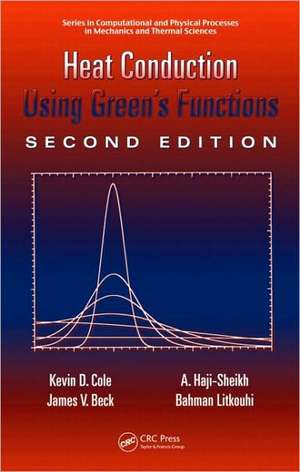
Heat Conduction Using Greens Functions: Series in Computational Methods and Physical Processes in Mechanics and Thermal Sciences
Autor Kevin Cole, James Beck, A. Haji-Sheikh, Bahman Litkouhien Limba Engleză Hardback – 16 iul 2010
Details how to access the accompanying Green’s Function Library site, a useful web-searchable collection of GFs based on the appendices in this book
The book reflects the authors’ conviction that although Green’s functions were discovered in the nineteenth century, they remain directly relevant to 21st-century engineers and scientists. It chronicles the authors’ continued search for new GFs and novel ways to apply them to heat conduction.
New features of this latest edition—
- Expands the introduction to Green’s functions, both steady and unsteady
- Adds a section on the Dirac Delta Function
- Includes a discussion of the eigenfunction expansion method, as well as sections on the convergence speed of series solutions, and the importance of alternate GF
- Adds a section on intrinsic verification, an important new tool for obtaining correct numerical values from analytical solutions
Preț: 1360.65 lei
Preț vechi: 1659.33 lei
-18%
Puncte Express: 2041
Carte tipărită la comandă
Livrare economică 11-25 august
Livrare prin curier în România Termenul estimat este afișat lângă disponibilitate.
Transport gratuit pentru acest produs Plată online sau ramburs, în funcție de opțiunile comenzii.
Retur gratuit în 14 zile Comandă securizată și suport în română.
Specificații
ISBN-13: 9781439813546
ISBN-10: 143981354X
Pagini: 663
Ilustrații: 131 b/w images and 74 tables
Dimensiuni: 156 x 234 x 41 mm
Greutate: 1.09 kg
Ediția:Revizuită
Editura: CRC Press
Colecția CRC Press
Seria Series in Computational Methods and Physical Processes in Mechanics and Thermal Sciences
Locul publicării:United States
ISBN-10: 143981354X
Pagini: 663
Ilustrații: 131 b/w images and 74 tables
Dimensiuni: 156 x 234 x 41 mm
Greutate: 1.09 kg
Ediția:Revizuită
Editura: CRC Press
Colecția CRC Press
Seria Series in Computational Methods and Physical Processes in Mechanics and Thermal Sciences
Locul publicării:United States
V-ar putea interesa
-
 Introductory Statistical ThermodynamicsNils Dalarsson-8%Preț: 332.91 lei361.86 lei
 -
 Light is a Messenger: The Life and Science of William Lawrence BraggGraeme K. Hunter-30%Preț: 573.56 lei815.35 lei
 -
 -23%Preț: 484.59 lei629.34 lei
 -
 Fundamentals of the Finite Element Method for Heat and Mass TransferPerumal Nithiarasu-11%Preț: 710.08 lei797.83 lei
 -
 Fundamentals of Classical and Statistical ThermodynamicsBimalendu N Roy-8%Preț: 635.21 lei690.44 lei
 -
 Thermodynamic FormalismDavid Ruelle-11%Preț: 597.00 lei670.80 lei
 -
 Numerical Heat Transfer and Fluid FlowSuhas Patankar-18%Preț: 2015.29 lei2457.67 lei
 -
 A Student's Guide to EntropyDon S. LemonsPreț: 240.04 lei
 -
 A Conceptual Guide to ThermodynamicsB PoirierPreț: 437.32 lei
 -
 Entropy and the Second LawArieh Ben-NaimPreț: 169.30 lei
Public țintă
UndergraduateCuprins
Introduction to Green’s Functions. Numbering System in Heat Conduction. Derivation of the Green’s Function Solution Equation. Methods for Obtaining Green’s Functions. Improvement of Convergence and Intrinsic Verification. Rectangular Coordinates. Cylindrical Coordinates. Radial Heat Flow in Spherical Coordinates. Steady-Periodic Heat Conduction. Galerkin-Based Green’s Functions and Solutions. Applications of the Galerkin-Based Green’s Functions. Unsteady Surface Element Method. Problems. References. Appendices. Index.
Notă biografică
Kevin D. Cole received his MS in aerospace engineering and mechanics from the University of Minnesota in 1979 and his PhD in mechanical engineering from Michigan State University in 1986. Dr. Cole has held several positions in academia and industry and is currently associate professor of mechanical engineering at the University of Nebraska–Lincoln. He is the creator of the Green’s Function Library Internet site.
James V. Beck received his SM in mechanical engineering from MIT in 1957 and his PhD from Michigan State University in 1964. Dr. Beck is currently professor emeritus of mechanical engineering at Michigan State University. He is the originator of the Inverse Problems Symposium and is the inventor, with Professor Litkouhi, of the numbering system for heat conduction solutions. Dr. Beck has contributed to the field of heat transfer with numerous referred journal articles and books.
A. Haji-Sheikh received his MS in ME, MA in Mathematics from the University of Michigan and a PhD in 1965 from the University of Minnesota. In 1966, he joined the Department of Mechanical Engineering at the University of Texas at Arlington, and is currently a professor and member of the Distinguished Scholars Academy. His contributions to heat conduction include the floating random walk in Monte Carlo method, Green’s function in two-step models, inverse problems, and Galerkin-based integral methods.
Bahman Litkouhi received his MS and PhD from Michigan State University and is presently professor and graduate program director of the Mechanical Engineering Department at Manhattan College. Dr. Litkouhi is a registered professional engineer in the state of New York and a member of the American Society of Mechanical Engineers. He has authored several technical publications in heat transfer and has served as an industrial consultant.
James V. Beck received his SM in mechanical engineering from MIT in 1957 and his PhD from Michigan State University in 1964. Dr. Beck is currently professor emeritus of mechanical engineering at Michigan State University. He is the originator of the Inverse Problems Symposium and is the inventor, with Professor Litkouhi, of the numbering system for heat conduction solutions. Dr. Beck has contributed to the field of heat transfer with numerous referred journal articles and books.
A. Haji-Sheikh received his MS in ME, MA in Mathematics from the University of Michigan and a PhD in 1965 from the University of Minnesota. In 1966, he joined the Department of Mechanical Engineering at the University of Texas at Arlington, and is currently a professor and member of the Distinguished Scholars Academy. His contributions to heat conduction include the floating random walk in Monte Carlo method, Green’s function in two-step models, inverse problems, and Galerkin-based integral methods.
Bahman Litkouhi received his MS and PhD from Michigan State University and is presently professor and graduate program director of the Mechanical Engineering Department at Manhattan College. Dr. Litkouhi is a registered professional engineer in the state of New York and a member of the American Society of Mechanical Engineers. He has authored several technical publications in heat transfer and has served as an industrial consultant.
Descriere
Chronicling the authors’ continued search for new Green’s functions (GFs) and novel ways to apply them to heat conduction, this book organizes the solution of heat conduction and diffusion problems through the use of GFs. This second edition expands the introduction to steady and unsteady GFs; adds new sections on the Dirac-delta function, convergence speed of series solutions, the importance of alternate GF, and intrinsic verification; and includes a discussion of the eigenfunction expansion method. A companion website provides a useful web-searchable collection of GFs.