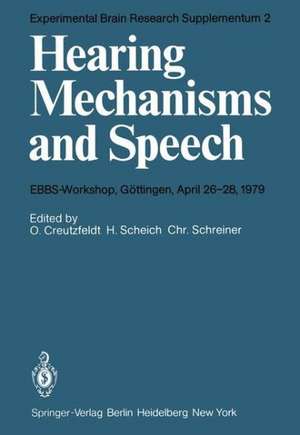
Hearing Mechanisms and Speech: EBBS-Workshop, Göttingen, April 26–28, 1979: Experimental Brain Research Series, cartea 2
Editat de O. Creutzfeldt, H. Scheich, C. Schreineren Limba Engleză Paperback – oct 1979
Din seria Experimental Brain Research Series
-
 Preț: 367.14 lei
 - 15%
 Preț: 634.07 lei
 -
 Preț: 381.30 lei
 - 15%
 Preț: 621.97 lei
 - 18%
 Preț: 1386.83 lei
 - 18%
 Preț: 914.52 lei
 - 15%
 Preț: 625.57 lei
 - 15%
 Preț: 646.20 lei
 -
 Preț: 380.99 lei
 - 15%
 Preț: 627.62 lei
 - 18%
 Preț: 908.91 lei
 - 15%
 Preț: 642.19 lei
 -
 Preț: 378.02 lei
 - 15%
 Preț: 620.68 lei
 - 5%
 Preț: 711.08 lei
 - 15%
 Preț: 654.86 lei
 - 5%
 Preț: 392.70 lei
 - 5%
 Preț: 362.83 lei
 - 15%
 Preț: 652.89 lei
 - 5%
 Preț: 690.73 lei
 - 5%
 Preț: 1126.23 lei
 - 15%
 Preț: 618.64 lei
 - 15%
 Preț: 617.57 lei
 - 15%
 Preț: 627.62 lei
Preț: 698.82 lei
Preț vechi: 735.60 lei
-5%
Puncte Express: 1048
Carte tipărită la comandă
Livrare economică 07-21 decembrie
Livrare prin curier în România Termenul estimat este afișat lângă disponibilitate.
Transport gratuit pentru acest produs Plată online sau ramburs, în funcție de opțiunile comenzii.
Retur gratuit în 14 zile Comandă securizată și suport în română.
Specificații
ISBN-13: 9783540096559
ISBN-10: 3540096558
Pagini: 440
Ilustrații: XXIV, 414 p. 3 illus.
Dimensiuni: 170 x 244 x 23 mm
Greutate: 0.69 kg
Ediția:Softcover reprint of the original 1st ed. 1979
Editura: Springer Berlin, Heidelberg
Colecția Springer
Seria Experimental Brain Research Series
Locul publicării:Berlin, Heidelberg, Germany
ISBN-10: 3540096558
Pagini: 440
Ilustrații: XXIV, 414 p. 3 illus.
Dimensiuni: 170 x 244 x 23 mm
Greutate: 0.69 kg
Ediția:Softcover reprint of the original 1st ed. 1979
Editura: Springer Berlin, Heidelberg
Colecția Springer
Seria Experimental Brain Research Series
Locul publicării:Berlin, Heidelberg, Germany
V-ar putea interesa
-
 Anaesthesia for Emergency CareJerry Nolan-21%Preț: 478.01 lei603.15 lei
 -
 Careers Beyond Clinical MedicineHeidi Moawad-27%Preț: 273.46 lei375.86 lei
 -
 A Practice of Anesthesia for Infants and ChildrenCharles J. Coté-26%Preț: 991.32 lei1340.15 lei
 -
 Handbook of Clinical AnesthesiaPaul G. Barash-21%Preț: 516.72 lei652.62 lei
 -
 Evidence-Based Practice of AnesthesiologyLee A. Fleisher-28%Preț: 478.55 lei668.06 lei
 -
 Board Stiff TEE: Transesophageal Echocardiography: ExpertConsult Online and PrintChristopher Gallagher-29%Preț: 350.04 lei492.22 lei
 -
 Epidural Labor AnalgesiaGiorgio Capogna-5%Preț: 751.83 lei791.40 lei
 -
 Advanced Headache TherapyLawrence Robbins-5%Preț: 688.04 lei724.25 lei
 -
 Mental Health Practice in a Digital WorldNaakesh A. Dewan-5%Preț: 744.98 lei784.18 lei
 -
 FibromyalgiaMd Lawson-5%Preț: 352.25 lei370.78 lei
 -
 Consumer Health InformaticsThomas Wetter-5%Preț: 669.45 lei704.68 lei
Public țintă
ResearchCuprins
I) Functional and structural conditions for transmission of auditory signals in the nervous system..- Basic mechanisms of auditory processing in the cochlea.- On the peripheral coding of the level of individual frequency components of complex sounds at high sound levels.- Universal mechanical response curves for the cochlea.- The human cochlea nuclei.- Coding of complex sounds in the auditory nervous system.- Embryological evolution and typology of cells of the inferior colliculus.- Functional and topographic organization of the auditory cortex.- II) The representation of complex natural sounds in the auditory system..- Neural image of sound in the grassfrog.- Spectro-temporal analysis of auditory neurons in the grassfrog.- Tonotopy and analysis of wide-band calls in field L of the guinea fowl.- Selective responses of neurons to vowel sounds in the auditory neostriatum of the mynah bird.- The increase of response selectivity within the avian auditory pathway.- Encoding of complex sounds by thalamic and cortical neurons.- Time segmentation in central analysis of complex signals.- Temporal suppression and speech processing.- Feature detection by single units in squirrel monkey auditory cortex.- Processing of self-produced vocalizations by single neurons in the auditory cortex of the squirrel monkey (Saimiri Sciureus).- Encoding processes of speech sounds in the auditory system.- Verb and noun meaning of homophone word activate different cortical generators: a topographical study of evoked potential fields.- III) Brain mechanisms of speech perception and production..- Anatomical and functional cerebral organization of phonation in animals.- Basal ganglia participation in aphasia.- Participation of mesial cortex in speech: evidence from cerebral potentials preceding speechproduction in man.- Electrical stimulation mapping of language cortex.- Human language cortex: identification of common sites for sequencing motor activity and speech discrimination.- Studies on language comprehension in hemispherectomy, split brain and asphasic patients. A possible contribution to the knowledge of the physiological mechanisms of speech comprehension.- Timing in speech production: aspects of (German) hesitation vowels.- Inborn vocalizations of the human baby and communicative value for the mother.- IV) Psychoacoustic elements in language..- What acoustic stimulation can teach us about physiological mechanisms underlying speech perception.- An outline of pitch analysis in speech: a hearing theory approach.- Pitch determination of speech signals — a survey.- Virtual pitch and our own voice.- On the perception of spectral information in speech.- Perceptual difference limens in pair-comparison of complex (speech-related) signals.- V) Linguistic elements in speech perception..- Aspects of categorical processing of speech sounds in man: on the determinants of phonetic category boundaries.- Selective adaptation of acoustic and phonetic feature sensitive detectors.- Speech sounds in realtion to speech processing.- Perceptual grouping of speech components.- Aspects of the temporal relationship between speech- and word-recognition processes.- The acquisiton of grammar.- VI) Receptive defects of linguistic elements in aphasia..- Auditory agnosia after lesions of the superior temporal gyrus in monkey and man.- Selective impairment of perception of articulatory place in a case of cortical auditory disorder.- Phonemic auditory discrimination and articulatory defects in aphasia.- Comprehension of natural sounds in aphasia.- Lexical and syntactic factors in languagecomprehension of aphasic patients.- Interaural integration in the perception of complete and truncated words by brain damaged and control subjects.- Auditory analogue of deep dyslexia.- The influence of prosodic features in language comprehension in aphasic patients.