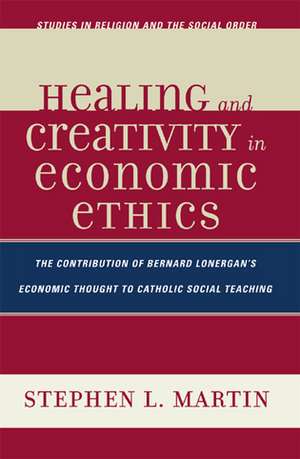
Healing and Creativity in Economic Ethics: The Contribution of Bernard Lonergan's Economic Thought to Catholic Social Teaching: Jacob Neusner Series: Religion/Social Order
Autor Stephen W. Martinen Limba Engleză Paperback – 23 oct 2007
Preț: 321.63 lei
Preț vechi: 418.24 lei
-23%
Puncte Express: 482
Carte tipărită la comandă
Livrare economică 10-24 noiembrie
Livrare prin curier în România Termenul estimat este afișat lângă disponibilitate.
Transport gratuit de la 400.00 lei Plată online sau ramburs, în funcție de opțiunile comenzii.
Retur gratuit în 14 zile Comandă securizată și suport în română.
Specificații
ISBN-13: 9780761837657
ISBN-10: 0761837655
Pagini: 200
Dimensiuni: 148 x 226 x 16 mm
Greutate: 0.34 kg
Editura: Bloomsbury Publishing
Colecția University Press of America
Seria Jacob Neusner Series: Religion/Social Order
Locul publicării:New York, United States
ISBN-10: 0761837655
Pagini: 200
Dimensiuni: 148 x 226 x 16 mm
Greutate: 0.34 kg
Editura: Bloomsbury Publishing
Colecția University Press of America
Seria Jacob Neusner Series: Religion/Social Order
Locul publicării:New York, United States
Cuprins
Part 1 Preface
Chapter 2 The End and the Beginning
Chapter 3 Rebirth
Chapter 4 The Watery Trail
Chapter 5 Trials and Tribulations
Chapter 6 Heart and Home: The Long Road into the Night
Chapter 7 Epilogue
Part 8 Bibliography
Part 9 Index
Part 10 About the Author
Chapter 2 The End and the Beginning
Chapter 3 Rebirth
Chapter 4 The Watery Trail
Chapter 5 Trials and Tribulations
Chapter 6 Heart and Home: The Long Road into the Night
Chapter 7 Epilogue
Part 8 Bibliography
Part 9 Index
Part 10 About the Author
Recenzii
Stephen Martin has provided us with what we need to get started envisioning the genuine alternative that Lonergan provides to the liberal capitalist and Marxist dead-ends. For this we can only be grateful. May this work be read by many, may it influence our religious leaders as they work out Catholic social and economic teaching, and may it help us affirm that a genuine alternative does indeed exist.
In this short book, Professor Martin presents a clear challenge to the Christian community to move forward towards a serious understanding of the fundamentals of economic life. One simply does not know what is happening economically without the functional division that is hinted at by Joseph Schumpeter but developed seriously by Lonergan...Perhaps Martin will do eventually what Lonergan failed to do: shake the orthodoxies of both the ecclesial and the economic establishments.
Martin succeeds in introducing his reader to the many relevant sides of Lonergan's thought in a clear and accessible style. His explanation...may engage readers and students in lively discussion and provide familiar images to assist the reader's understanding.
The body of this fascinating book mines the deep economic thought of one of Catholicism's geniuses, Bernard Lonergan, a Jesuit who died in 1982, whose brilliant career of teaching and writing culminated in a short book on economics which was published posthumously. Martin does a great service to both economics and Lonergan studies by illuminating his economic thought and bringing its implications for economics to the surface.
In this short book, Professor Martin presents a clear challenge to the Christian community to move forward towards a serious understanding of the fundamentals of economic life. One simply does not know what is happening economically without the functional division that is hinted at by Joseph Schumpeter but developed seriously by Lonergan...Perhaps Martin will do eventually what Lonergan failed to do: shake the orthodoxies of both the ecclesial and the economic establishments.
Martin succeeds in introducing his reader to the many relevant sides of Lonergan's thought in a clear and accessible style. His explanation...may engage readers and students in lively discussion and provide familiar images to assist the reader's understanding.
The body of this fascinating book mines the deep economic thought of one of Catholicism's geniuses, Bernard Lonergan, a Jesuit who died in 1982, whose brilliant career of teaching and writing culminated in a short book on economics which was published posthumously. Martin does a great service to both economics and Lonergan studies by illuminating his economic thought and bringing its implications for economics to the surface.