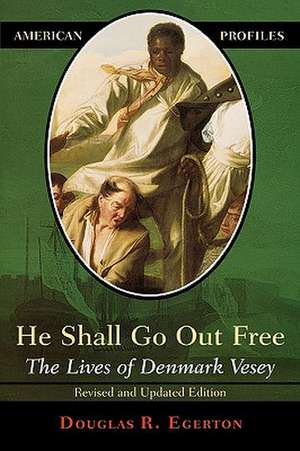
He Shall Go Out Free: The Lives of Denmark Vesey: American Profiles
Autor Douglas R. Egertonen Limba Engleză Paperback – 10 dec 2004
In this biography of the great rebel leader, Douglas R. Egerton employs a variety of historical sources-church records, court documents, travel accounts, and newspapers from America and Saint Domingue-to recreate the lost world of the mysterious Vesey. The revised and updated edition reflects the most recent scholarship on Vesey, and a new afterword by the author explores the current debate about the existence of the 1822 conspiracy. If Vesey's plot was unique in the annals of slave rebellions in North America, it was because he was unique; his goals, as well as the methods he chose to achieve them, were the product of a hard life's experience.


Preț: 265.53 lei
Preț vechi: 351.37 lei
-24%
Puncte Express: 398
Carte tipărită la comandă
Livrare economică 07-21 iulie
Specificații
ISBN-13: 9780742542235
ISBN-10: 0742542238
Pagini: 296
Dimensiuni: 150 x 228 x 17 mm
Greutate: 0.39 kg
Ediția:Revised
Editura: Bloomsbury Publishing
Colecția Rowman & Littlefield
Seria American Profiles
Locul publicării:New York, United States
ISBN-10: 0742542238
Pagini: 296
Dimensiuni: 150 x 228 x 17 mm
Greutate: 0.39 kg
Ediția:Revised
Editura: Bloomsbury Publishing
Colecția Rowman & Littlefield
Seria American Profiles
Locul publicării:New York, United States
Cuprins
Chapter 1: The Book of Telemaque, 1767-1782
Chapter 2: Stranger in a Strange Land, 1783-1793
Chapter 3: Nor a Lender Be, 1794-1799
Chapter 4: Freedom, 1800-1817
Chapter 5: Building the House of the Lord, 1817-1821
Chapter 6: Exodus, 1821-1822
Chapter 7: Lamentations, May-June 1822
Chapter 8: Judges, June-August 1822
Chapter 9: The Temple Finished, 1822-1865
Appendix 1: The Charleston Hanged
Appendix 2: Denmark Vesey and the Historians
Essay on Sources
Chapter 2: Stranger in a Strange Land, 1783-1793
Chapter 3: Nor a Lender Be, 1794-1799
Chapter 4: Freedom, 1800-1817
Chapter 5: Building the House of the Lord, 1817-1821
Chapter 6: Exodus, 1821-1822
Chapter 7: Lamentations, May-June 1822
Chapter 8: Judges, June-August 1822
Chapter 9: The Temple Finished, 1822-1865
Appendix 1: The Charleston Hanged
Appendix 2: Denmark Vesey and the Historians
Essay on Sources
Recenzii
This is an extraordinary work, the product of probing research and fluent writing. Despite the sparse written record, Vesey's 'lives' as emigrant, slave, and freeman are sketched with vitality and understanding. The twenty-first century needs this readable reminder of an inspiring man and a significant event.
The riveting story of Denmark Vesey and his comrades allows Egerton to explore expertly both the brutality and the limits of white planters' rule. This study is a rich reminder of the centrality of movement and revolt in the history of the emancipation of U.S. slaves.
A fine biography that sheds light on an important but often misunderstood conspiracy. Together with Gabriel's Rebellion, this book establishes Douglas R. Egerton as a leading student of American slave revolts.
An informed and compelling portrait of a Herculean figure in Southern history. Egerton combines careful sleuthing and a biographer's intuition to bring a key American life out of the shadows and place it in a complicated Atlantic setting.
Egerton seeks Vesey in the few records that remain, ranging from newspaper stories to hastily scribbled court transcripts, in uncommon sources from the Carolinas to Haiti. He finds that Vesey was a complicated man whose freed status and eloquence in several languages did not seem to matter, whose frustration with white society, white religion, and white power led him to organize a revolt that consisted of slaves simply walking away from it all. Egerton includes very useful essays on his sources and on Vesey's treatment by historians.
Egerton writes in a clear, engaging style; his work is fully documented and reflects a solid grasp of scholarship on slavery and slave revolts.
The riveting story of Denmark Vesey and his comrades allows Egerton to explore expertly both the brutality and the limits of white planters' rule. This study is a rich reminder of the centrality of movement and revolt in the history of the emancipation of U.S. slaves.
A fine biography that sheds light on an important but often misunderstood conspiracy. Together with Gabriel's Rebellion, this book establishes Douglas R. Egerton as a leading student of American slave revolts.
An informed and compelling portrait of a Herculean figure in Southern history. Egerton combines careful sleuthing and a biographer's intuition to bring a key American life out of the shadows and place it in a complicated Atlantic setting.
Egerton seeks Vesey in the few records that remain, ranging from newspaper stories to hastily scribbled court transcripts, in uncommon sources from the Carolinas to Haiti. He finds that Vesey was a complicated man whose freed status and eloquence in several languages did not seem to matter, whose frustration with white society, white religion, and white power led him to organize a revolt that consisted of slaves simply walking away from it all. Egerton includes very useful essays on his sources and on Vesey's treatment by historians.
Egerton writes in a clear, engaging style; his work is fully documented and reflects a solid grasp of scholarship on slavery and slave revolts.