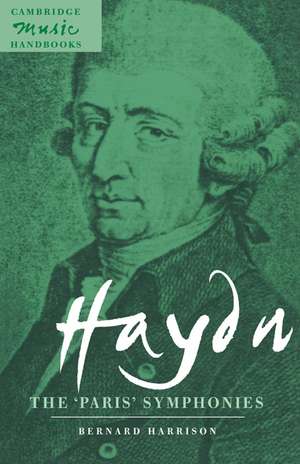
Haydn
Autor Bernard Harrison, Harrison Bernard Editat de Julian Rushtonen Limba Engleză Paperback – 26 mai 2009
Preț: 103.43 lei
Puncte Express: 155
Carte disponibilă
Livrare economică 05-19 noiembrie
Livrare prin curier în România Termenul estimat este afișat lângă disponibilitate.
Transport gratuit de la 400.00 lei Plată online sau ramburs, în funcție de opțiunile comenzii.
Retur gratuit în 14 zile Comandă securizată și suport în română.
Specificații
ISBN-13: 9780521477437
ISBN-10: 0521477433
Pagini: 136
Ilustrații: 9 tables 17 music examples
Dimensiuni: 140 x 216 x 8 mm
Greutate: 0.18 kg
Editura: Cambridge University Press
Locul publicării:Cambridge, United Kingdom
ISBN-10: 0521477433
Pagini: 136
Ilustrații: 9 tables 17 music examples
Dimensiuni: 140 x 216 x 8 mm
Greutate: 0.18 kg
Editura: Cambridge University Press
Locul publicării:Cambridge, United Kingdom
V-ar putea interesa
-
 Beethoven and the Creative ProcessBarry Cooper-31%Preț: 557.95 lei808.00 lei
 -
 Haydn and the Enlightenment: The Late Symphonies and their AudienceDavid P. Schroeder-29%Preț: 417.57 lei584.03 lei
 -
 A Companion to Mozart's Piano ConcertosArthur Hutchings-29%Preț: 390.10 lei546.21 lei
 -
 Dance and the Music of J. S. BachMeredith LittlePreț: 237.34 lei
 -
 Preț: 227.94 lei
 -
 Mozart's WomenJane Glover-35%Preț: 78.29 lei120.11 lei
 -
 Preț: 89.72 lei
 -
 Beethoven's HairRussell Martin-28%Preț: 74.44 lei102.92 lei
 -
 The Life of HaydnDavid Wyn JonesPreț: 186.55 lei
 -
 Young People's ConcertsLeonard Bernstein-23%Preț: 190.11 lei247.37 lei
 -
 Verdi: The Operas and Choral WorksVictor Lederer-25%Preț: 180.64 lei239.87 lei
 -
 Classical Music EncyclopediaStanley Sadie-9%Preț: 132.71 lei146.09 lei
 -
 Preț: 203.94 lei
Cuprins
1. Introduction; 2. Haydn's music at the Concert spirituel; 3. Popular taste; 4. Learned taste; 5. Splendour and beauty: Symphonies Nos. 82 and 86; 6. Convention and originality: Symphony No. 85; 7. Irony and humour: Symphony No. 83; 8. The refinement of popular taste: Symphonies Nos. 84 and 87.
Recenzii
'This is an excellent introduction to a wonderful set of symphonies, and a popular vindication of the new direction of Haydn scholarship.' The Times Literary Supplement