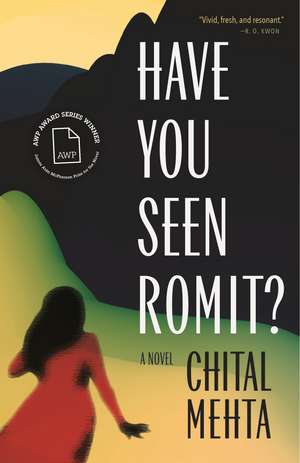
Have You Seen Romit?: A Novel: The James Alan McPherson Prize for the Novel
Autor Chital Mehtaen Limba Engleză Paperback – oct 2026
When twenty-five-year-old Romit, Usha’s adopted son, doesn’t respond to her calls, she has a sinking feeling in her stomach. Her husband, Om, who has never accepted their adopted son, tries to convince her to move on. With time, though, it’s clear Usha is right: Romit has gone missing. When the police fail to help, Usha takes matters into her own hands and discovers that Romit went on a trek into the dangerous forests of Sholai in the state of Andhra Pradesh. Although her husband warns Usha to stay put, she leaves for Bengaluru to find Romit.
On her journey she meets Vijaya, a young, fearless, and opinionated trekker fighting her own demons. Together they embark on a dangerous journey into the dense forests of southern India, coming up against unexpected complications. In Have You Seen Romit? the two women of different generations discover they have more in common than they originally thought, and Usha begins to realize that while she may very well discover what happened to Romit, it will come at a cost. Usha, who has always strived to adhere to the societal norms of Indian society, must question everything she once believed in.


Preț: 130.04 lei
Nou
Puncte Express: 195
Carte disponibilă
Livrare economică 10-24 noiembrie
Livrare prin curier în România Termenul estimat este afișat lângă disponibilitate.
Transport gratuit de la 400.00 lei Plată online sau ramburs, în funcție de opțiunile comenzii.
Retur gratuit în 14 zile Comandă securizată și suport în română.
Specificații
ISBN-13: 9781496248053
ISBN-10: 1496248058
Pagini: 218
Ilustrații: n-a
Dimensiuni: 140 x 216 mm
Greutate: 0.26 kg
Editura: Nebraska
Colecția University of Nebraska Press
Seria The James Alan McPherson Prize for the Novel
Locul publicării:United States
ISBN-10: 1496248058
Pagini: 218
Ilustrații: n-a
Dimensiuni: 140 x 216 mm
Greutate: 0.26 kg
Editura: Nebraska
Colecția University of Nebraska Press
Seria The James Alan McPherson Prize for the Novel
Locul publicării:United States
Notă biografică
Chital Mehta was born and raised in India. Her short stories have appeared in the Pinch, Oyez Review, SLAB magazine, and elsewhere. Her story “Damaged Gifts” won the SLAB fiction contest in 2022. She lives in Delaware with her husband and children. Visit her website at chitalmehtajey.com.
Extras
1
Coimbatore, 2018
When Om complains about Romit’s lack of response to his calls, Usha wants to slap him. In a nice way, near his mouth, off to the right side, where a little hair is growing on his face. But she doesn’t do anything of the sort. They haven’t touched in years.
Three months ago, when Om’s twenty-year-old scooter broke down, they were forced to take a crowded bus after attending a wedding. As they held onto the metal handle of the bus, she remembered the feeling of his warm skin when his hand accidentally grazed hers. Later, when she suggested purchasing a car, Om, who was chewing a mound of pan leaves, spat on the ground. His scooter would live with him until his death, he said, making a smear of pan mix on the side of the road.
“There is nothing to worry about. You know Romit,” she tells him from the kitchen as she drops the greased stainless steel plates into the sink.
She turns the tap on to let the dried bits of food float to the surface to make it easier for Hema, the maid, to clean the plates. When she turns around, Usha loses her balance. She leans on the wall, which is stained with brown-colored oil bubbles.
She enters the hall to find Om pacing in front of the sandalwood-colored sofa, now turned to the color of cha. It doesn’t suit the white-painted walls, but Om never cared for mismatched things. He had picked the sofa on sale for two hundred rupees at an exhibition, refusing to consider the brown sofa with soft cushions and red embroidered covers.
He’d said: “Color combination is a concept created by marketers and businessmen to fool people into buying color-themed furniture. Anyway, why should color matter when it comes to a sofa?”
With his cell phone in hand, he resembles a bored tiger locked inside his cage.
From their marriage of thirty years, Usha has learned this much about him. He can spend his day watching classic Hindi songs on their old Videocon television and simply complain. He can spend hours talking about corruption or politics with people who listen patiently. Usually, they are his workers who help him run his store, Shah Textiles, in the city of Coimbatore. Then there are days when his only complaint is this: she has forgotten to make his favorite dessert—Shrikhand. A sweet dish she makes by beating dehydrated yogurt and sugar with a spoon, topping it with saffron strands and sliced pistachios.
The store keeps him busy most days, but when he finds the time, he likes to talk about their children, who are all grown up. Ashmit, Romit, and Pari are good kids. Not talented like Sarika Patel’s daughter, Jinal, who grew up to become a dentist, or Das’s son, Rakesh, who flew to America right after college. In the free yoga classes she sometimes attends, funded by the Gujarati Samaj, Usha has heard women talk endlessly about Rakesh, who earns two lakh rupees each month just to sit in front of a computer.
Her children earn money. Not big money but enough to keep them happy. Sometimes Romit will ask for money because his job doesn’t pay well. It has become more frequent over the past few months. She keeps reminding Om about giving him time to get what he wants. Om’s frequent complaint is this: Romit doesn’t have a proper job like Ashmit or Pari. A proper job comes with countable money and peace of mind.
“Enough walking. You want to increase your blood pressure again?” she asks as he marches in the hall.
Om isn’t pacing the room because of worry. He loves being a controller like the tv remote, switching channels with the press of a thumb. He believes he holds a string to control people in his life as if they are his puppets. Usha doesn’t mind being a puppet because it keeps the air inside their house peaceful and quiet. It is the purpose of her life as a married woman. To keep her family together. To keep the love contained. A house with a roof, a husband, and three children digging their way through life. What else can a woman like her want? She is more than blessed.
Om clicks his tongue and folds his hands. He is not in a good mood. On the wall above the television, Pari fixed a family frame last summer with a hammer and nails. In one picture the children hug Om tightly around his neck. The children appear much younger in the picture, when all they knew was to stick their tongues out and laugh. Om looks like the kind of father Usha watches in the serials late in the night when sleep won’t come easily. In the serials the fathers are big and hairy. They always wear spectacles and cry often and hug their children more than needed.
“No use in feeling tension about things not in your control. Your pressure will shoot up like a steam engine. Last week Purushottam ji was admitted to the hospital for high blood pressure,” says Usha as she gives him cha in a stainless steel cup.
She crosses her legs and sits on the floor as she takes a sip from her cup. Cha is the magical element in her life. The taste of ginger helps her sit down and forget things momentarily, transporting her on a boat with just kilometers of gray, emptiness, and a cup of cha for company. Cha is her friend, someone she meets twice a day to empty the contents of her mind and become the woman she longs to be—a woman who has nothing to worry about. A woman whose mind isn’t full of chores. It’s the only time she watches the world pass by through the window as the air leaves her chest and nose. Om isn’t good company to enjoy cha. At times, if he is at the store, she’ll call her neighbor Bina so they can gossip over a cup of cha and a plate of Marie biscuits.
When Om brings the cup to his mouth, the steam covers his face like an invisible curtain. “Purushottam ji was admitted because of his alcohol problem. Every day he drinks three bottles. I have seen it with my own eyes. Tell me now?”
“He has a drinking problem. You have tension problems. It’s all the same. Both will increase pressure and cause a heart attack one day. Bina was telling me her uncle got his third attack at fifty-six. He was watching his favorite reality show about singers when he felt something holding his chest. His wife thought it was just a breathing problem. But when they took him to hospital, they said he was gone. These things come without making any noise,” says Usha.
His eyes widen with displeasure. He hasn’t heard anything she said. He’s staring at his phone and clicking his tongue. “You have spoiled this boy. Always holding him to your chest. See now, he is not answering the phone.”
Romit is a slow-burning problem, but there is something else. She is concerned about the blood boiling under Om’s skin. After Ashmit forced them to see the doctor a few months ago, the doctor ran some tests and said his blood pressure levels were not good. They also found diabetes. Since then, she plans his meals with very little salt and sugar, which, according to him, is no fun. Gujaratis love eating sweets at any time of the day. Even their curries and dals contain a hint of jaggery. These days she usually chops an apple or a papaya instead of offering him a milk barfi.
She plans meticulously to keep his brain worry-free. At sixty-four he shouldn’t get worked up about everything. They are members of the Coimbatore Gujarati Samaj, a group of migrants who had moved from Gujarat to South India twenty-five years ago. On Sunday evenings they play Hindi movies on a projector in a park, chairs arranged under the shade of a thin sheet of asbestos. They watch classic movies from the eighties such as Silsila and Sadma.
Om sits through the movies without a complaint or a laugh. Later, when they announce in the WhatsApp group that the movie Baazigar is in queue for next week, Om doesn’t say no. He simply nods when she suggests they watch the movie to pass some time.
Again, it’s time to distract his brain. She must get him out on the road.
“Shall we walk?” she says, rubbing a hand over her large abdomen.
Usha pictures bubbles of oil and ghee floating in her stomach with digestive juices underneath. Their lunch is never simple. Om prefers a full course meal for afternoons, which means she is usually making rotis, okra or potato curry, white rice, lentil gravy with a bowl of creamy homemade curd. When cravings turn intense, he’ll ignore his sugar problem and demand a cup of cold mango lassi or rice pudding.
He considers her offer as he rests his chin on the back of his hand, his little finger scratching the surface of his cheek. It usually means he wants to lie down for a nap. But he surprises her by shaking his head.
“One minute,” he says as he removes his cell phone from its charging port.
He places the device in his chest pocket, before quickly removing it and slipping it inside his pants pocket. Someone had once told him that placing a cell phone near the chest could increase the chances of developing a tumor. Om pays close attention to health warnings and keeps them, with red labels, in all the corners of his head.
Coimbatore, 2018
When Om complains about Romit’s lack of response to his calls, Usha wants to slap him. In a nice way, near his mouth, off to the right side, where a little hair is growing on his face. But she doesn’t do anything of the sort. They haven’t touched in years.
Three months ago, when Om’s twenty-year-old scooter broke down, they were forced to take a crowded bus after attending a wedding. As they held onto the metal handle of the bus, she remembered the feeling of his warm skin when his hand accidentally grazed hers. Later, when she suggested purchasing a car, Om, who was chewing a mound of pan leaves, spat on the ground. His scooter would live with him until his death, he said, making a smear of pan mix on the side of the road.
“There is nothing to worry about. You know Romit,” she tells him from the kitchen as she drops the greased stainless steel plates into the sink.
She turns the tap on to let the dried bits of food float to the surface to make it easier for Hema, the maid, to clean the plates. When she turns around, Usha loses her balance. She leans on the wall, which is stained with brown-colored oil bubbles.
She enters the hall to find Om pacing in front of the sandalwood-colored sofa, now turned to the color of cha. It doesn’t suit the white-painted walls, but Om never cared for mismatched things. He had picked the sofa on sale for two hundred rupees at an exhibition, refusing to consider the brown sofa with soft cushions and red embroidered covers.
He’d said: “Color combination is a concept created by marketers and businessmen to fool people into buying color-themed furniture. Anyway, why should color matter when it comes to a sofa?”
With his cell phone in hand, he resembles a bored tiger locked inside his cage.
From their marriage of thirty years, Usha has learned this much about him. He can spend his day watching classic Hindi songs on their old Videocon television and simply complain. He can spend hours talking about corruption or politics with people who listen patiently. Usually, they are his workers who help him run his store, Shah Textiles, in the city of Coimbatore. Then there are days when his only complaint is this: she has forgotten to make his favorite dessert—Shrikhand. A sweet dish she makes by beating dehydrated yogurt and sugar with a spoon, topping it with saffron strands and sliced pistachios.
The store keeps him busy most days, but when he finds the time, he likes to talk about their children, who are all grown up. Ashmit, Romit, and Pari are good kids. Not talented like Sarika Patel’s daughter, Jinal, who grew up to become a dentist, or Das’s son, Rakesh, who flew to America right after college. In the free yoga classes she sometimes attends, funded by the Gujarati Samaj, Usha has heard women talk endlessly about Rakesh, who earns two lakh rupees each month just to sit in front of a computer.
Her children earn money. Not big money but enough to keep them happy. Sometimes Romit will ask for money because his job doesn’t pay well. It has become more frequent over the past few months. She keeps reminding Om about giving him time to get what he wants. Om’s frequent complaint is this: Romit doesn’t have a proper job like Ashmit or Pari. A proper job comes with countable money and peace of mind.
“Enough walking. You want to increase your blood pressure again?” she asks as he marches in the hall.
Om isn’t pacing the room because of worry. He loves being a controller like the tv remote, switching channels with the press of a thumb. He believes he holds a string to control people in his life as if they are his puppets. Usha doesn’t mind being a puppet because it keeps the air inside their house peaceful and quiet. It is the purpose of her life as a married woman. To keep her family together. To keep the love contained. A house with a roof, a husband, and three children digging their way through life. What else can a woman like her want? She is more than blessed.
Om clicks his tongue and folds his hands. He is not in a good mood. On the wall above the television, Pari fixed a family frame last summer with a hammer and nails. In one picture the children hug Om tightly around his neck. The children appear much younger in the picture, when all they knew was to stick their tongues out and laugh. Om looks like the kind of father Usha watches in the serials late in the night when sleep won’t come easily. In the serials the fathers are big and hairy. They always wear spectacles and cry often and hug their children more than needed.
“No use in feeling tension about things not in your control. Your pressure will shoot up like a steam engine. Last week Purushottam ji was admitted to the hospital for high blood pressure,” says Usha as she gives him cha in a stainless steel cup.
She crosses her legs and sits on the floor as she takes a sip from her cup. Cha is the magical element in her life. The taste of ginger helps her sit down and forget things momentarily, transporting her on a boat with just kilometers of gray, emptiness, and a cup of cha for company. Cha is her friend, someone she meets twice a day to empty the contents of her mind and become the woman she longs to be—a woman who has nothing to worry about. A woman whose mind isn’t full of chores. It’s the only time she watches the world pass by through the window as the air leaves her chest and nose. Om isn’t good company to enjoy cha. At times, if he is at the store, she’ll call her neighbor Bina so they can gossip over a cup of cha and a plate of Marie biscuits.
When Om brings the cup to his mouth, the steam covers his face like an invisible curtain. “Purushottam ji was admitted because of his alcohol problem. Every day he drinks three bottles. I have seen it with my own eyes. Tell me now?”
“He has a drinking problem. You have tension problems. It’s all the same. Both will increase pressure and cause a heart attack one day. Bina was telling me her uncle got his third attack at fifty-six. He was watching his favorite reality show about singers when he felt something holding his chest. His wife thought it was just a breathing problem. But when they took him to hospital, they said he was gone. These things come without making any noise,” says Usha.
His eyes widen with displeasure. He hasn’t heard anything she said. He’s staring at his phone and clicking his tongue. “You have spoiled this boy. Always holding him to your chest. See now, he is not answering the phone.”
Romit is a slow-burning problem, but there is something else. She is concerned about the blood boiling under Om’s skin. After Ashmit forced them to see the doctor a few months ago, the doctor ran some tests and said his blood pressure levels were not good. They also found diabetes. Since then, she plans his meals with very little salt and sugar, which, according to him, is no fun. Gujaratis love eating sweets at any time of the day. Even their curries and dals contain a hint of jaggery. These days she usually chops an apple or a papaya instead of offering him a milk barfi.
She plans meticulously to keep his brain worry-free. At sixty-four he shouldn’t get worked up about everything. They are members of the Coimbatore Gujarati Samaj, a group of migrants who had moved from Gujarat to South India twenty-five years ago. On Sunday evenings they play Hindi movies on a projector in a park, chairs arranged under the shade of a thin sheet of asbestos. They watch classic movies from the eighties such as Silsila and Sadma.
Om sits through the movies without a complaint or a laugh. Later, when they announce in the WhatsApp group that the movie Baazigar is in queue for next week, Om doesn’t say no. He simply nods when she suggests they watch the movie to pass some time.
Again, it’s time to distract his brain. She must get him out on the road.
“Shall we walk?” she says, rubbing a hand over her large abdomen.
Usha pictures bubbles of oil and ghee floating in her stomach with digestive juices underneath. Their lunch is never simple. Om prefers a full course meal for afternoons, which means she is usually making rotis, okra or potato curry, white rice, lentil gravy with a bowl of creamy homemade curd. When cravings turn intense, he’ll ignore his sugar problem and demand a cup of cold mango lassi or rice pudding.
He considers her offer as he rests his chin on the back of his hand, his little finger scratching the surface of his cheek. It usually means he wants to lie down for a nap. But he surprises her by shaking his head.
“One minute,” he says as he removes his cell phone from its charging port.
He places the device in his chest pocket, before quickly removing it and slipping it inside his pants pocket. Someone had once told him that placing a cell phone near the chest could increase the chances of developing a tumor. Om pays close attention to health warnings and keeps them, with red labels, in all the corners of his head.
Recenzii
“A gripping, intensely moving portrayal of a woman whose ferocious love for her children ends up clashing with how others expect her to behave. I loved spending time with the rule-breaking Usha and with the complicated world Chital Mehta has conjured. Vivid, fresh, and resonant.”—R. O. Kwon, author of Exhibit and The Incendiaries
“Chital Mehta delivers a tender, layered portrait of an Indian family on the brink of unraveling. When their son vanishes without a trace, a mother’s quiet endurance and a father’s relentless pride collide in a search that exposes love, loss, and the unspoken tensions between generations. With warmth, humor, and keen emotional insight, Mehta explores what it means to hold on—and what it takes to finally let go. Lyrical and deeply human, Mehta has arrived as an empathetic and observant voice.”—Kali White VanBaale, author of The Monsters We Make
“A stirring and deeply introspective meditation on family, gender, and maternal love. Chital Mehta writes her characters’ lives with such humanity and care; to read this novel is to be invited into their world, to hurt for them as they falter and fall short, and to wish—at the final page—that you could have just a little more time with them.”—Sheila Sundar, author of Habitations
“At once the story of a disappearance and a meditation on belonging, Chital Mehta’s novel asks what it means to lose someone you love—not only to the shadows of a city, but also to the distances within a family. With prose that lingers on textures of everyday life, Mehta renders the heartbreak and resilience of ordinary people caught between duty, desire, and the silences that shape them.”—Jai Chakrabarti, author of A Small Sacrifice for an Enormous Happiness
“What’s more terrifying than the wilderness of a woman’s unspoken wants and needs and what happens when she finds the perfect mystery, a missing son, to finally reveal what she is made of and why? Have You Seen Romit? is a ferocious novel that explores the hidden fragmentations of self, family, and societies bonded by obedience and fear. Sinuously surprising and timely, this is a book for readers seeking the intimacy, interiority, and soulfulness that makes fiction important to maintaining the reality of our psyches.”—N. Jooyoun Kim, New York Times best-selling author of The Last Story of Mina Lee and What We Kept to Ourselves
“At once universal and deeply evocative of its southern Indian settings, Chital Mehta’s debut novel interrogates our basic assumptions around inherited and chosen family. In this keenly observed and unflinching portrait of a family under duress, nothing is simple as we uncover uncomfortable truths about each flawed character in turn. Through prose both spare and intricate, Mehta navigates questions of gender, loss, belonging, and motherhood with striking tenderness and complexity.”—Roohi Choudhry, author of Outside Women
“Chital Mehta’s Have You Seen Romit? is a Waiting for Godot for our world; economically pitiless, rancorously divided by ethnicity, and always teetering on the knife’s edge of the fallout from natural disasters. What Mehta shows in this lively, often amusing novel is that one person’s true love for another is enough to carry us home.”—Tony D’Souza, author of Whiteman and The Konkans
“Chital Mehta’s novel Have You Seen Romit? excavates what it means to be a family in a searing portrait of one woman’s fierce struggle to find and save her son in a troubled, divided world. Mehta has written a moving and harrowing novel that will stay with me.”—Reena Shah, author of Every Happiness
“Chital Mehta delivers a tender, layered portrait of an Indian family on the brink of unraveling. When their son vanishes without a trace, a mother’s quiet endurance and a father’s relentless pride collide in a search that exposes love, loss, and the unspoken tensions between generations. With warmth, humor, and keen emotional insight, Mehta explores what it means to hold on—and what it takes to finally let go. Lyrical and deeply human, Mehta has arrived as an empathetic and observant voice.”—Kali White VanBaale, author of The Monsters We Make
“A stirring and deeply introspective meditation on family, gender, and maternal love. Chital Mehta writes her characters’ lives with such humanity and care; to read this novel is to be invited into their world, to hurt for them as they falter and fall short, and to wish—at the final page—that you could have just a little more time with them.”—Sheila Sundar, author of Habitations
“At once the story of a disappearance and a meditation on belonging, Chital Mehta’s novel asks what it means to lose someone you love—not only to the shadows of a city, but also to the distances within a family. With prose that lingers on textures of everyday life, Mehta renders the heartbreak and resilience of ordinary people caught between duty, desire, and the silences that shape them.”—Jai Chakrabarti, author of A Small Sacrifice for an Enormous Happiness
“What’s more terrifying than the wilderness of a woman’s unspoken wants and needs and what happens when she finds the perfect mystery, a missing son, to finally reveal what she is made of and why? Have You Seen Romit? is a ferocious novel that explores the hidden fragmentations of self, family, and societies bonded by obedience and fear. Sinuously surprising and timely, this is a book for readers seeking the intimacy, interiority, and soulfulness that makes fiction important to maintaining the reality of our psyches.”—N. Jooyoun Kim, New York Times best-selling author of The Last Story of Mina Lee and What We Kept to Ourselves
“At once universal and deeply evocative of its southern Indian settings, Chital Mehta’s debut novel interrogates our basic assumptions around inherited and chosen family. In this keenly observed and unflinching portrait of a family under duress, nothing is simple as we uncover uncomfortable truths about each flawed character in turn. Through prose both spare and intricate, Mehta navigates questions of gender, loss, belonging, and motherhood with striking tenderness and complexity.”—Roohi Choudhry, author of Outside Women
“Chital Mehta’s Have You Seen Romit? is a Waiting for Godot for our world; economically pitiless, rancorously divided by ethnicity, and always teetering on the knife’s edge of the fallout from natural disasters. What Mehta shows in this lively, often amusing novel is that one person’s true love for another is enough to carry us home.”—Tony D’Souza, author of Whiteman and The Konkans
“Chital Mehta’s novel Have You Seen Romit? excavates what it means to be a family in a searing portrait of one woman’s fierce struggle to find and save her son in a troubled, divided world. Mehta has written a moving and harrowing novel that will stay with me.”—Reena Shah, author of Every Happiness
Descriere
A story about Usha, a middle-aged mother, who sets out on a harrowing journey to find her missing son in the dense forests of southern India.