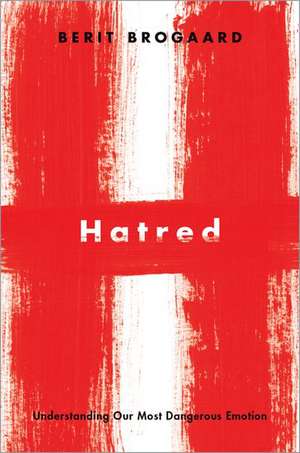
Hatred: Understanding Our Most Dangerous Emotion
Autor Berit Brogaarden Limba Engleză Hardback – 28 ian 2021
În volumul Hatred, descoperim o analiză riguroasă a uneia dintre cele mai complexe și distructive emoții umane, abordată nu doar ca fenomen social, ci ca obiect de studiu în filozofia minții și neuroștiințe. Aplicabilitatea practică a acestui studiu rezidă în capacitatea sa de a descifra mecanismele prin care prejudecățile implicite declanșează ura colectivă, oferind instrumente conceptuale pentru a înțelege tensiunile politice și sociale contemporane. Apreciem modul în care Berit Brogaard depășește dihotomia simplistă iubire-ură, investigând dacă această emoție poate fi, în anumite circumstanțe, un răspuns moral justificat, similar furiei.
Din punct de vedere structural, Hatred completează perspectiva oferită de The Moral Psychology of Hate de Noell Birondo, adăugând o dimensiune experimentală și neurologică esențială, pe care lucrările pur teoretice o omit adesea. În timp ce volumul lui Noell Birondo se concentrează pe o abordare sistematică a eseurilor academice, Berit Brogaard utilizează exemple din cultura populară și literatură pentru a face accesibile concepte precum „identitatea de ancorare” sau „dezumanizarea”.
Poziționăm această lucrare ca un punct de cotitură în opera autoarei. Dacă în On Romantic Love Berit Brogaard explora raționalitatea iubirii, în Hatred ea aplică aceeași rigoare analitică pentru a vedea dacă putem „urî mai bine” sau mai critic. Reținem că această tranziție de la studiul percepției pure, prezent în Seeing and Saying, către studiul emoțiilor morale, consolidează reputația autoarei de a integra neuroștiința în dezbaterile filozofice fundamentale. Este o lectură densă, dar fluidă, care transformă o stare afectivă viscerală într-un subiect de reflecție etică și științifică.
Preț: 176.86 lei
Preț vechi: 212.41 lei
-17%
Carte disponibilă
Livrare economică 09-15 iulie
Livrare express 23-27 iunie pentru 66.100 lei
Specificații
ISBN-10: 0190084448
Pagini: 432
Dimensiuni: 180 x 137 x 41 mm
Greutate: 0.5 kg
Editura: Oxford University Press
Colecția OUP USA
Locul publicării:New York, United States
V-ar putea interesa
-
 Skin in the GameNassim Nicholas TalebPreț: 91.67 lei
 -
 The Oxford Handbook of Parenting and Moral DevelopmentDeborah J. Laible-37%Preț: 717.40 lei1130.09 lei
 -
 -20%Preț: 265.26 lei332.09 lei
 -
 -25%Preț: 139.38 lei185.83 lei
 -
 Action and InteractionShaun GallagherPreț: 314.39 lei
 -
 The Oxford Handbook of the History of PhysicsJed Z. Buchwald-36%Preț: 1025.84 lei1607.07 lei
 -
 The Better HalfSharon MoalemPreț: 137.04 lei
 -
 Preț: 445.09 lei
 -
 History Mathematics 3eCarl B. BoyerPreț: 259.00 lei
 -
 War by Other MeansRobert D. BlackwillPreț: 132.02 lei
 -
 For a New WestKarl PolanyiPreț: 187.31 lei
 -
 Ludwig von Mises: The Man and His EconomicsIsrael M. Kirzner-13%Preț: 67.14 lei77.44 lei
 -
 Invisible ArmiesMax BootPreț: 152.26 lei
 -
 Cognitive ScienceJosé Luis BermúdezPreț: 414.04 lei
 -
 The Cambridge Companion to LiberalismSteven WallPreț: 292.67 lei
 -
 Introducing PalaeontologyPatrick Wyse JacksonPreț: 194.48 lei
 -
 -20%Preț: 73.69 lei92.27 lei
 -
 Structuring the SelfMajid Davoody Beni-15%Preț: 510.59 lei600.70 lei
De ce să citești această carte
Recomandăm această carte celor interesați de psihologie morală și științe cognitive care doresc să înțeleagă rădăcinile biologice și filozofice ale ostilității. Cititorul câștigă o perspectivă nuanțată asupra modului în care ura ne modelează identitatea și societatea. Este un ghid esențial pentru a înțelege cum funcționează mintea umană în condiții de conflict, oferind claritate într-o epocă marcată de polarizare extremă.
Despre autor
Berit Brogaard (născută în 1970) este un filozof danez-american de renume, specializat în neuroștiințe cognitive, filozofia minții și a limbajului. În prezent, ocupă funcția de profesor de filozofie și conduce un laborator dedicat cercetării percepției la Universitatea din Miami. Expertiza sa vastă, ce include studii despre sinestezie și sindromul savantului, îi permite să abordeze teme abstracte precum ura sau iubirea printr-o lentilă interdisciplinară unică. A fost, de asemenea, co-editor al prestigiosului Philosophical Gourmet Report, fiind o voce autoritară în mediul academic internațional.
Descriere
Recenzii
In this important and timely work, Berit Brogaard takes on an profoundly important topic that has been surprisingly neglected by other philosophers: the psychology of hatred. Brogaard's artful exploration of the ways our animosities shape our lives is at once deeply disturbing and profoundly engaging; the reader who follows her to journey's end will be rewarded with a deepened understanding of what is it is be human, and how we all might be human better. Hatred is a remarkably substantial, sophisticated, and spirited contribution to public philosophy, and I wish we had lot more philosophy like it.
Hate turns into a wonderfully fertile source of serious thinking in Berit Brogaard's hands. When it is morally defensible to hate? When is it dehumanizing? If how and what we hate defines us, here is a timely and thoughtful manual on how to hate better and more critically.