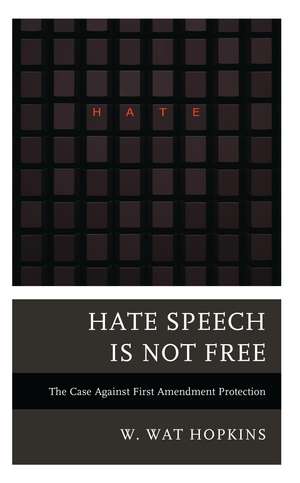
Hate Speech Is Not Free: The Case Against First Amendment Protection
Autor W. Wat Hopkinsen Limba Engleză Hardback – 7 feb 2024
Methods to protect individuals and groups from hate speech have eluded lawmakers as the call for restrictions or bans on such speech are confronted by claims of First Amendment protection. Problematic speech, the argument goes, should be confronted by more speech rather than by restriction.
Debate over the extent of First Amendment protection is based on two bodies of law-the practical, precedent determined by the Supreme Court, and the theoretical framework of First Amendment jurisprudence. In this book, W. Wat Hopkins argues that the prevailing thought that hate is protected by both case law and theory is incorrect.
Within the Supreme Court's established hierarchy of speech protection, hate speech falls to the lowest level, deserving no protection as it does not advance ideas containing social value. Ultimately, the Supreme Court's cases addressing protected and unprotected speech set forth a clear rationale for excommunicating hate speech from First Amendment protection.
Preț: 501.95 lei
Preț vechi: 733.23 lei
-32%
Puncte Express: 753
Carte tipărită la comandă
Livrare economică 02-16 decembrie
Livrare prin curier în România Termenul estimat este afișat lângă disponibilitate.
Transport gratuit pentru acest produs Plată online sau ramburs, în funcție de opțiunile comenzii.
Retur gratuit în 14 zile Comandă securizată și suport în română.
Specificații
ISBN-13: 9781538165614
ISBN-10: 1538165619
Pagini: 154
Dimensiuni: 152 x 232 x 16 mm
Greutate: 0.4 kg
Editura: Bloomsbury Publishing
Colecția Rowman & Littlefield
Locul publicării:New York, United States
ISBN-10: 1538165619
Pagini: 154
Dimensiuni: 152 x 232 x 16 mm
Greutate: 0.4 kg
Editura: Bloomsbury Publishing
Colecția Rowman & Littlefield
Locul publicării:New York, United States
Cuprins
Preface
1. Hate Speech and the "No Law" Conundrum
2. The Scope of Hate Speech
3. Speech Protection from Chaplinsky to Alvarez
4. Professor Meiklejohn, Justice Brennan and Absolute First Amendment Protection
5. The Idea of Hate Speech
6. The Idea of Hate Speech Redux
Bibliography
Case Index
Subject Index
About the Author
1. Hate Speech and the "No Law" Conundrum
2. The Scope of Hate Speech
3. Speech Protection from Chaplinsky to Alvarez
4. Professor Meiklejohn, Justice Brennan and Absolute First Amendment Protection
5. The Idea of Hate Speech
6. The Idea of Hate Speech Redux
Bibliography
Case Index
Subject Index
About the Author
Recenzii
The strength of Hopkins's slim new book lies not so much in what one might learn about hate speech-although that is ostensibly the book's subject-but in the Supreme Court's muddled First Amendment jurisprudence. Hopkins's most interesting and important contribution is his explication of the Meiklejohn-Brennan (and maybe Kalven) collaboration to find the central meaning of the First Amendment for protecting the communication of ideas important to self-governance. Hopkins asserts that the First Amendment does not protect hate speech, however defined, because it contains no such ideas. Hopkins contrasts this theory of the First Amendment with the better-known "marketplace of ideas" concept, in which all speech is presumptively protected, absent a compelling reason to the contrary, and allowed to compete for acceptance. It is that theory, albeit inconsistently applied, that permits hate speech to thrive. Noting that the Supreme Court has never faced a hate speech case that it could not resolve by avoiding the issue-whether hate speech should be expelled from the First Amendment umbrella-Hopkins concludes on a hopeful note that a new court with a new issue might someday do just that. Recommended. Graduate students, faculty, and professionals.
An in-depth critique of hate speech and its proper place within First Amendment law and 21st century America is sorely needed. In this book, Wat Hopkins tackles the challenge with intellect and passion, offering compelling arguments and conclusions that significantly contribute to the debate on this vitality important issue.
Grounding his timely work in judicial opinions, academic scholarship and free-speech theory, Hopkins makes an engaging, well-researched and compelling argument why First Amendment protection for hate speech is wrongheaded. As he crisply encapsulates it, such destructive expression 'is harmful, without value, and does not constitute ideas for First Amendment purposes.'
Hate Speech is Not Free Speech contributes mightily to the nation's ongoing conversation about the boundaries of freedom of expression.Wat Hopkins draws from his extensive experience in First Amendment scholarship to provide a historically grounded and thoughtful argument for why we should rethink First Amendment safeguards for hate speech.
What a lucid and compelling clarion call to the US Supreme Court: Unprotect hate speech. Hopkins' book couldn't be more timely and relevant in the Internet 21st century. It cogently clarifies why and how hate speech has no place in First Amendment law. Hopkins' incisive analysis of key caselaw and free speech theories is a scholarly tour de force.
An in-depth critique of hate speech and its proper place within First Amendment law and 21st century America is sorely needed. In this book, Wat Hopkins tackles the challenge with intellect and passion, offering compelling arguments and conclusions that significantly contribute to the debate on this vitality important issue.
Grounding his timely work in judicial opinions, academic scholarship and free-speech theory, Hopkins makes an engaging, well-researched and compelling argument why First Amendment protection for hate speech is wrongheaded. As he crisply encapsulates it, such destructive expression 'is harmful, without value, and does not constitute ideas for First Amendment purposes.'
Hate Speech is Not Free Speech contributes mightily to the nation's ongoing conversation about the boundaries of freedom of expression.Wat Hopkins draws from his extensive experience in First Amendment scholarship to provide a historically grounded and thoughtful argument for why we should rethink First Amendment safeguards for hate speech.
What a lucid and compelling clarion call to the US Supreme Court: Unprotect hate speech. Hopkins' book couldn't be more timely and relevant in the Internet 21st century. It cogently clarifies why and how hate speech has no place in First Amendment law. Hopkins' incisive analysis of key caselaw and free speech theories is a scholarly tour de force.