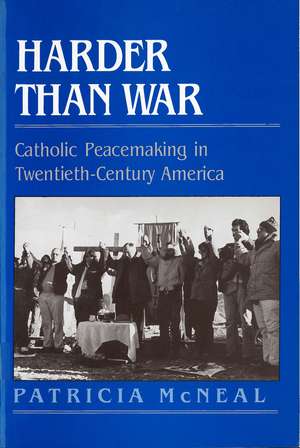
Harder than War: Catholic Peacemaking in Twentieth-Century America
Autor Patricia F. McNealen Limba Engleză Paperback – 31 ian 1992 – vârsta ani
McNeal
begins
with
the
first
official
Catholic
peace
organization
in
the
United
States,
the
Catholic
Association
for
International
Peace,
founded
in
1927.
An
elitist
lay
organization
supported
by
the
church
hierarchy,
the
CAIP
based
their
opposition
to
war
on
the
"just
war"
doctrine.
With
the
emergence
of
pacifism
among
American
Catholics
in
1930s,
Dorothy
Day,
co-founder
of
the
Catholic
Peace
movement,
added
to
the
Catholic
theological
agenda
the
concepts
of
pacifism,
conscientious
objection,
and
nuclear
pacifism.
Dorothy
Day
and
the
Catholic
Worker
movement
became
the
midwife
in
the
formation
of
other
Catholic
peace
organizations
such
as
PAX,
the
Catholic
Peace
Fellowship,
and
PAX
Christi-USA
during
the
Vietnam
War.
Members
of
these
groups
cooperated
with
the
broader
peace
movement
in
the
United
States.
Their
main
focus
became
opposition
to
nuclear
warfare
and
nuclear
weapons.
During the Viet Nam War, Catholic Workers burned their draft cards and turned from nonviolence to resistance by practicing civil disobedience. Daniel and Philip Berrigan escalated that resistance when they destroyed draft files, and symbolically poured blood over and hammered nuclear weapons to awaken the national conscience to the life-ending effects of nuclear warfare.
McNeal
concludes
that
Catholic
peacemakers
had
the
greatest
impact
not
on
the
government
but
on
the
institutional
church.
In
1971
the
American
hierarchy
judged
that
the
Vietnam
War
was
not
a
"just
war."
For
the
first
time
in
the
United
States,
and
possibly
in
history,
a
national
hierarchy
announced
as
unjust
a
war
being
waged
by
its
own
nation.
Preț: 249.81 lei
Puncte Express: 375
Preț estimativ în valută:
44.23€ • 51.50$ • 38.42£
44.23€ • 51.50$ • 38.42£
Carte disponibilă
Livrare economică 03-17 februarie
Livrare express 20-24 ianuarie pentru 29.35 lei
Preluare comenzi: 021 569.72.76
Specificații
ISBN-13: 9780813517407
ISBN-10: 0813517400
Pagini: 344
Dimensiuni: 152 x 229 x 25 mm
Greutate: 0.41 kg
Ediția:None
Editura: Rutgers University Press
Colecția Rutgers University Press
ISBN-10: 0813517400
Pagini: 344
Dimensiuni: 152 x 229 x 25 mm
Greutate: 0.41 kg
Ediția:None
Editura: Rutgers University Press
Colecția Rutgers University Press
V-ar putea interesa
-
 The Second Vatican Council on Other ReligionsGerald O'Collins, SJ-11%Preț: 198.80 lei223.44 lei
 -
 The American Catholic Revolution: How the Sixties Changed the Church ForeverMark S. Massa, S.J.Preț: 180.01 lei
 -
 -24%Preț: 672.18 lei886.62 lei
 -
 Preț: 264.18 lei
 -
 God Gave Us the RightChristel ManningPreț: 268.99 lei
 -
 Into Africa: A Transnational History of Catholic Medical Missions and Social ChangeProfessor Barbra Mann Wall-5%Preț: 502.96 lei529.44 lei
 -
 The Church of Mercy: A Vision for the ChurchPope FrancisPreț: 88.11 lei
 -
 The Glories of MaryLiguoriPreț: 199.26 lei
 -
 The Great FacadeChristopher A. FerraraPreț: 186.67 lei
Recenzii
"More
than
a
history
of
a
movement,
this
book
tells
the
stories
of
some
of
those
men
and
women
in
the
Catholic
community
who
have
helped
bring
the
U.S.
church
into
a
highly
visible
role
of
peacemaking."
"McNeal
narrates
the
tortuous
search
for
a
Catholic
approach
to
peace....
This
is
an
original
and
comprehensive
history...
[it]
belongs
in
every
library
on
peace
movement
history
and
Catholic
social
thought."
"A
valuable
and
highly
significant
work.
It
is
the
definitive
account
of
the
growth
of
pacifism...
among
American
Catholics
and
of
the
impact
of
the
peace
movement
on
the
Roman
Catholic
church
in
the
United
States
in
the
twentieth
century."
"McNeal
demonstrates
a
broad
understanding
of
contemporary
Roman
Catholicism
and
of
the
historical
context
of
its
development....
This
is
an
impressive
book."
Descriere
Patricia
McNeal's
comprehensive
study
of
American
Catholic
peacemaking
in
the
twentieth
century
documents
the
growth
of
pacifism
and
nonviolence
within
the
American
Catholic
community,
and
assesses
its
impact
on
the
church
and
the
nation.
During the Viet Nam War, Catholic Workers burned their draft cards and turned from nonviolence to resistance by practicing civil disobedience. Daniel and Philip Berrigan escalated that resistance when they destroyed draft files, and symbolically poured blood over and hammered nuclear weapons to awaken the national conscience to the life-ending effects of nuclear warfare.
McNeal
begins
with
the
first
official
Catholic
peace
organization
in
the
United
States,
the
Catholic
Association
for
International
Peace,
founded
in
1927.
An
elitist
lay
organization
supported
by
the
church
hierarchy,
the
CAIP
based
their
opposition
to
war
on
the
"just
war"
doctrine.
With
the
emergence
of
pacifism
among
American
Catholics
in
1930s,
Dorothy
Day,
co-founder
of
the
Catholic
Peace
movement,
added
to
the
Catholic
theological
agenda
the
concepts
of
pacifism,
conscientious
objection,
and
nuclear
pacifism.
Dorothy
Day
and
the
Catholic
Worker
movement
became
the
midwife
in
the
formation
of
other
Catholic
peace
organizations
such
as
PAX,
the
Catholic
Peace
Fellowship,
and
PAX
Christi-USA
during
the
Vietnam
War.
Members
of
these
groups
cooperated
with
the
broader
peace
movement
in
the
United
States.
Their
main
focus
became
opposition
to
nuclear
warfare
and
nuclear
weapons.
During the Viet Nam War, Catholic Workers burned their draft cards and turned from nonviolence to resistance by practicing civil disobedience. Daniel and Philip Berrigan escalated that resistance when they destroyed draft files, and symbolically poured blood over and hammered nuclear weapons to awaken the national conscience to the life-ending effects of nuclear warfare.
McNeal
concludes
that
Catholic
peacemakers
had
the
greatest
impact
not
on
the
government
but
on
the
institutional
church.
In
1971
the
American
hierarchy
judged
that
the
Vietnam
War
was
not
a
"just
war."
For
the
first
time
in
the
United
States,
and
possibly
in
history,
a
national
hierarchy
announced
as
unjust
a
war
being
waged
by
its
own
nation.