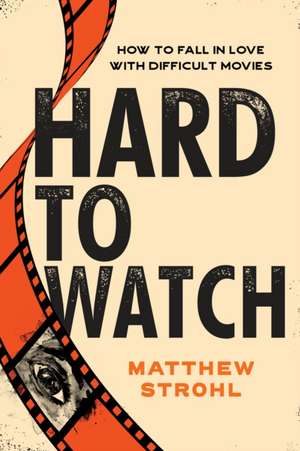
Hard to Watch: How to Fall in Love with Difficult Movies
Autor Matthew Strohlen Limba Engleză Paperback – 15 oct 2024
Yet, despite this embarrassment of riches, most of us gravitate to the popular and familiar, barely scratching the surface of what's available. According to philosopher Matthew Strohl, we're doing ourselves a disservice by overlooking the range of so-called "difficult" movies. Hard to Watch is a joyous celebration of cinema that might seem boring, pretentious, or offensive at first glance but that offers its own distinctive rewards when we give ourselves over to it. Writing with infectious enthusiasm-and a refreshing lack of condescension-Strohl discusses everything from the challenging late works of beloved directors like Terrence Malick and David Lynch to such visionary but divisive films as Alain Resnais's Muriel, or the Time of Return, Chantal Akerman's Jeanne Dielman, 23, Quai du Commerce, 1080 Bruxelles, and Julia Ducournau's Titane, evocatively showing why they're worth the time and effort to engage with, and how to get the most out of them.
Whether you're a film lover looking to step up your game or just someone who's bored with Netflix, Hard to Watch is a brisk and accessible guide to expanding your horizons.
Preț: 105.37 lei
Preț vechi: 110.88 lei
-5%
Puncte Express: 158
Preț estimativ în valută:
18.66€ • 21.79$ • 16.21£
18.66€ • 21.79$ • 16.21£
Carte tipărită la comandă
Livrare economică 21 februarie-07 martie
Livrare express 17-23 ianuarie pentru 137.21 lei
Preluare comenzi: 021 569.72.76
Specificații
ISBN-13: 9781493074341
ISBN-10: 1493074342
Pagini: 218
Ilustrații: 25 BW Photos
Dimensiuni: 152 x 229 x 19 mm
Greutate: 0.37 kg
Editura: Bloomsbury Publishing
Colecția Applause
Locul publicării:New York, United States
ISBN-10: 1493074342
Pagini: 218
Ilustrații: 25 BW Photos
Dimensiuni: 152 x 229 x 19 mm
Greutate: 0.37 kg
Editura: Bloomsbury Publishing
Colecția Applause
Locul publicării:New York, United States
V-ar putea interesa
-
 Preț: 201.29 lei
 -
 Le radici oscure dell'Unione EuropeaMassimo RaviolaPreț: 34.14 lei
 -
 Why It's OK to Love Bad MoviesMatthew StrohlPreț: 194.96 lei
 -
 Preț: 161.87 lei
 -
 -18%Preț: 907.33 lei1106.49 lei
 -
 -18%Preț: 1335.24 lei1628.34 lei
 -
 Cinema: Concept & PracticeEdward Dmytryk-18%Preț: 1015.32 lei1238.19 lei
 -
 Preț: 349.48 lei
 -
 Generation of DreamsAyasha TrippPreț: 94.49 lei
 -
 Preț: 94.05 lei
 -
 Why Are American Feminists So Angry? 100 Good ReasonsNancy Quinn CollinsPreț: 59.54 lei
 -
 Why Are Feminists So Angry? 100 Good ReasonsNancy Quinn CollinsPreț: 59.54 lei
 -
 The Adam Carter SagaMatthew BokPreț: 305.34 lei
 -
 Lillian LorraineNils HansonPreț: 228.59 lei
 -
 Quite Quite Fantastic! The Avengers for Modern ViewersMichael Scott PhillipsPreț: 266.94 lei
 -
 Born To Be BadTimon SinghPreț: 239.80 lei
 -
 Starmaker MachineryMeredith M DayPreț: 121.52 lei
 -
 Great U.K. Drama FilmsScott V. Palmer-8%Preț: 420.97 lei457.58 lei
 -
 Boho DaysJ. CollisPreț: 259.82 lei
 -
 -15%Preț: 679.99 lei799.98 lei
Recenzii
Through an argument couched primarily in ideas about taste and aesthetics-as well as in a plugged-in sense of internet cinephilia, including TikTok trends and Letterboxed social networking-the book has a welcome depth.
Strohl should be celebrated as a writer whose prose is clear, considered, approachable, and chummy. If the weakness of many philosophical texts is how readily they descend into illegibility and casuistry, the bonus of Hard to Watch is how it grounds serious thinking without denuding its complexity.. Hard to Watch is a rewarding read.
Hard to Watch lays out a pragmatic path - directions for how to preserve your time and attention - that will help just about anybody engage with any kind of art thoughtfully and purposefully.
[Hard to Watch] provides a snapshot of the place of art cinema within a mediascape in transition.
Matthew Strohl's Hard to Watch is a guide for the perplexed and a call to act.. Hard to Watch is a cogent reminder that many of life's most profound experience require work on our part-or at least an open mind.
... described as a "guide to expanding your horizons," and the author nicely details the pleasures gained from watching "difficult" cinema. He also reminds us that revisiting movies can be a game-changer: "The last time I watched Jeanne Dielman, I wasn't bored for a second. That was not at all the case the first time I watched it, two decades ago. The movie hasn't changed; I have.
I thought I was already a cinephile, but reading Matt Strohl's lively book taught me how to love the cinema even more.
Hard to Watch is not hard to read. Matthew Strohl offers a passionate, engaging, and utterly convincing case that seemingly difficult films (of all kinds) are worth persevering with and fighting for - for the sake of both the collective, public health and our individual, personal growth. Without snobbery, defensiveness, or fear, Strohl shows the way to love demanding cinema.
As with Strohl's first, excellent work - Why It's Ok To Love Bad Movies - there is real ambition driving this book. He sets out to show us why there's no such thing as a balanced aesthetic diet without difficult art.
[W]hat a timely and engaging book this is, sparking rich discussion with spellbinding examples of superb film criticism
Strohl should be celebrated as a writer whose prose is clear, considered, approachable, and chummy. If the weakness of many philosophical texts is how readily they descend into illegibility and casuistry, the bonus of Hard to Watch is how it grounds serious thinking without denuding its complexity.. Hard to Watch is a rewarding read.
Hard to Watch lays out a pragmatic path - directions for how to preserve your time and attention - that will help just about anybody engage with any kind of art thoughtfully and purposefully.
[Hard to Watch] provides a snapshot of the place of art cinema within a mediascape in transition.
Matthew Strohl's Hard to Watch is a guide for the perplexed and a call to act.. Hard to Watch is a cogent reminder that many of life's most profound experience require work on our part-or at least an open mind.
... described as a "guide to expanding your horizons," and the author nicely details the pleasures gained from watching "difficult" cinema. He also reminds us that revisiting movies can be a game-changer: "The last time I watched Jeanne Dielman, I wasn't bored for a second. That was not at all the case the first time I watched it, two decades ago. The movie hasn't changed; I have.
I thought I was already a cinephile, but reading Matt Strohl's lively book taught me how to love the cinema even more.
Hard to Watch is not hard to read. Matthew Strohl offers a passionate, engaging, and utterly convincing case that seemingly difficult films (of all kinds) are worth persevering with and fighting for - for the sake of both the collective, public health and our individual, personal growth. Without snobbery, defensiveness, or fear, Strohl shows the way to love demanding cinema.
As with Strohl's first, excellent work - Why It's Ok To Love Bad Movies - there is real ambition driving this book. He sets out to show us why there's no such thing as a balanced aesthetic diet without difficult art.
[W]hat a timely and engaging book this is, sparking rich discussion with spellbinding examples of superb film criticism