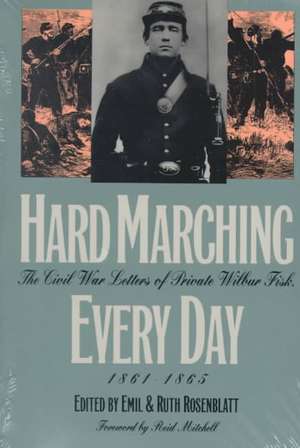
Hard Marching Every Day: The Civil War Letters of Private Wilbur Fisk, 1861-1865: Modern War Studies (Paperback)
Autor Wilbur Fisk Editat de Ruth Rosenblatt, Emil Rosenblatten Limba Engleză Paperback – 30 apr 1992
Studiul istoriografiei Războiului Civil American a evoluat semnificativ, trecând de la analiza strategiilor marilor generali la valorificarea vocilor individuale, autentice, ale soldaților din prima linie. Observăm că Hard Marching Every Day se înscrie perfect în această tendință, oferind o cronică nefiltrată a conflictului prin ochii lui Wilbur Fisk, un învățător din Vermont transformat în infanterist. Spre deosebire de corespondenții de război profesioniști, Fisk scrie din noroiul tranșeelor, descriind cu o elocvență surprinzătoare nu doar mizeria cotidiană, ci și dilemele morale profunde ale epocii.
Această ediție revizuită, publicată de University Press of Kansas în seria Modern War Studies (Paperback), se distinge prin rigoarea editorială a lui Ruth și Emil Rosenblatt. Aceștia au integrat și discursuri ulterioare ale autorului, oferind un arc narativ complet: de la entuziasmul exuberant din 1861 până la deziluzia viscerală post-Gettysburg. Stilul lui Fisk este remarcabil prin onestitate; el nu evită descrierile macabre ale câmpului de luptă, dar rămâne ancorat în convingerea că lupta împotriva sclaviei este necesară.
Lucrarea completează perspectiva oferită de A Fierce, Wild Joy de Stephen E. Towne, care se concentrează pe administrarea regimentului de către un ofițer. În timp ce volumul lui Towne oferă o viziune ierarhică asupra organizării militare, Fisk aduce vocea „omului de rând” care execută ordine fără a le înțelege întotdeauna logica. De asemenea, dacă Rebel Private Front and Rear de William Andrew Fletcher explorează experiența soldatului confederat fără eroism, Fisk oferă contraponderea unionistă, definită de un simț civic și politic mult mai articulat, reflectând rădăcinile sale intelectuale din Vermont.
Din seria Modern War Studies (Paperback)
-
 Preț: 232.32 lei
 -
 Preț: 237.34 lei
 -
 Preț: 237.34 lei
 -
 Preț: 306.18 lei
 -
 Preț: 300.40 lei
 -
 Preț: 317.59 lei
 -
 Preț: 237.34 lei
 -
 Preț: 311.26 lei
 -
 Preț: 293.38 lei
 -
 Preț: 302.32 lei
 -
 Preț: 247.41 lei
 -
 Preț: 317.59 lei
 -
 Preț: 242.61 lei
 -
 Preț: 320.82 lei
 -
 Preț: 229.23 lei
 -
 Preț: 295.42 lei
 -
 Preț: 303.42 lei
 -
 Preț: 365.80 lei
 -
 Preț: 246.01 lei
 -
 Preț: 306.57 lei
 -
 Preț: 302.24 lei
 -
 Preț: 304.50 lei
 -
 Preț: 365.11 lei
 -
 Preț: 308.24 lei
 -
 Preț: 302.56 lei
 -
 Preț: 338.23 lei
 -
 Preț: 297.04 lei
 -
 Preț: 293.38 lei
 -
 Preț: 283.23 lei
 -
 Preț: 295.57 lei
 -
 Preț: 287.99 lei
 -
 Preț: 225.56 lei
 -
 Preț: 338.38 lei
 -
 Preț: 290.60 lei
 -
 Preț: 288.57 lei
 -
 Preț: 198.38 lei
 -
 Preț: 290.40 lei
 -
 Preț: 270.23 lei
 -
 Preț: 291.50 lei
Preț: 290.98 lei
Carte disponibilă
Livrare economică 02-16 noiembrie
Specificații
ISBN-10: 0700606815
Pagini: 400
Dimensiuni: 155 x 228 x 57 mm
Greutate: 0.53 kg
Ediția:Revised
Editura: University Press of Kansas
Seria Modern War Studies (Paperback)
V-ar putea interesa
-
 Hidden FiguresMargot Lee ShetterlyPreț: 92.41 lei
 -
 Texas RisingStephen L MoorePreț: 109.77 lei
 -
 KissingerNiall Ferguson-16%Preț: 118.02 lei141.07 lei
 -
 Ronald ReaganMichael Schaller-19%Preț: 79.66 lei98.75 lei
 -
 Preț: 106.98 lei
 -
 The N WordJabari AsimPreț: 107.13 lei
 -
 The Imperial PresidencyArthur Meier Jr. SchlesingerPreț: 186.59 lei
 -
 Preț: 229.45 lei
 -
 Federal Ecosystem Management: Its Rise, Fall, and AfterlifeJames R. SkillenPreț: 457.65 lei
 -
 Frontier Manhattan: Yankee Settlement to Kansas Town, 1854-1894Kevin G. W. OlsonPreț: 229.23 lei
 -
 Preț: 227.39 lei
 -
 Twenty-Five Years Among the Indians and Buffalo: A Frontier MemoirWilliam D. StreetPreț: 555.09 lei
 -
 The Cold War Comes to Main StreetLisle A. RosePreț: 315.47 lei
 -
 Preț: 363.89 lei
 -
 Preț: 258.24 lei
 -
 Preț: 446.59 lei
 -
 Black Hawk and the Warrior's PathRoger L NicholsPreț: 267.51 lei
 -
 Preț: 183.42 lei
 -
 All Our RelationsWinona LadukePreț: 111.87 lei
 -
 The Secret Societies of All Ages & Countries (Two Volumes in One)Charles William HeckethornPreț: 245.18 lei
 -
 Rio de JaneiroLuiz Eduardo SoaresPreț: 115.54 lei
De ce să citești această carte
Recomandăm această lucrare oricărui cititor pasionat de istoria militară care dorește să înțeleagă Războiul Civil dincolo de hărți și tactici. Prin Hard Marching Every Day, obțineți acces direct la psihologia soldatului de rând. Este o resursă valoroasă pentru curriculumul de istorie americană, oferind o perspectivă rară asupra evoluției morale a unui participant direct, de la idealism la realismul crunt al supraviețuirii.
Descriere scurtă
But Fisk was no novelist. He was a rural school teacher from Vermont, primarily self-educated, who enlisted in the Union Army simply because he believed he would regret it later if he didn't.
Unlike professional war correspondents, Private Fisk had no access to rank or headquarters. Instead, he wrote of life as a private as one of the foot soldiers who slept in the mud and obeyed orders no matter how incomprehensible. "As for the plans our superiors are laying out for us to execute," he wrote, "we know as little as a horse knows of his driver."
Between December 11, 1861 and July 26, 1865, Fisk wrote nearly 100 letters from the battlefield to the Green Mountain Freeman, all of them signed "Anti-Rebel." At the beginning of the war he was exuberant and eager for contact with the enemy. In his first letter he boasted, "This regiment would relish a fight now extremely well."
Two years later, after the battle of Gettysburg, Fisk was disillusioned and war weary. "The rebel dead and ours lay thickly together, their thirst for blood forever quenched. Their bodies were swollen, black, and hideously unnatural. Their eyes glared from their sockets, their tongues protruded from their mouths, and in almost every case, clots of blood and mangled flesh showed how they had died, and rendered a sight ghastly beyond description. I thought I had become hardened to almost anything, but I cannot say I ever wish to see another sight like that I saw on the battlefield of Gettysburg."
Fisk wrote as eloquently on the moral and political issues behind the war as he did on the everyday hardships of life in the Army of the Potomac. He saw the war as a question of right and wrong of freedom against slavery and democracy against aristocracy and he continued to believe that the war had to be fought, even after he was well acquainted with its horror and pointlessness. "When they have done their killing, there remains the question to be settled the same as before. They might as well have settled it before the shooting as afterwards."
In this volume editors Ruth and Emil Rosenblatt have included all of Fisk's existing letters to the Freeman, along with three speeches from the 1890s in which Fisk looks back on his wartime experiences from the vantage point of an older man."