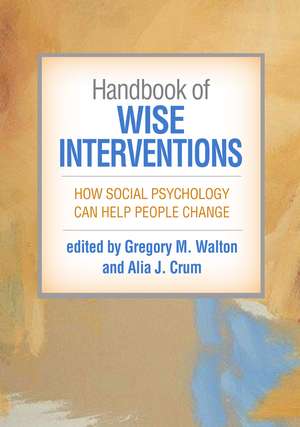
Handbook of Wise Interventions: How Social Psychology Can Help People Change
Editat de Gregory M. Walton, Alia J. Crumen Limba Engleză Paperback – 5 ian 2023
Reținem, înainte de toate, componenta aplicată a acestui volum: fiecare capitol este construit în jurul unor strategii concrete, non-clinice, menite să modifice modul în care indivizii interpretează situațiile sociale pentru a-și îmbunătăți performanța și bunăstarea. Găsim în Handbook of Wise Interventions o structură riguroasă, unde autorii nu se limitează la teorie, ci descriu detaliat implementarea practică și dovezile empirice pentru intervenții specifice, cum ar fi cele privind mentalitatea de creștere (growth mindset) sau apartenența socială.
Notăm cu interes organizarea tematică a lucrării, care debutează cu o secțiune extinsă dedicată educației. Aici, sunt explorate metode de reducere a decalajelor academice prin schimbarea teoriilor elevilor despre diferență și utilizarea strategică a resurselor. Progresia către secțiunea de sănătate și stare de bine permite cititorului să înțeleagă cum ajustările fine în percepția stresului sau a fericirii pot genera schimbări comportamentale durabile. Această abordare completează perspectiva oferită de Social Psychology in Action, adăugând un cadru metodologic specific pentru „intervențiile scurte” care vizează mecanismele psihologice de interpretare, element mai puțin central în manualele de psihologie socială aplicată generalistă.
Stilul editorial coordonat de Gregory M. Walton și Alia J. Crum asigură o coerență rară pentru un handbook, transformând cercetarea academică într-un instrumentar accesibil pentru practicieni. Analizând contribuțiile unor cercetători precum Carol S. Dweck, observăm o rigoare științifică ce ancorează fiecare studiu de caz în date statistice solide, oferind o resursă esențială pentru cei interesați de modul în care psihologia socială poate genera schimbări reale în societate.
Preț: 327.06 lei
Carte disponibilă
Livrare economică 29 octombrie-12 noiembrie
Livrare express 14-20 octombrie pentru 52.47 lei
Specificații
ISBN-10: 1462551009
Pagini: 474
Dimensiuni: 178 x 254 x 24 mm
Greutate: 0.86 kg
Ediția:1
Editura: Guilford Publications
Colecția Guilford Press
De ce să citești această carte
Această carte este indispensabilă pentru psihologi, educatori și decidenți politici care doresc să implementeze schimbări comportamentale eficiente cu resurse minime. Cititorul câștigă acces la un set de instrumente validate științific care pot transforma eșecul academic în succes și stresul în combustibil pentru performanță, totul prin reîncadrarea cognitivă a experiențelor cotidiene.
Despre autor
Gregory M. Walton este profesor asociat de psihologie la Universitatea Stanford, recunoscut pentru cercetările sale asupra intervențiilor psihologice care promovează succesul academic și echitatea. Alia J. Crum, de asemenea profesor la Stanford, conduce Stanford Mind & Body Lab, unde studiază modul în care mentalitățile (mindsets) influențează sănătatea fizică și performanța. Împreună, cei doi editori au reunit în acest volum un colectiv de experți internaționali pentru a sintetiza decenii de cercetare în psihologie socială aplicată, oferind o viziune unitară asupra puterii intervențiilor „înțelepte”.
Descriere scurtă
Cuprins
I. Education
1. A Growth Mindset about Intelligence, Carol S. Dweck & David S. Yeager
2. The Social-Belonging Intervention, Gregory M. Walton & Shannon T. Brady
3. Self-Affirmation Interventions, David K. Sherman, Mohini Lokhande, Tim Müller, & Geoffrey L. Cohen
4. The Utility-Value Intervention, Chris S. Hulleman & Judith M. Harackiewicz
5. Difference Education: Improving Disadvantaged Students’ Academic Outcomes by Changing Their Theory of Difference, Nicole M. Stephens, MarYam G. Hamedani, & Sarah S. M. Townsend
6. The Pathways Intervention as a Model to Design Broader Systems of Equitable Student Support, Mesmin Destin & Ivan A. Hernandez
7. The Strategic Resource Use Intervention, Patricia Chen
II. Health and Well-Being
8. Happiness Interventions, Kristin Layous
9. The Stress-Mindset Intervention, Alia J. Crum, Isaac J. Handley-Miner, & Eric N. Smith
10. Stress Reappraisal Interventions: Improving Acute Stress Responses in Motivated Performance Contexts, Jeremy P. Jamieson & Emily J. Hangen
11. Values-Alignment Interventions: An Alternative to Pragmatic Appeals for Behavior Change, Christopher J. Bryan
12. The Taste-Focused-Labeling Intervention: Emphasizing the Tasty and Enjoyable Attributes of Healthy Foods, Bradley P. Turnwald & Alia J. Crum
III. Conflict and Relationships
13. The Incremental Theory of Personality Intervention, David S. Yeager & Hae Yeon Lee
14. The Empathic-Discipline Intervention, Jason Okonofua & Michael Ruiz
15. The Group-Malleability Intervention: Addressing Intergroup Conflicts by Changing Perceptions of Outgroup Malleability, Amit Goldenberg, James J. Gross, & Eran Halperin
16. The Couples Activity for Reappraising Emotions Intervention: A 7-Minute Marital Conflict Intervention Benefits Relational and Individual Well-Being, Erica B. Slotter & Laura B. Luchies
17. The Abstract Reframing Intervention: Helping Insecure Individuals Benefit from Romantic Partners’ Positive Feedback, Denise C. Marigold
IV. Sustainability
18. The Social Norms Approach: A Wise Intervention for Solving Social and Environmental Problems, Jessica M. Nolan, P. Wesley Schultz, Robert B. Cialdini, & Noah J. Goldstein
19. Dynamic Norm Interventions: How to Enable the Spread of Positive Change, Gregg Sparkman
Author Index
Subject Index
Notă biografică
Alia J. Crum, PhD, is Assistant Professor of Psychology at Stanford University and Primary Investigator of the Stanford Mind and Body Lab. Her research focuses on mindsets; how they affect important outcomes in such domains as exercise, diet, and stress; and how they can be consciously and deliberately changed through intervention to increase physiological and psychological well-being. Dr. Crum is a recipient of awards including the Director's New Innovator Award from the National Institutes of Health and the Rising Star Award from the Association for Psychological Science. She has worked as a clinical psychologist for the VA health care system and has developed interventions focused on mindset change for organizations, including LinkedIn, UBS, Stanford Health Care, and the U.S. Navy.
Recenzii
"This volume highlights innovative interventions and provides behind-the-scenes commentary from their developers. It is indispensable for anyone who wants to use psychological science to change behavior for the better. Each chapter explains a research-based approach to enhancing motivation or changing behavior, and discusses why it works, for whom, and under what conditions."--Angela Duckworth, PhD, Founder and CEO, Character Lab; Christopher H. Browne Distinguished Professor of Psychology, University of Pennsylvania
“It’s not often that the world’s leading experts on the psychology of changing behavior and improving well-being come together to share their knowledge. This book presents the latest science on what it takes to promote learning, belonging, happiness, health, and peace.”--Adam Grant, PhD, The Saul P. Steinberg Professor of Management and Psychology, Wharton School of the University of Pennsylvania
"This book is particularly useful in terms of teaching about and critically evaluating the value of psychology in the real world. Its underlying framing is quite pragmatic for different ways to organize a course. It centers both the domains of interventions and the psychological concepts underlying those interventions. Instructors using this book as a text might organize their course around domains (for example, units on health, education, relationships) or psychological concepts (for example, belonging and groups, implicit theories, reappraisal)."--Kody Manke, PhD, Department of Psychology, Carnegie Mellon University-
"In the last decade, researchers from across psychology have been developing and testing a new generation of theory-guided brief interventions that are changing behaviors of hundreds of people at a time. These 'wise' interventions effectively alter the ways people think about themselves, their studying or eating habits, their marriages, and their health. The outcomes are usually objective and meaningful, and often last for years. From leading researchers in the field, this is the kind of book that has the potential to change the lives of undergraduates, graduate students, and even faculty who yearn to make a difference in the world and who also want to discover new insights about people, institutions, and culture."--James W. Pennebaker, PhD, Regents Centennial Professor of Liberal Arts and Psychology, The University of Texas at Austin
"This volume highlights innovative interventions and provides behind-the-scenes commentary from their developers. It is indispensable for anyone who wants to use psychological science to change behavior for the better. Each chapter explains a research-based approach to enhancing motivation or changing behavior, and discusses why it works, for whom, and under what conditions."--Angela Duckworth, PhD, Founder and CEO, Character Lab; Christopher H. Browne Distinguished Professor of Psychology, University of Pennsylvania
“It’s not often that the world’s leading experts on the psychology of changing behavior and improving well-being come together to share their knowledge. This book presents the latest science on what it takes to promote learning, belonging, happiness, health, and peace.”--Adam Grant, PhD, The Saul P. Steinberg Professor of Management and Psychology, Wharton School of the University of Pennsylvania
"This book is particularly useful in terms of teaching about and critically evaluating the value of psychology in the real world. Its underlying framing is quite pragmatic for different ways to organize a course. It centers both the domains of interventions and the psychological concepts underlying those interventions. Instructors using this book as a text might organize their course around domains (for example, units on health, education, relationships) or psychological concepts (for example, belonging and groups, implicit theories, reappraisal)."--Kody Manke, PhD, Department of Psychology, Carnegie Mellon University
"I've been able to evaluate the impact of switching from journal readings to the Handbook of Wise Interventions this term in my Psychological Interventions course, an honours seminar that includes psychology majors and those going into helping professions. Students reported that they preferred this text to reading journal articles--they found the workload reasonable and the book engaging. During one-on-one meetings to help students prepare for their projects, I found they were much clearer on the concepts from the course than in previous years. They used to get to that meeting without entirely understanding what a psychological intervention even was, but now they come to it actually understanding the central course concepts--a huge win!"--Christine Logel, PhD, Professor of Social Development Studies, Renison University College, University of Waterloo, Ontario, Canada-