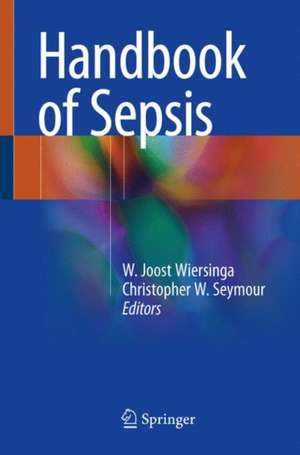
Handbook of Sepsis
Editat de W. Joost Wiersinga, Christopher W. Seymouren Limba Engleză Paperback – 25 apr 2018
Recomandăm Handbook of Sepsis ca o resursă fundamentală pentru studenți la medicină, rezidenți, specialiști în boli infecțioase și medici de familie care se confruntă cu complexitatea acestui sindrom în unitățile de terapie intensivă sau în medicina internă. Această primă ediție publicată de Springer sub coordonarea editorilor W. Joost Wiersinga și Christopher W. Seymour reușește să sintetizeze fiziopatologia moleculară și aplicațiile clinice într-un format accesibil de tip manual.
Descoperim o structură riguroasă în patru părți care ghidează cititorul de la definițiile fundamentale și epidemiologie către mecanismele intime ale patogenezei. Remarcăm atenția deosebită acordată sistemelor de coagulare și endocrine, precum și rolul critic al biomarkerilor în intervenția timpurie. Managementul clinic este tratat exhaustiv prin capitole dedicate resuscitării lichidiene, terapiei cu vasopresoare și strategiilor antimicrobiene, toate fiind aliniate la ghidurile de practică internațională actuale. Clinicienii care folosesc Sepsis de Guillermo Ortiz-Ruiz ca referință vor găsi aici o completare valoroasă, în special în ceea ce privește imunoterapia adjuvantă și analiza răspunsului la insuficiența multiorganică.
Spre deosebire de abordările pur teoretice, acest volum privește spre viitor, discutând în secțiunea finală despre designul studiilor clinice moderne și provocările tratamentului în regiunile cu resurse limitate. Tonul este precis și clinic, facilitând o înțelegere rapidă a dovezilor științifice necesare pentru a optimiza rezultatele pacienților critici.
Preț: 753.80 lei
Preț vechi: 793.47 lei
-5%
Carte disponibilă
Livrare economică 18 mai-01 iunie
Specificații
ISBN-10: 3319735055
Pagini: 276
Ilustrații: VIII, 267 p. 22 illus., 19 illus. in color.
Dimensiuni: 155 x 235 x 15 mm
Greutate: 0.47 kg
Ediția:1st ed. 2018
Editura: Springer
Locul publicării:Cham, Switzerland
V-ar putea interesa
-
 Antimicrobial ChemotherapyRoger Finch-16%Preț: 375.68 lei448.60 lei
 -
 Prepositioning Antibiotics for AnthraxInstitute Of Medicine-11%Preț: 444.53 lei499.48 lei
 -
 The Silent SaboteursWilliam D Nordquist DMD MS-5%Preț: 187.93 lei197.82 lei
 -
 Treatment of Chronic Lyme DiseaseBurton A. MD FACP Waisbren Sr.-5%Preț: 168.42 lei177.29 lei
 -
 Vaccine-nationAndreas MoritzPreț: 136.64 lei
 -
 Making Disease, Making Citizens: The Politics of Hepatitis CSuzanne Fraser-18%Preț: 1201.50 lei1465.24 lei
 -
 -30%Preț: 1343.23 lei1929.40 lei
 -
 Pneumonia: Symptoms, Diagnosis & TreatmentMicaela L Suárez-30%Preț: 1270.99 lei1824.10 lei
 -
 Global Malaria Threat & the U.S. ResponseRobert N Moynihan-30%Preț: 777.02 lei1112.71 lei
 -
 Molecular Aspects of Infectious DiseasesMazen T Saleh-30%Preț: 1245.33 lei1784.95 lei
 -
 Molecular Typing Methods for Tracking Foodborne MicroorganismsSteven L. Foley-30%Preț: 1476.61 lei2114.68 lei
De ce să citești această carte
Această lucrare este esențială pentru orice medic care dorește să stăpânească protocoalele actualizate de management al sepsisului. Cititorul câștigă o înțelegere clară a mecanismelor de coagulare și a utilizării biomarkerilor, elemente vitale pentru un diagnostic rapid. Este un instrument practic de teren care transformă datele clinice complexe în decizii terapeutice sigure, fiind ideal pentru pregătirea rezidențiatului sau pentru practica zilnică în secțiile de terapie intensivă.
Despre autor
W. Joost Wiersinga este un reputat specialist în boli infecțioase, cunoscut pentru cercetările sale asupra interacțiunilor gazdă-patogen în sepsis. Alături de Christopher W. Seymour, expert în medicină critică și epidemiologie clinică, acesta a reușit să reunească o echipă globală de lideri de opinie. Expertiza lor combinată asigură o perspectivă interdisciplinară, integrând cunoștințele de laborator cu nevoile imediate de la patul bolnavului, reflectând cele mai noi standarde de îngrijire stabilite de comunitatea medicală internațională.
Cuprins
Recenzii
Notă biografică
Dr. Seymour is an Assistant Professor in the Departments of Critical Care, Emergency Medicine, and Clinical and Translational Science at the University of Pittsburgh School of Medicine. He is a core faculty member in the Clinical Research and Systems Modeling of Acute Illness (CRISMA) Center. Over the past 5 years, he has led numerous clinical and translational studies involving sepsis, biomarkers, and large electronic health record databases and received funding for his research from the National Institutes of Health. He has served on international clinical guideline committees and panels that focus on the definition and management of sepsis. Among many accolades, he has received early career investigator awards from the American Thoracic Society and the Australian and New Zealand Intensive Care Society (ANZICS) Intensive Care.