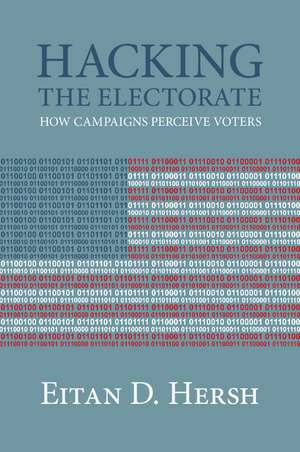
Hacking the Electorate: How Campaigns Perceive Voters
Autor Eitan D. Hershen Limba Engleză Paperback – 8 iun 2015
Aplicabilitatea practică a volumului Hacking the Electorate rezidă în capacitatea sa de a demonta mitul omnipotenței algoritmilor privați, readucând în prim-plan rolul crucial al datelor administrative publice. Eitan D. Hersh propune o analiză riguroasă a modului în care arhitectura bazelor de date guvernamentale dictează strategiile de mobilizare electorală. Remarcăm faptul că autorul nu se limitează la aspectele tehnice, ci investighează cum discrepanțele în colectarea datelor de la un stat la altul produc o „percepție fragmentată” a electoratului, influențând direct coalizarea alegătorilor.
Cititorii familiarizați cu The Psychology of Micro-Targeted Election Campaigns de Jens Koed Madsen vor aprecia trecerea de la perspectiva psihologică individuală la o analiză sistemică a modului în care politicile publice de date modelează comportamentul elitelor politice. În timp ce Madsen se concentrează pe persuasiune, Hersh pune accent pe infrastructura informațională care face aceste strategii posibile. De asemenea, spre deosebire de abordarea generală din Political Campaigning in the U.S., acest volum oferă o metodologie de cuantificare a percepțiilor de campanie, oferind un fundament academic solid pentru studiul comunicării politice moderne.
Structura cărții urmărește o progresie logică, de la fundamentarea teoretică a „modelului alegătorului perceput” (capitolul 2), la analiza empirică a modului în care factori precum rasa (capitolul 6) sau rețelele sociale și fișierele de consum (capitolul 8) sunt integrate în calculele strategice. Putem afirma că lucrarea reprezintă un instrument indispensabil pentru înțelegerea mecanismelor interne ale democrației digitale, explicând de ce campaniile par să „vadă” alegători diferiți în funcție de codul poștal în care aceștia rezidă.
Preț: 226.58 lei
Carte tipărită la comandă
Livrare economică 09-23 iulie
Specificații
ISBN-10: 1107501164
Pagini: 270
Ilustrații: 31 b/w illus.
Dimensiuni: 150 x 226 x 25 mm
Greutate: 0.36 kg
Editura: Cambridge University Press
Colecția Cambridge University Press
Locul publicării:New York, United States
V-ar putea interesa
-
 TargetedBrittany Kaiser-20%Preț: 102.45 lei128.07 lei
 -
 The Constitution After Scott: Government UnwrappedAdam Tomkins-12%Preț: 338.26 lei386.16 lei
 -
 Constitutional Futures: A History of the Next Ten YearsRobert Hazell-35%Preț: 238.67 lei366.47 lei
 -
 Cultural Evolution in the Digital AgeAlberto Acerbi-22%Preț: 333.77 lei427.88 lei
 -
 The Republic and The LawsCicero-20%Preț: 51.27 lei64.05 lei
 -
 -16%Preț: 423.54 lei501.93 lei
 -
 The British ConstitutionAnthony KingPreț: 337.98 lei
 -
 Preț: 243.30 lei
 -
 Ruling Europe: The Politics of the Stability and Growth PactMartin HeipertzPreț: 297.82 lei
 -
 Plato: 'The Republic'PlatoPreț: 147.23 lei
 -
 The Cambridge Companion to Plato's RepublicG. R. F. FerrariPreț: 285.23 lei
 -
 The Rise and Decline of the StateMartin van CreveldPreț: 288.03 lei
 -
 Understanding Russian PoliticsStephen WhitePreț: 528.58 lei
 -
 A Civil ActionJonathan HarrPreț: 107.00 lei
 -
 The Constitution of the United States, with Index, and the Declaration of IndependenceNational Center for Constitutional StudiPreț: 17.19 lei
 -
 Preț: 240.51 lei
 -
 The President's Legislative Policy Agenda, 1789-2002Jeffrey E. Cohen-24%Preț: 213.36 lei280.23 lei
 -
 Preț: 51.26 lei
 -
 The Constitution of Australia: A Contextual AnalysisProfessor Cheryl Saunders-17%Preț: 193.02 lei233.27 lei
 -
 The Constitution of France: A Contextual AnalysisSophie Boyron-20%Preț: 192.91 lei242.51 lei
 -
 -18%Preț: 191.44 lei232.70 lei
 -
 We have been harmonisedKai Strittmatter-20%Preț: 78.97 lei98.71 lei
De ce să citești această carte
Recomandăm această carte profesioniștilor din științe politice și consultanților electorali care doresc să înțeleagă mecanismele reale din spatele „big data”. Cititorul câștigă o perspectivă critică asupra modului în care informațiile publice colectate de stat devin arme strategice. Este un studiu esențial despre cum datele nu doar reflectă realitatea electorală, ci o modelează activ prin deciziile strategice pe care le impun echipelor de campanie.
Descriere scurtă
Cuprins
Recenzii
'Think political campaigns know you better than you know yourself? Think again. It's not what magazines you read or which beer you drink that drives campaign strategies, it's the information on public records gathered by local governments. In Hacking the Electorate, Eitan Hersh delivers a much-needed corrective to the myths of modern campaigning - microtargeting may be effective, but the algorithms are far simpler than candidates and strategists would have you believe.' Lynn Vavreck, University of California, Los Angeles
'You may have heard that campaigns have encyclopedic data about you and can use your choice of car, beer, or magazine to target a message specifically to you. You've heard wrong. Eitan Hersh shows what campaigns really know about voters, and how it matters. This is the first political science account of what 'big data' can and cannot do for campaigns. It is a must-read for academics and campaign practitioners alike.' John Sides, George Washington University, Washington DC
'Hersh offers a compelling account of the link between campaign strategy and candidate access to the personal information citizens provide to the government to register to vote. The book should be required reading for scholars of campaigns and elections, but it holds broader appeal to anyone interested in understanding the dynamics of campaign communication and the politics of public records.' Sunshine Hillygus, Duke University, North Carolina
'In Hacking the Electorate, Eitan Hersh has not only drawn attention to a critical feature of modern campaigns but he has also opened up an entirely new field of study in American politics. Commentators speak about the importance of 'big data' to contemporary campaigns and governance, but Hersh shows us the link between the available data and many well-known, if poorly understood, pathologies of our politics. Anyone interested in the trajectory of American campaigns and the important role of data and technology in them should read this book and heed its lessons.' Nathaniel Persily, James B. McClatchy Professor of Law, Stanford University, California