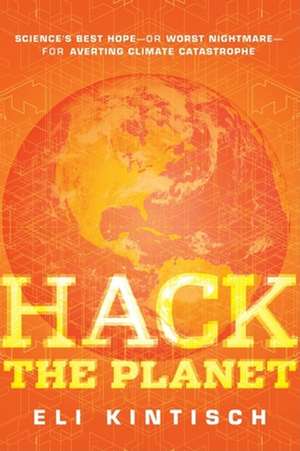
Hack the Planet
Autor Eli Kintischen Limba Engleză Hardback – apr 2010
Nivelul de studiu recomandat pentru acest volum este cel de licență sau referință profesională, fiind o lucrare esențială pentru cei care activează în științele mediului, politici publice sau jurnalism științific. Putem afirma că Hack the Planet nu este doar o trecere în revistă a unor soluții tehnice, ci o cronică a momentului în care comunitatea științifică a trecut de la scepticism la o acceptare forțată de împrejurări a geoingineriei. Ne-a atras atenția modul în care Eli Kintisch structurează narațiunea, începând cu dilema etică a cercetătorilor la workshop-ul din 2007 și continuând cu explorarea unor soluții care par desprinse din literatura de anticipație. Capitole precum „The Pinatubo Option” sau „The Sucking-1-Ton Challenge” demonstrează o progresie logică de la mecanismele naturale (erupții vulcanice) la intervenții tehnologice directe de captare a carbonului. Autorul analizează riguros riscurile acestor „hack-uri” planetare, punând în balanță nevoia de acțiune urgentă cu pericolul unor dezastre imprevizibile. Cititorii familiarizați cu How To Cool The Planet de Jeff Goodell vor aprecia modul în care volumul de față adâncește contextul politic și presiunea exercitată de punctele de inflexiune climatică (tipping points). În timp ce ambele lucrări explorează tehnologii similare, Kintisch pune un accent deosebit pe factorul uman și pe transformarea radicală a rolului omului de la simplu administrator la inginer al sistemului terestru. Stilul este alert, specific unui reporter de investigație de la revista Science, oferind claritate fără a sacrifica rigoarea datelor științifice.
Preț: 147.31 lei
Carte disponibilă
Livrare economică 14-28 noiembrie
Specificații
ISBN-10: 047052426X
Pagini: 288
Dimensiuni: 167 x 241 x 34 mm
Greutate: 0.51 kg
Editura: Turner Publishing Company
Locul publicării:Hoboken, United States
V-ar putea interesa
-
 -20%Preț: 704.20 lei878.72 lei
 -
 -25%Preț: 622.78 lei830.57 lei
 -
 Nonlinear and Stochastic Climate DynamicsChristian L. E. Franzke-14%Preț: 1139.37 lei1324.85 lei
 -
 Cased-Hole Log Analysis and Reservoir Performance MonitoringRichard M. Bateman-23%Preț: 591.52 lei768.21 lei
 -
 -23%Preț: 848.57 lei1102.04 lei
 -
 Principles of River HydraulicsAronne Armanini-18%Preț: 1264.11 lei1541.60 lei
 -
 Modern Earthquake EngineeringJunbo Jia-18%Preț: 1467.39 lei1789.50 lei
 -
 Preț: 310.44 lei
 -
 Preț: 400.94 lei
 -
 Handbuch der Baugeologie und GeotechnikWolfgang Dachroth-13%Preț: 1453.55 lei1670.74 lei
 -
 Hydrologie und WasserwirtschaftUlrich Maniak-13%Preț: 831.99 lei956.31 lei
 -
 -15%Preț: 664.79 lei782.11 lei
 -
 Geotechnical Hazards from Large Earthquakes and Heavy RainfallsHemanta Hazarika-18%Preț: 1286.51 lei1568.92 lei
 -
 -18%Preț: 1161.22 lei1416.12 lei
 -
 Jute Geotextiles and their Applications in Civil EngineeringTapobrata Sanyal-15%Preț: 668.42 lei786.38 lei
 -
 -18%Preț: 1007.71 lei1228.91 lei
 -
 Slope Earthquake StabilityYang Changwei-18%Preț: 981.27 lei1196.67 lei
 -
 Fundamentals of Fibre-Reinforced Soil EngineeringSanjay Kumar Shukla-24%Preț: 721.84 lei949.79 lei
 -
 Geoenvironmental Practices and SustainabilityG. L. Sivakumar Babu-20%Preț: 658.23 lei822.79 lei
 -
 Environmental Vibrations and Transportation GeodynamicsXuecheng Bian-18%Preț: 1294.99 lei1579.26 lei
 -
 -18%Preț: 983.57 lei1199.48 lei
 -
 Hydrologic ModelingVijay P. Singh-18%Preț: 1291.60 lei1575.12 lei
 -
 Seismic Fragility Assessment for Buildings due to Earthquake ExcitationFadzli Mohamed NazriPreț: 391.56 lei
 -
 -15%Preț: 667.41 lei785.19 lei
Public țintă
For years, "environmentalism" languished as a current affairs topics, but climate change has given science writers a vast, urgent topic with a steady flow of new research. (Not to mention a steady flow of bestsellers.) Readers in this area want two things in a book like this: (1) specific, urgent problems and (2) facts about practical, near–term actions, negative or positive. Like Six Degrees or Field Notes from a Catastrophe, this book offers both.De ce să citești această carte
Această carte este ideală pentru cititorul care dorește să înțeleagă viitorul imediat al luptei împotriva schimbărilor climatice. Câștigați o perspectivă avizată asupra unor tehnologii controversate care ar putea deveni singura noastră opțiune de supraviețuire. Este o lectură necesară pentru a înțelege de ce oamenii de știință iau acum în serios idei care, până recent, erau considerate de neconceput în cercurile academice.
Despre autor
Eli Kintisch este un jurnalist științific de renume, reporter pentru prestigioasa publicație Science Magazine. Specializat în politici climatice și cercetare fundamentală, Kintisch a urmărit îndeaproape evoluția discuțiilor despre geoinginerie în ultimul deceniu. Experiența sa de reporter îi permite să traducă concepte complexe de fizică atmosferică și oceanografie într-un limbaj accesibil, menținând în același timp standardele de acuratețe cerute de mediul academic. Activitatea sa a fost recunoscută pentru capacitatea de a evidenția intersecția dintre știința pură și implicațiile politice globale.
Descriere scurtă
While the pernicious effects of global warming are clear, efforts to reduce the carbon emissions that cause it have fallen far short of what s needed. Some scientists have started exploring more direct and radical ways to cool the planet, such as:
- Pouring reflective pollution into the upper atmosphere
- Making clouds brighter
- Growing enormous blooms of algae in the ocean
Scientists are developing geoengineering techniques for worst–case scenarios. But what would those desperate times look like? Kintisch outlines four circumstances: collapsing ice sheets, megadroughts, a catastrophic methane release, and slowing of the global ocean conveyor belt.
As incredible and outlandish as many of these plans may seem, could they soon become our only hope for avoiding calamity? Or will the plans of brilliant and well–intentioned scientists cause unforeseeable disasters as they play out in the real world? And does the advent of geoengineering mean that humanity has failed in its role as steward of the planet or taken on a new responsibility? Kintisch lays out the possibilities and dangers of geoengineering in a time of planetary tipping points. His investigation is required reading as the debate over global warming shifts to whether humanity should Hack the Planet.
Descriere
Elizabeth Kolbert, author of Field Notes from a Catastrophe: Man, Nature, and Climate Change
"Anyone who considers themselves scientifically literate had better get versed in the new discipline of geoengineering or planethacking, as Eli Kintisch calls it in this nuanced and useful new account. This discussion is not going to go away anytime soon!"
Bill McKibben, author of Eaarth: Making a Life on a Tough New Planet
"As climate change goes unmitigated and continues to worsen,it seems we can no longer avoid a public debate on the prospect of planetary geoengineering doing something probably bad to the planet to avert something even worse. It will be an Earth–changing discussion, and no one should feel competent to participate without having first read Eli Kintisch′s Hack the Planet, an indispensable introduction to the topic. The scientific ideas he explains and characters he depicts are compelling and occasionally riveting."
Chris Mooney, author of The Republican War on Science and coauthor of Unscientific America
"Hack the Planet is a superbly written and reportedchronicle of a remarkable story. In just a few years, ′geoengineering′ fixes to climate change simulating volcanoes, CO2–sucking, cloud–brightening have gone from crackpot to considered ideas. Eli Kintisch′s book is boundlessly smarter and more deeplyresearched on this topic than SuperFreakonomics. Expect to hear much more in coming years from the planet–hackers and from Kintisch."
Eric Roston, author of The Carbon Age: How Life′s Core Element Has Become Civilization′s Greatest Threat
Cuprins
3 The Point of No Return.
4 The Pinatubo Option.
5 The Pursuit of Levers.
6 The Sucking–1–Ton Challenge.
7 Credit Is Due.
8 Victor′s Garden.
9 The Sky and Its Reengineer.
10 The Right Side of the Issue.
11 A Political Climate.
12 Geoengineering and Earth.
Acknowledgments.
Notes.
Index.
Recenzii
New York Times