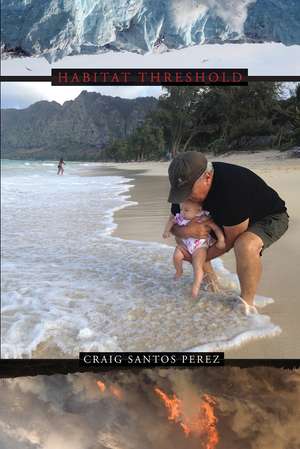
Habitat Threshold
Autor Craig Santos Perezen Limba Engleză Paperback – 15 apr 2020
Through experimental forms, free verse, prose, haiku, sonnets, satire, and a method he calls “recycling,” Perez has created a diverse collection filled with passion. Habitat Threshold invites us to reflect on the damage done to our world and to look forward, with urgency and imagination, to the possibility of a better future.
Preț: 94.73 lei
Puncte Express: 142
Carte disponibilă
Livrare economică 16-30 noiembrie
Livrare prin curier în România Termenul estimat este afișat lângă disponibilitate.
Transport gratuit de la 400.00 lei Plată online sau ramburs, în funcție de opțiunile comenzii.
Retur gratuit în 14 zile Comandă securizată și suport în română.
Specificații
ISBN-13: 9781632430809
ISBN-10: 1632430800
Pagini: 80
Ilustrații: 4 halftones, 4 graphs
Dimensiuni: 152 x 229 x 8 mm
Greutate: 0.14 kg
Ediția:1
Editura: Omnidawn Publishing, Inc.
Colecția Omnidawn
ISBN-10: 1632430800
Pagini: 80
Ilustrații: 4 halftones, 4 graphs
Dimensiuni: 152 x 229 x 8 mm
Greutate: 0.14 kg
Ediția:1
Editura: Omnidawn Publishing, Inc.
Colecția Omnidawn
V-ar putea interesa
-
 Lives of the Heart, TheJane HirshfieldPreț: 96.23 lei
 -
 Blessings for the HandsMatthew SchwartzPreț: 359.41 lei
 -
 EddaAnthony Faulkes-30%Preț: 59.81 lei85.28 lei
 -
 Osborne Street Attic BluesBill GleesonPreț: 60.98 lei
 -
 The LoverBaharak SedighPreț: 81.63 lei
 -
 Indigenous Literatures from MicronesiaEvelyn FloresPreț: 229.79 lei
 -
 Indigenous Pacific Islander Eco-LiteraturesKathy Jetñil-KijinerPreț: 170.45 lei
 -
 Mutual ShoresPhillip SterlingPreț: 111.68 lei
 -
 Everybody's Jonesin' for SomethingIndigo MoorPreț: 84.88 lei
 -
 Unholy Heart: New and Selected PoemsGrace BauerPreț: 111.40 lei
 -
![from unincorporated territory [lukao]](https://i1.books-express.ro/bt/9781632430410/from-unincorporated-territory-lukao.jpg) from unincorporated territory [lukao]Craig Santos PerezPreț: 94.95 lei
from unincorporated territory [lukao]Craig Santos PerezPreț: 94.95 lei -
![from unincorporated territory [hacha]](https://i4.books-express.ro/bt/9781632430496/from-unincorporated-territory-hacha.jpg) from unincorporated territory [hacha]Craig Santos PerezPreț: 94.95 lei
from unincorporated territory [hacha]Craig Santos PerezPreț: 94.95 lei -
 Storage Unit for the Spirit HouseMaw Shein WinPreț: 97.51 lei
 -
![From Unincorporated Territory [Åmot]](https://i3.books-express.ro/bt/9781632431189/from-unincorporated-territory-mot.jpg) From Unincorporated Territory [Åmot]Craig Santos PerezPreț: 122.62 lei
From Unincorporated Territory [Åmot]Craig Santos PerezPreț: 122.62 lei -
 Effigies IIIAllison Adelle Hedge CokePreț: 89.30 lei
 -
 EverythingAndrea CohenPreț: 90.75 lei
Notă biografică
Craig Santos Perez is the author of four books of poetry, coeditor of three anthologies of Pacific literature, and cofounder of Ala Press. He is an indigenous Chamorro from the Pacific Island of Guam and, in 2010, was recognized in a resolution by the Guam Legislature as “an accomplished poet who has been a phenomenal ambassador for our island, eloquently conveying through his words, the beauty and love that is the Chamorro culture.” He lives in Aiea, Hawai'i.
Cuprins
Age of Plastic
Halloween in the Anthropocene
Teething Borders
Disaster Haiku
Rings of Fire
Thirteen Ways of Looking at a Glacier
A Sonnet at the Edge of the Reef
Rainbow after the Massacre
Care
Love in a Time of Climate Change
Chanting the Waters
~
(Silent) Spring Haiku
Blood Ivory
One fish, Two fish, Plastics, Dead fish
Th S xth M ss Ext nct n
Thanksgiving in the Plantationocene
This is Just to Say
Cockroach Ode
We Aren’t the Only Species
Echolocation
Endangered Haiku
The Last Safe Habitat
~
Christmas in the Capitalocene
Postcards from Taiwan
The Flatulencene
America
Earth Day Haiku
This Changes Everything
Hush Little Planet
New Year’s Eve and Day in the Chthulucene
Fossil Fuels
Nuclear Family
Praise Song for Oceania
Halloween in the Anthropocene
Teething Borders
Disaster Haiku
Rings of Fire
Thirteen Ways of Looking at a Glacier
A Sonnet at the Edge of the Reef
Rainbow after the Massacre
Care
Love in a Time of Climate Change
Chanting the Waters
~
(Silent) Spring Haiku
Blood Ivory
One fish, Two fish, Plastics, Dead fish
Th S xth M ss Ext nct n
Thanksgiving in the Plantationocene
This is Just to Say
Cockroach Ode
We Aren’t the Only Species
Echolocation
Endangered Haiku
The Last Safe Habitat
~
Christmas in the Capitalocene
Postcards from Taiwan
The Flatulencene
America
Earth Day Haiku
This Changes Everything
Hush Little Planet
New Year’s Eve and Day in the Chthulucene
Fossil Fuels
Nuclear Family
Praise Song for Oceania
Recenzii
"Celebrated as 'a phenomenal ambassador for our island' by the Guam legislature, Chamorro professor, editor, and writer Perez explores environmental themes endemic to his island home and also to the inhabitants of other Pacific communities and the planet as a whole, such as carbon emissions, sea level rise, and the scourge of omnipresent plastics. Perez applies sharp wit and surprising humor through an expansive variety of forms . . . . A wickedly intelligent, endlessly talented poet, to be read alongside Daniel Borzutzky, Juliana Spahr, and Clarissa Mendiola."
"The cover is a fitting reflection of the poems in this striking collection, in which the poet’s tenderness for family—and particularly his children— is consistently juxtaposed with environmental and ecological catastrophe. This is a vital book of ecopoetry: Perez is an essential voice in the face of the ongoing and relentless intertwining of ecological and social calamities of the Anthropocene/Capitalocene. I am struck by the variety of tonal registers in these poems, from gentle and caring to bitingly satirical, from outraged and dark to playful and devastatingly funny."
"A native Chamorro from Guam, Perez has challenged colonial dominance in his excellent 'from unincorporated territory' series. Here he examines ecological catastrophe in urgent, forthright language, limning a world pushed to the limit by escalating carbon emissions. . . . VERDICT: Not just for environmental activists; showing what an informed poetic voice can do."
"Longlisted"
"In this most recent collection, Craig Santos Perez interweaves parental tenderness with knowledge of environmental crisis. With poetic verve and acuity, Perez invites us to the bedside of our ailing world. Formally inventive, these poems read like ritual. The invitation is to come closer, to be with a troubled world. The steady accumulation of these poems will move you to action."
"'There’s no half-life of sorrow when our children / inherit this toxic legacy,' Craig Santos Perez writes in Habitat Threshold—and though he is referring specifically to nuclear energy, the line colors everything in the book. No half-life to sorrow: but unending sorrow and rage and terror, expressed in blazing and eloquent poems, at the barely imaginable environmental crisis that has become our world. And still, somehow, tenderness. 'I love you without knowing how or when this world / will end,' Santos Perez writes in 'Love in a Time of Climate Change,' a poem for his wife, which perhaps speaks also to his little daughter, to the creatures and mountains and sea and air, to us all."
"Craig Santos Perez returns poetry to its ancient vocation: not only to sing of the dark times, in a public voice, but to sing in and against the darkness. Always exquisite in his attention to the placement of words for power, beauty, and insight, with Habitat Threshold Perez raises poetry to earth magnitude: his pastorals, odes, sonnets, haikus, recyclings, occasional verse, lullabies, and chants sing plainly and with great precision of the vast and intricate inequalities in and through which world-ecology enmeshes us. These are songs of protest, to be recited in places of public debate and decision, and to be learned by children, but also love songs, for family, place, plant and animal, celebrating the many-hued lifeways of humans and their others. The poems find music in inconvenient truths, with a sobering and detailed indictment of our Capitalocene footprint. Habitat Threshold asks us to change our lives: it is motivating, necessary, and inspiring work."
"Craig Santos Perez is a writer I seriously watch. He includes a variety of environmentally important writing, seamlessly combined with history, politics, and the familial."
"Essential. Read this book."
"This book is not for the faint of heart — but neither is contemplating the existential threat of climate change. And just like awareness of the climate crisis is necessary, so too is reading this collection. Poetry won’t remove microplastics from the ocean or reverse the melting of glaciers, but Perez demonstrates that it can make you feel something genuine in a seemingly doomed world."