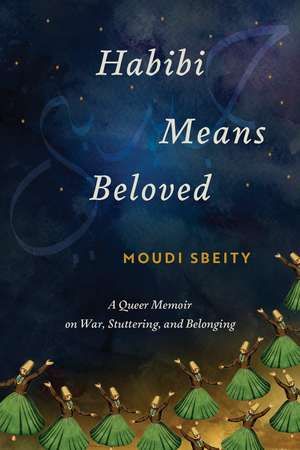
Habibi Means Beloved: A Queer Memoir on War, Stuttering, and Belonging
Autor Moudi Sbeityen Limba Engleză Paperback – 23 oct 2026
Born into a Muslim family from a small Lebanese village, Moudi Sbeity came of age at the intersection of war, displacement, and difference. Queer, with a stutter, and often on the margins of belonging, Sbeity survived the conflicts that fractured their homeland and family before arriving in Utah as an eighteen-year-old evacuee.
From there, Sbeity transformed anonymity into advocacy as plaintiff in Kitchen v. Herbert, the landmark case that secured marriage equality across the 10th Circuit, and as founder of the celebrated Salt Lake City queer-friendly restaurant Laziz Kitchen. Yet behind these outward triumphs, Sbeity felt an inner call to return to their roots through writing and poetry. Habibi Means Beloved interweaves personal narrative, Sufi mysticism, and Lebanese heritage in a memoir of resilience, disconnection, and reconciliation. Both intimate and universal, it invites readers to reimagine belonging and recognize ourselves—and one another—as already beloved.
Preț: 150.16 lei
Precomandă
Puncte Express: 225
Carte nepublicată încă
Livrare prin curier în România Precomanda se expediază când titlul devine disponibil.
Transport gratuit de la 400.00 lei Plată online sau ramburs, în funcție de opțiunile comenzii.
Retur gratuit în 14 zile Comandă securizată și suport în română.
Doresc să fiu notificat când acest titlu va fi disponibil:
Se trimite...
Specificații
ISBN-13: 9781647692926
ISBN-10: 164769292X
Pagini: 296
Dimensiuni: 152 x 229 mm
Greutate: 0.41 kg
Ediția:First Edition
Editura: University of Utah Press
Colecția University of Utah Press
ISBN-10: 164769292X
Pagini: 296
Dimensiuni: 152 x 229 mm
Greutate: 0.41 kg
Ediția:First Edition
Editura: University of Utah Press
Colecția University of Utah Press
Recenzii
“Moudi Sbeity's Habibi Means Beloved is an astonishingly beautiful memoir, written by a poet . . . a poet who stutters, a poet evacuated from Beirut by Navy Seals, a poet whose queer identity disqualified him from his own life in Lebanon . . . and then in America. It reminds me that poets, like immigrants, are not categories for culture wars, but human beings marked by their experiences. I loved every word of this reflective and poignant window on a human life.”—Netanel Miles-Yépez, author of In The Teahouse of Experience
“Habibi Means Beloved is an unflinching memoir by Moudi Sbeity. While challenging stereotypes about being Lebanese, queer, and queer Lebanese, the beating heart of Moudi's story is one of family, love and joy. This is a memoir that everyone needs to read.”
—Elias Jahshan, Editor, This Arab Is Queer & This Queer Arab Family
“In Habibi Means Beloved, Sbeity invites us to pursue the real task of living, which is to recognize our suffering as our most essential teacher and to love everything entirely. This book sings with old magic and supersensible wisdom.”—Jonathan T. Bailey, author of The Sun Has Shifted as Have I
“What is more political and transformative than the heart’s potential to turn its greatest suffering into poetry? asks Moudi Sbeity in his debut memoir Habibi Means Beloved. Part fire-sermon, part narrative prose, all deft heart-working magic, this book takes the reader on a journey from one war to another, from Lebanon aggressed by Israel to queer-loving men aggressed by the Utah government. Sbeity tempers silence and rejection with curiosity and tenacity in forging a life for himself, far from his family and home. This book proves a new divinity of voice willing to speak out, willing to sing out, despite the limitations of the State’s definition, dysfluency, and the limitations of other people’s minds. Sbeity dreams a new language of the heartscape that invites the reader, insisting, Abide with me, here, Habibi.”—Rajiv Mohabir author of Antiman: A Hybrid Memoir
“Moudi Sbeity tells the story of his struggle to belong with the candor of a truth-teller, the vision of a mystic, the eloquence of a poet, and the humility of a brother. On every page, he invites us into a revolution of the heart—one that reorients us toward others with radical acceptance and compassion. I’m all in.”—Phyllis Cole-Dai, co-editor, Poetry of Presence anthologies of mindfulness poetry
“Habibi Means Beloved is an unflinching memoir by Moudi Sbeity. While challenging stereotypes about being Lebanese, queer, and queer Lebanese, the beating heart of Moudi's story is one of family, love and joy. This is a memoir that everyone needs to read.”
—Elias Jahshan, Editor, This Arab Is Queer & This Queer Arab Family
“In Habibi Means Beloved, Sbeity invites us to pursue the real task of living, which is to recognize our suffering as our most essential teacher and to love everything entirely. This book sings with old magic and supersensible wisdom.”—Jonathan T. Bailey, author of The Sun Has Shifted as Have I
“What is more political and transformative than the heart’s potential to turn its greatest suffering into poetry? asks Moudi Sbeity in his debut memoir Habibi Means Beloved. Part fire-sermon, part narrative prose, all deft heart-working magic, this book takes the reader on a journey from one war to another, from Lebanon aggressed by Israel to queer-loving men aggressed by the Utah government. Sbeity tempers silence and rejection with curiosity and tenacity in forging a life for himself, far from his family and home. This book proves a new divinity of voice willing to speak out, willing to sing out, despite the limitations of the State’s definition, dysfluency, and the limitations of other people’s minds. Sbeity dreams a new language of the heartscape that invites the reader, insisting, Abide with me, here, Habibi.”—Rajiv Mohabir author of Antiman: A Hybrid Memoir
“Moudi Sbeity's book tells many stories at once—it is a story about Lebanon, a story about America, it is a story about feeling close to God and about feeling far from God. It is a story about the beginning of love and the ending of love and love's endlessness. It is a story about queerness and family and food and political struggle and desire. In other words, it's an epic, but one with the intimate feel of the daily details which tell the truth of a life lived with kaleidoscopic intensity, one lived with, most of all, love.”—Kazim Ali, author of The Man in 119 (Poems)
“Moudi Sbeity tells the story of his struggle to belong with the candor of a truth-teller, the vision of a mystic, the eloquence of a poet, and the humility of a brother. On every page, he invites us into a revolution of the heart—one that reorients us toward others with radical acceptance and compassion. I’m all in.”—Phyllis Cole-Dai, co-editor, Poetry of Presence anthologies of mindfulness poetry
Notă biografică
Moudi Sbeity is a Lebanese-American poet, author, and contemplative educator. Their first poetry collection, Alhamdulillah Anyway, is set to be published in 2026.
Extras
The bombs did not stop.
My cousin, Daniel, a lanky thirteen-year-old with silky straight brownish-blond hair, was visiting for the summer from Utah. His father is American. His mother, khalto Zahra, is Mama’s sister, and so is Lebanese. This was Daniel’s first trip to Lebanon. A trip meant as a summertime adventure to familiarize him with his roots. In addition to day-long excursions to the beach and daily snacking on hummus, his roots included the close pulse of war. We woke one morning at four to shivering windowpanes and a building teetering from the shock waves.
All three of us, Daniel, my brother Nour, and I, piled on Mama’s bed, waiting for the next shock to pass. Nour, also lanky and tall, and rough around the edges, was fourteen and accustomed to the sound of explosions and the run-of-the-mill street violence. He was living with Mama then, after a handful of treacherous years with Baba post-divorce. With us was Peter, the white Persian cat with the flat face Mama loved and defended defiantly against our unrelenting mockery. Peter remained hiding under the bed. Our plan for a day at the beach was postponed for after the bombings, whenever that might be. We spent the afternoon on the balcony of our first-floor apartment, watching smoke rise in the distance.
The United States embassy, along with the embassies of other countries, organized evacuations. They called on Daniel and me to schedule a day and time for our evacuation. I was born in Houston in 1988 under the citizenship guarantees of the Fourteenth Amendment, an amendment I later became familiar with when I decided to sue the state of Utah with my then-boyfriend for the right to marry. No one else in my immediate family is endowed with the privileges of an American passport and so could not evacuate with me. Call it grace, call it luck, call it a cursed blessing. Having an American passport estranged me by war across two continents, returning to my ancestral land as a visitor, alien to the culture.
A part of me wanted to stay, but Mama did not entertain the idea, insisting that I had no future in Lebanon and that success for myself and the family hinged on this now-auspicious opportunity to flee. Emigrating to America has always been the plan since before the divorce. There I would earn a respectable education in order to support my family. With Baba largely out of the picture, I had added pressure to deliver on the promise of the West. I already had plans to apply to universities in Utah. The war simply sped up the timeline and eased the process.
The embassy allowed me one bag. Mama promised to ship the rest of my belongings after the war ended, inshallah—God willing. She had friends at the airport who could help her get the bags across, she said, so I needn’t worry. Mama has wasta, meaning she had, still has, friends in high places she could call in favors with.
Wasta is as much a currency in Lebanon as the Lebanese pound—colloquially called lira—or the American dollar, with sometimes greater reliability. This is something foreign intelligences don’t quite understand when they send in their troops or play their political games. Not everything here is about capitalistic pursuits, and not everyone is driven by greed. We are also driven by reciprocity and trust, investing firstly in the foundation of our interpersonal relationships. Poverty strikes many Lebanese lives, but you are hard-pressed to find anyone without the shelter of family. We just don’t give up on one another that easily. Mama’s relationships with folks who worked in several governmental agencies extended far enough to help Nour graduate from high school against all conceivable odds. She even convinced the prison warden to release several family members after multiple arrests. It also meant she shipped two large suitcases of my belongings for loose change.
Wasta isn’t just about who you know, but who you are socially. When it comes to social bonds and building relationships, Mama soars. She knows how to wield attention and grip an audience with her many stories, captivating the better part of an hour without a yawn from guests. She animates the spaces she finds herself in with a confident indifference keenly tuned to every move.
Mama is daring in a way not expected of most Lebanese women, and that earned her respect. I wondered why, if she had such strong wasta, was she still unemployed and reliant on khalto Zahra for her basic needs? Mama answered by saying that though she could call in favors from her friends, she still had her self-respect and dignity, something she wasn’t willing to sacrifice. Those characteristics are perhaps the last of what she still has to hold on to and why she refuses any man who asks for her hand in marriage. For a divorced Lebanese woman of her age and social status, remarrying signifies a giving-in, or giving away of herself, out of financial necessity. Besides, she isn’t bent toward falling in love in the way people usually are.
Mama and Nour drove Daniel and me to the American University of Beirut campus, a war-neutral zone given its American status, where we were temporarily housed until embassy personnel called on us. The plan was to meet a driver who would take us to the coast nearby from where we’d board a helicopter, then fly to a nearby U.S. Navy SEAL ship. The university campus sat barely a quarter of a kilometer from the Mediterranean shore, serving as a safe route of escape.
[end of excerpt]
My cousin, Daniel, a lanky thirteen-year-old with silky straight brownish-blond hair, was visiting for the summer from Utah. His father is American. His mother, khalto Zahra, is Mama’s sister, and so is Lebanese. This was Daniel’s first trip to Lebanon. A trip meant as a summertime adventure to familiarize him with his roots. In addition to day-long excursions to the beach and daily snacking on hummus, his roots included the close pulse of war. We woke one morning at four to shivering windowpanes and a building teetering from the shock waves.
All three of us, Daniel, my brother Nour, and I, piled on Mama’s bed, waiting for the next shock to pass. Nour, also lanky and tall, and rough around the edges, was fourteen and accustomed to the sound of explosions and the run-of-the-mill street violence. He was living with Mama then, after a handful of treacherous years with Baba post-divorce. With us was Peter, the white Persian cat with the flat face Mama loved and defended defiantly against our unrelenting mockery. Peter remained hiding under the bed. Our plan for a day at the beach was postponed for after the bombings, whenever that might be. We spent the afternoon on the balcony of our first-floor apartment, watching smoke rise in the distance.
The United States embassy, along with the embassies of other countries, organized evacuations. They called on Daniel and me to schedule a day and time for our evacuation. I was born in Houston in 1988 under the citizenship guarantees of the Fourteenth Amendment, an amendment I later became familiar with when I decided to sue the state of Utah with my then-boyfriend for the right to marry. No one else in my immediate family is endowed with the privileges of an American passport and so could not evacuate with me. Call it grace, call it luck, call it a cursed blessing. Having an American passport estranged me by war across two continents, returning to my ancestral land as a visitor, alien to the culture.
A part of me wanted to stay, but Mama did not entertain the idea, insisting that I had no future in Lebanon and that success for myself and the family hinged on this now-auspicious opportunity to flee. Emigrating to America has always been the plan since before the divorce. There I would earn a respectable education in order to support my family. With Baba largely out of the picture, I had added pressure to deliver on the promise of the West. I already had plans to apply to universities in Utah. The war simply sped up the timeline and eased the process.
The embassy allowed me one bag. Mama promised to ship the rest of my belongings after the war ended, inshallah—God willing. She had friends at the airport who could help her get the bags across, she said, so I needn’t worry. Mama has wasta, meaning she had, still has, friends in high places she could call in favors with.
Wasta is as much a currency in Lebanon as the Lebanese pound—colloquially called lira—or the American dollar, with sometimes greater reliability. This is something foreign intelligences don’t quite understand when they send in their troops or play their political games. Not everything here is about capitalistic pursuits, and not everyone is driven by greed. We are also driven by reciprocity and trust, investing firstly in the foundation of our interpersonal relationships. Poverty strikes many Lebanese lives, but you are hard-pressed to find anyone without the shelter of family. We just don’t give up on one another that easily. Mama’s relationships with folks who worked in several governmental agencies extended far enough to help Nour graduate from high school against all conceivable odds. She even convinced the prison warden to release several family members after multiple arrests. It also meant she shipped two large suitcases of my belongings for loose change.
Wasta isn’t just about who you know, but who you are socially. When it comes to social bonds and building relationships, Mama soars. She knows how to wield attention and grip an audience with her many stories, captivating the better part of an hour without a yawn from guests. She animates the spaces she finds herself in with a confident indifference keenly tuned to every move.
Mama is daring in a way not expected of most Lebanese women, and that earned her respect. I wondered why, if she had such strong wasta, was she still unemployed and reliant on khalto Zahra for her basic needs? Mama answered by saying that though she could call in favors from her friends, she still had her self-respect and dignity, something she wasn’t willing to sacrifice. Those characteristics are perhaps the last of what she still has to hold on to and why she refuses any man who asks for her hand in marriage. For a divorced Lebanese woman of her age and social status, remarrying signifies a giving-in, or giving away of herself, out of financial necessity. Besides, she isn’t bent toward falling in love in the way people usually are.
Mama and Nour drove Daniel and me to the American University of Beirut campus, a war-neutral zone given its American status, where we were temporarily housed until embassy personnel called on us. The plan was to meet a driver who would take us to the coast nearby from where we’d board a helicopter, then fly to a nearby U.S. Navy SEAL ship. The university campus sat barely a quarter of a kilometer from the Mediterranean shore, serving as a safe route of escape.
[end of excerpt]
Cuprins
Characters
Glossary
Preface. Habibi
Part I. Conditions of War
1. Dawn's Early Light
2. Fluent
3. The White House
4. Qaaqaait Al Jisr
5. Part of Your World
6. Boy Meets World
7. How to Break Things
8. The Will and the Way
9. Becoming a Man
Part II. Oh Lone Traveler
10. Sandy, Utah
11. Any Way the Wind Blows
12. Renouncing God
13. The Cedar Revolution
14. Drunk in Love
15. Take Me Home, Ya Habibi
Part III. In Search of Belonging
16. Logan
17. Family Letter
18. Bicycle Race
19. The Utah Conservation Corps
Part IV. A Seat at the Table
20. First Day of My Life
21. Tasty, Enjoyable, Lighthearted
22. The Right to Love
23. The Right to Fail
24. Pop ‘n’ Pop
25. Effortless, In Fact
26. Love Is a Seed
Afterword. Beloved: An Open Letter
Gratitudes
Notes
Glossary
Preface. Habibi
Part I. Conditions of War
1. Dawn's Early Light
2. Fluent
3. The White House
4. Qaaqaait Al Jisr
5. Part of Your World
6. Boy Meets World
7. How to Break Things
8. The Will and the Way
9. Becoming a Man
Part II. Oh Lone Traveler
10. Sandy, Utah
11. Any Way the Wind Blows
12. Renouncing God
13. The Cedar Revolution
14. Drunk in Love
15. Take Me Home, Ya Habibi
Part III. In Search of Belonging
16. Logan
17. Family Letter
18. Bicycle Race
19. The Utah Conservation Corps
Part IV. A Seat at the Table
20. First Day of My Life
21. Tasty, Enjoyable, Lighthearted
22. The Right to Love
23. The Right to Fail
24. Pop ‘n’ Pop
25. Effortless, In Fact
26. Love Is a Seed
Afterword. Beloved: An Open Letter
Gratitudes
Notes