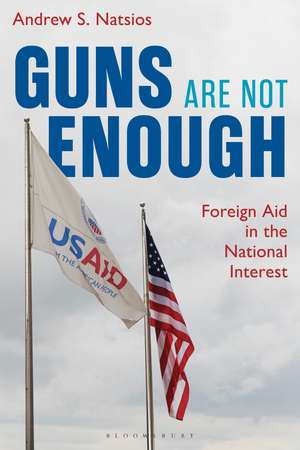
Guns Are Not Enough: Foreign Aid in the National Interest
Autor Andrew S. Natsiosen Limba Engleză Hardback – 21 ian 2027
Natsios shares deeply personal accounts from his more than 35 years of experience in international development, time in government, and often high stakes moments in Afghanistan, covering everything from preventing a famine, educating girls, building health clinics, restoring irrigation canals, and more. These experiences led Natsios to observe what he calls the five clashes of development with other bureaucratic and political interests which often hindered USAID's potential successes. He argues that these five clashes of development cannot be solved, only managed. Exploring development theory, the counter bureaucracy, diplomacy, politics, and defense - he presents sharp insights on USAID's operational model and how the Agency could have been more effective.
The destruction of USAID in 2025 is already causing profound and tragic consequences for tens of millions of people around the world. This timely portrait of USAID offers a compelling reminder of how American engagement in global affairs requires more than projections of military power. It concludes with a chapter on what American foreign aid should look like in a new era of great power rivalry.
Preț: 176.39 lei
Preț vechi: 249.56 lei
-29% Precomandă
Puncte Express: 265
Carte nepublicată încă
Livrare prin curier în România Precomanda se expediază când titlul devine disponibil.
Transport gratuit de la 400.00 lei Plată online sau ramburs, în funcție de opțiunile comenzii.
Retur gratuit în 14 zile Comandă securizată și suport în română.
Doresc să fiu notificat când acest titlu va fi disponibil:
Se trimite...
Specificații
ISBN-13: 9798216277545
Pagini: 416
Ilustrații: 30 b&w figures
Dimensiuni: 152 x 229 mm
Editura: Bloomsbury Publishing
Colecția Bloomsbury Academic
Locul publicării:New York, United States
Pagini: 416
Ilustrații: 30 b&w figures
Dimensiuni: 152 x 229 mm
Editura: Bloomsbury Publishing
Colecția Bloomsbury Academic
Locul publicării:New York, United States
Cuprins
Part I: The Mission
1. Foreign Aid: Past, Present, and Future
2. The Dismantling of the United States Agency for International Development
3. The Unintended Consequences of the Dismantling of USAID
4. The Clash of Development Theory and Practice: The Schools of Development and the Demand for Quick, Visible, and Measurable Results
Part II: Relative Autonomy from other Federal Agencies?
5. The Clash of the Counter-bureaucracy and Development: The Spread of the Obsessive Measurement Disorder
6. The Clash of the Counter-bureaucracy and Development II: The Industrialization of Development
7. The Clash of Diplomacy and Development: The Benefits and Dangers of Using Aid for Diplomatic Purposes
8. The Clash of Politics and Development: The Rise of the Foreign Aid Industrial Complex, Congress and Ideology
9. The Clash of Defense and Development: The Militarization of International Development?
10. Afghanistan Reconstruction and Development: A Case Study in the Five Clashes
Part III: The Operating Systems to Implement Programs
11. Buying Development: Business Systems, Allocating Aid, Managing Risk, and Choosing Partners
12. Conclusion: The Collapse and Rebirth of the International Aid Order: Consolidation, Decentralization, and Deregulation
1. Foreign Aid: Past, Present, and Future
2. The Dismantling of the United States Agency for International Development
3. The Unintended Consequences of the Dismantling of USAID
4. The Clash of Development Theory and Practice: The Schools of Development and the Demand for Quick, Visible, and Measurable Results
Part II: Relative Autonomy from other Federal Agencies?
5. The Clash of the Counter-bureaucracy and Development: The Spread of the Obsessive Measurement Disorder
6. The Clash of the Counter-bureaucracy and Development II: The Industrialization of Development
7. The Clash of Diplomacy and Development: The Benefits and Dangers of Using Aid for Diplomatic Purposes
8. The Clash of Politics and Development: The Rise of the Foreign Aid Industrial Complex, Congress and Ideology
9. The Clash of Defense and Development: The Militarization of International Development?
10. Afghanistan Reconstruction and Development: A Case Study in the Five Clashes
Part III: The Operating Systems to Implement Programs
11. Buying Development: Business Systems, Allocating Aid, Managing Risk, and Choosing Partners
12. Conclusion: The Collapse and Rebirth of the International Aid Order: Consolidation, Decentralization, and Deregulation
Recenzii
"After 9/11, American foreign policy was reformulated to three instruments of national power: defense, diplomacy, and development. Development has been severely damaged as a tool of U.S. power. This book describes well how that happened, why it happened, and what can be done to fix it."
"Andrew Natsios in this book puts together all his extraordinary knowledge built up over decades in the aid industry at the highest levels. This is one of those fundamental books that cannot be ignored."
"A brilliant insider assessment of the too-much maligned U.S. government's international aid agency. For U.S. government insiders and Elon Musk alike-and all students of what makes the U.S. government tick."
"Guns Are Not Enough could not be more timely. It explains how the Trump Administration took down USAID and the resulting dire consequences. More importantly, it preserves for future reference key aspects of how USAID operated and explains alternative theories of development and how to execute assistance, thereby providing the intellectual and practical knowledge, when the political time is right, for rebuilding the U.S. foreign assistance architecture."
"The Trump Administration has expended massive firepower on Iran while squandering its soft power. The unintended effect has been to entrench a cruel and unpopular regime. The truths of Guns Are Not Enough could hardly be better demonstrated!"
"Andrew Natsios was the best foreign aid director in the history of the Republic. This urgently needed book explains why-and how-U.S. foreign aid should be imagined in the future."
"Guns Are Not Enough is a must-read for understanding U.S. foreign assistance and the impact of the Trump administration's dismantling of USAID. Andrew Natsios brings the reader inside the room as consequential decisions are made on the use of development assistance as an essential pillar of national security and advancing American values. As we debate the future of foreign assistance, Guns Are Not Enough serves as an indispensable guide."
In 2025, the Trump Administration dismantled USAID. Former Administrator Natsios makes a powerful and compelling case for the contributions of USAID to U.S. national interests for less than 1 percent of the federal budget, and the need to reinvent the agency to protect those interests in this new era of great power competition. Successive administrations, Republican and Democratic, have emphasized the importance of defense, development, and diplomacy as the three pillars of American strength abroad and security at home. The virtual elimination of development and the weakening of diplomacy put our nation at risk."
"Andrew Natsios watched USAID's collapse from a vantage point almost no one else has-as a career-long leader in international development and lifelong conservative. He has written the definitive account of USAID's rise and fall-clear-eyed, unsentimental, and finally honest about what we lost. But this is not a eulogy. 'Of one thing I am certain,' he writes, 'No country can be a greater power in the modern era unless it has a functioning foreign aid program.' This is the book anyone who wants to understand American power, and its limits, needs to read."
"My friend Andrew Natsios identifies himself as a conservative Republican. In this highly readable volume he has made a case for foreign aid that is thoroughly pragmatic and compelling to citizens of all persuasions. In a clear and very persuasive way he has addressed every shibboleth raised to question the worth of this instrumental tool of international cooperation. In doing so he doesn't duck legitimate concerns raised about overly bureaucratic rules that inhibit creativity and responsiveness to local needs. In his five "clashes" to development: theory to practice, bureaucratic behavior, diplomacy, politics, and defense, he addresses real tensions and amplifies the challenges and opportunities presented by foreign aid. When working well and in concert with partners and other donors, development cooperation prevents worst-case crises, facilitates diplomatic progress, provides solutions to transnational challenges and produces results on the ground. This book should be required reading in every international relations program in the country."
"Andrew Natsios in this book puts together all his extraordinary knowledge built up over decades in the aid industry at the highest levels. This is one of those fundamental books that cannot be ignored."
"A brilliant insider assessment of the too-much maligned U.S. government's international aid agency. For U.S. government insiders and Elon Musk alike-and all students of what makes the U.S. government tick."
"Guns Are Not Enough could not be more timely. It explains how the Trump Administration took down USAID and the resulting dire consequences. More importantly, it preserves for future reference key aspects of how USAID operated and explains alternative theories of development and how to execute assistance, thereby providing the intellectual and practical knowledge, when the political time is right, for rebuilding the U.S. foreign assistance architecture."
"The Trump Administration has expended massive firepower on Iran while squandering its soft power. The unintended effect has been to entrench a cruel and unpopular regime. The truths of Guns Are Not Enough could hardly be better demonstrated!"
"Andrew Natsios was the best foreign aid director in the history of the Republic. This urgently needed book explains why-and how-U.S. foreign aid should be imagined in the future."
"Guns Are Not Enough is a must-read for understanding U.S. foreign assistance and the impact of the Trump administration's dismantling of USAID. Andrew Natsios brings the reader inside the room as consequential decisions are made on the use of development assistance as an essential pillar of national security and advancing American values. As we debate the future of foreign assistance, Guns Are Not Enough serves as an indispensable guide."
In 2025, the Trump Administration dismantled USAID. Former Administrator Natsios makes a powerful and compelling case for the contributions of USAID to U.S. national interests for less than 1 percent of the federal budget, and the need to reinvent the agency to protect those interests in this new era of great power competition. Successive administrations, Republican and Democratic, have emphasized the importance of defense, development, and diplomacy as the three pillars of American strength abroad and security at home. The virtual elimination of development and the weakening of diplomacy put our nation at risk."
"Andrew Natsios watched USAID's collapse from a vantage point almost no one else has-as a career-long leader in international development and lifelong conservative. He has written the definitive account of USAID's rise and fall-clear-eyed, unsentimental, and finally honest about what we lost. But this is not a eulogy. 'Of one thing I am certain,' he writes, 'No country can be a greater power in the modern era unless it has a functioning foreign aid program.' This is the book anyone who wants to understand American power, and its limits, needs to read."
"My friend Andrew Natsios identifies himself as a conservative Republican. In this highly readable volume he has made a case for foreign aid that is thoroughly pragmatic and compelling to citizens of all persuasions. In a clear and very persuasive way he has addressed every shibboleth raised to question the worth of this instrumental tool of international cooperation. In doing so he doesn't duck legitimate concerns raised about overly bureaucratic rules that inhibit creativity and responsiveness to local needs. In his five "clashes" to development: theory to practice, bureaucratic behavior, diplomacy, politics, and defense, he addresses real tensions and amplifies the challenges and opportunities presented by foreign aid. When working well and in concert with partners and other donors, development cooperation prevents worst-case crises, facilitates diplomatic progress, provides solutions to transnational challenges and produces results on the ground. This book should be required reading in every international relations program in the country."
Notă biografică
ANDREW S. NATSIOS served as director of the Office of Foreign Disaster Assistance in USAID during the Bush administration, as President Bush's special coordinator of Somalia relief, as vice president of World Vision, a leading international nongovernmental organization involved in disaster responses, and as a civil affairs officer in the U.S. Army reserves.