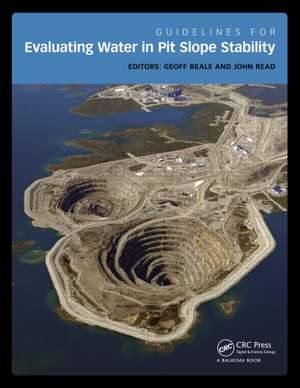
Guidelines for Evaluating Water in Pit Slope Stability
Editat de Geoff Beale, John Readen Limba Engleză Hardback – 24 ian 2014
The book comprises six sections which outline the latest technology and best practice procedures for hydrogeological investigations. The sections cover: the framework used to assess the effect of water in slope stability; how water pressures are measured and tested in the field; how a conceptual hydrogeological model is prepared; how water pressures are modelled numerically; how slope depressurisation systems are implemented; and how the performance of a slope depressurisation program is monitored and reconciled with the design.
Guidelines for Evaluating Water in Pit Slope Stability offers slope design practitioners with a road map that that will help them decide how to investigate and treat water pressures in pit slopes. It provides guidance and essential information for mining and civil engineers, geotechnical engineers, engineering geologists and hydrogeologists involved in the investigation, design and construction of stable rock slopes.
Preț: 1399.78 lei
Preț vechi: 1949.22 lei
-28%
Puncte Express: 2100
Carte indisponibilă temporar
Doresc să fiu notificat când acest titlu va fi disponibil:
Se trimite...
Specificații
ISBN-13: 9781138001343
ISBN-10: 1138001341
Pagini: 616
Ilustrații: colour illustrations, black & white tables, figures
Dimensiuni: 210 x 280 x 2 mm
Greutate: 2.25 kg
Ediția:1
Editura: CSIRO Publishing
Colecția CRC Press
ISBN-10: 1138001341
Pagini: 616
Ilustrații: colour illustrations, black & white tables, figures
Dimensiuni: 210 x 280 x 2 mm
Greutate: 2.25 kg
Ediția:1
Editura: CSIRO Publishing
Colecția CRC Press
Cuprins
1. Framework: assessing water in slope stability 2. Site characterisation 3. Preparing a conceptual hydrogeological model 4. Numerical Model 5. Implementation of slope depressurisation systems 6. Monitoring and design reconciliation.
Appendices: 1. Hydrogeological background to pit slope depressurisation 2. Guidelines for field data collection and interpretation 3. Case study: Diavik North-west wall 4. Case studies: Escondida East wall; Chuquicamata; Radomiro Tomic; Antamina West wall; Jwaneng; Cowal; Whaleback South wall; La Quinua (Yanacocha) 5. Case studies for numerical modelling 6. The lattice formulation and the Slope Model code 7. Lessons learnt and basic guidelines to monitoring for general dewatering.
Appendices: 1. Hydrogeological background to pit slope depressurisation 2. Guidelines for field data collection and interpretation 3. Case study: Diavik North-west wall 4. Case studies: Escondida East wall; Chuquicamata; Radomiro Tomic; Antamina West wall; Jwaneng; Cowal; Whaleback South wall; La Quinua (Yanacocha) 5. Case studies for numerical modelling 6. The lattice formulation and the Slope Model code 7. Lessons learnt and basic guidelines to monitoring for general dewatering.
Descriere
Guidelines for Evaluating Water in Pit Slope Stability is a comprehensive account of the hydrogeological procedures that should be followed when performing open pit slope stability design studies. Created as an outcome of the Large Open Pit (LOP) project, an international research and technology transfer project on the stability of rock slopes in open pit mines, this book expands on the hydrogeological model chapter in the LOP project’s previous book Guidelines for Open Pit Slope Design (Read & Stacey, 2009; CSIRO Publishing/CRC Press).
The book comprises six sections which outline the latest technology and best practice procedures for hydrogeological investigations. The sections cover: the framework used to assess effect of water in slope stability; how water pressures are measured and tested in the field; how a conceptual hydrogeological model is prepared; how water pressures are modelled numerically; how slope depressurisation systems are implemented; and how the performance of a slope depressurisation program is monitored and reconciled with the design.
Guidelines for Evaluating Water in Pit Slope Stability offers slope design practitioners with a road map that that will help them decide how to investigate and treat water pressures in pit slopes. It provides guidance and essential information for mining and civil engineers, geotechnical engineers, engineering geologists and hydrogeologists involved in the investigation, design and construction of stable rock slopes.
The book comprises six sections which outline the latest technology and best practice procedures for hydrogeological investigations. The sections cover: the framework used to assess effect of water in slope stability; how water pressures are measured and tested in the field; how a conceptual hydrogeological model is prepared; how water pressures are modelled numerically; how slope depressurisation systems are implemented; and how the performance of a slope depressurisation program is monitored and reconciled with the design.
Guidelines for Evaluating Water in Pit Slope Stability offers slope design practitioners with a road map that that will help them decide how to investigate and treat water pressures in pit slopes. It provides guidance and essential information for mining and civil engineers, geotechnical engineers, engineering geologists and hydrogeologists involved in the investigation, design and construction of stable rock slopes.