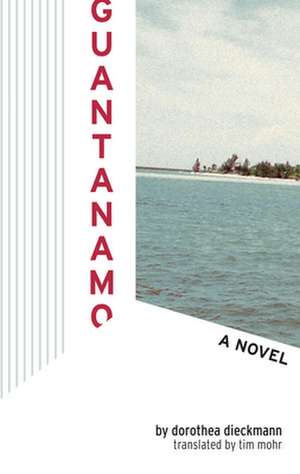
Guantanamo: Haikus for Modern Living
Autor Dorothea Dieckmann Traducere de Tim Mohren Limba Engleză Paperback – 18 apr 2007
Preț: 83.86 lei
Puncte Express: 126
Carte disponibilă
Livrare economică 11-25 iulie
Livrare prin curier în România Termenul estimat este afișat lângă disponibilitate.
Transport gratuit de la 400.00 lei Plată online sau ramburs, în funcție de opțiunile comenzii.
Retur gratuit în 14 zile Comandă securizată și suport în română.
Specificații
ISBN-13: 9781933368542
ISBN-10: 1933368543
Pagini: 151
Dimensiuni: 134 x 201 x 11 mm
Greutate: 0.15 kg
Editura: SOFT SKULL PRESS
ISBN-10: 1933368543
Pagini: 151
Dimensiuni: 134 x 201 x 11 mm
Greutate: 0.15 kg
Editura: SOFT SKULL PRESS
Notă biografică
Dorothea Dieckmann is an award-winning author from Germany. Her first novel to be translated into English is Guantanamo, which won the Best Translated Book Award. Tim Mohr is a New York-based translator, writer, and editor.
Descriere
At the beginning of the Afghan war, young Rashid, born in Hamburg to an Indian father and a German mother, travels to India to claim an inheritance. There, he befriends a young Afghan and continues his journey to Peshawar, where he ends up in the middle of an anti-American demonstration. He is arrested, handed over to the Americans, and taken to the notorious Guantanamo.
What ensues is a remarkable literary experiment, a novel based on meticulous research. In six scenes, it describes Rashid’s life at the camp. Sensitive yet utterly unsentimental, the novel explores the existential consequences of isolation, suppression, and uncertainty — paralyzing fear, psychotic delusions, manic identification with fellow prisoners, and ultimately, resignation. Written with fierce moral clarity and a remarkable economy of expression, Guantanamo functions as both a political statement and a fascinating examination of the prisoner/jailer relationship.
What ensues is a remarkable literary experiment, a novel based on meticulous research. In six scenes, it describes Rashid’s life at the camp. Sensitive yet utterly unsentimental, the novel explores the existential consequences of isolation, suppression, and uncertainty — paralyzing fear, psychotic delusions, manic identification with fellow prisoners, and ultimately, resignation. Written with fierce moral clarity and a remarkable economy of expression, Guantanamo functions as both a political statement and a fascinating examination of the prisoner/jailer relationship.