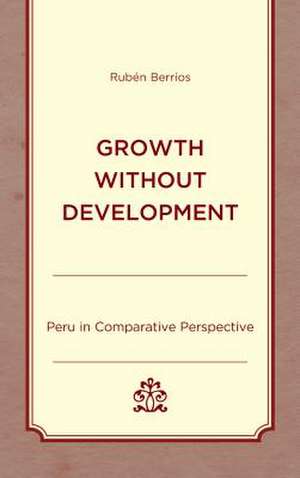
Growth without Development: Peru in Comparative Perspective
Autor Rubén Berríosen Limba Engleză Hardback – 26 noi 2018
Preț: 545.11 lei
Preț vechi: 816.54 lei
-33%
Puncte Express: 818
Carte tipărită la comandă
Livrare economică 05-19 decembrie
Livrare prin curier în România Termenul estimat este afișat lângă disponibilitate.
Transport gratuit pentru acest produs Plată online sau ramburs, în funcție de opțiunile comenzii.
Retur gratuit în 14 zile Comandă securizată și suport în română.
Specificații
ISBN-13: 9781498550734
ISBN-10: 1498550738
Pagini: 162
Dimensiuni: 163 x 229 x 17 mm
Greutate: 0.39 kg
Editura: Bloomsbury Publishing
Colecția Lexington Books
Locul publicării:New York, United States
ISBN-10: 1498550738
Pagini: 162
Dimensiuni: 163 x 229 x 17 mm
Greutate: 0.39 kg
Editura: Bloomsbury Publishing
Colecția Lexington Books
Locul publicării:New York, United States
Cuprins
Chapter One: Development Outcomes: Why Some Countries Develop and Others Fall Behind
Chapter Two: Growth Without Development
Chapter Three: Chile and Peru: Close Neighbors, Distant Paths
Chapter Four: Extractive Versus Productive Economy
Chapter Five: Human Capital and Technology Deficiencies
Chapter Six: Conclusion
Chapter Two: Growth Without Development
Chapter Three: Chile and Peru: Close Neighbors, Distant Paths
Chapter Four: Extractive Versus Productive Economy
Chapter Five: Human Capital and Technology Deficiencies
Chapter Six: Conclusion
Recenzii
An informed analysis of growth, middle-income trap, and productivity in contemporary Peru with lessons for the developing world.
Using Korea and Chile as counterexamples, Ruben Berrios asks the crucial question about Peru: why has it lacked behind in development? The book provides a fascinating political and economic analysis, helping to illuminate the importance of sound policies and the role of the state in generating economic progress.
Professor Berríos offers a welcome addition to the political-economy literature with an extremely timely and valuable comparative analysis of Latin America and Asia. The cases of Peru, South Korea, and Chile reveal that good governance and effective political leadership are as important to development as economic growth. Policymakers and scholars alike will find important lessons in this book.
Using Korea and Chile as counterexamples, Ruben Berrios asks the crucial question about Peru: why has it lacked behind in development? The book provides a fascinating political and economic analysis, helping to illuminate the importance of sound policies and the role of the state in generating economic progress.
Professor Berríos offers a welcome addition to the political-economy literature with an extremely timely and valuable comparative analysis of Latin America and Asia. The cases of Peru, South Korea, and Chile reveal that good governance and effective political leadership are as important to development as economic growth. Policymakers and scholars alike will find important lessons in this book.