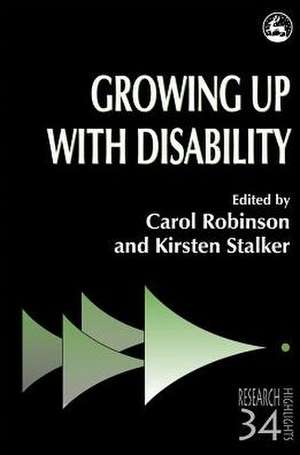
Growing Up with Disability: Research Highlights in Social Work
Editat de Carol Robinson, Kirsten Stalkeren Limba Engleză Paperback – iul 1998
Din seria Research Highlights in Social Work
- 27%
 Preț: 188.52 lei
 - 27%
 Preț: 188.00 lei
 - 26%
 Preț: 228.97 lei
 - 26%
 Preț: 192.93 lei
 - 27%
 Preț: 202.34 lei
 - 27%
 Preț: 191.79 lei
 - 26%
 Preț: 244.33 lei
 - 26%
 Preț: 242.17 lei
 - 27%
 Preț: 202.45 lei
 - 26%
 Preț: 244.68 lei
 - 27%
 Preț: 190.62 lei
 - 27%
 Preț: 170.30 lei
 - 27%
 Preț: 202.34 lei
 - 22%
 Preț: 296.63 lei
 - 27%
 Preț: 168.64 lei
 - 24%
 Preț: 218.07 lei
 -
 Preț: 233.14 lei
 - 27%
 Preț: 196.28 lei
 - 27%
 Preț: 190.45 lei
 - 27%
 Preț: 190.65 lei
 - 41%
 Preț: 194.22 lei
 -
 Preț: 282.92 lei
 - 25%
 Preț: 216.97 lei
 - 27%
 Preț: 182.83 lei
Preț: 169.76 lei
Preț vechi: 232.61 lei
-27%
Puncte Express: 255
Preț estimativ în valută:
30.06€ • 35.11$ • 26.12£
30.06€ • 35.11$ • 26.12£
Carte disponibilă
Livrare economică 31 ianuarie-14 februarie
Preluare comenzi: 021 569.72.76
Specificații
ISBN-13: 9781853025686
ISBN-10: 1853025682
Pagini: 224
Dimensiuni: 155 x 234 x 10 mm
Greutate: 0.32 kg
Editura: JESSICA KINGSLEY PUBLISHERS
Colecția Jessica Kingsley Publishers
Seria Research Highlights in Social Work
Locul publicării:London, United Kingdom
ISBN-10: 1853025682
Pagini: 224
Dimensiuni: 155 x 234 x 10 mm
Greutate: 0.32 kg
Editura: JESSICA KINGSLEY PUBLISHERS
Colecția Jessica Kingsley Publishers
Seria Research Highlights in Social Work
Locul publicării:London, United Kingdom
V-ar putea interesa
-
 Childhood PovertyOxford Department of International Development-15%Preț: 621.67 lei731.37 lei
 -
 Preț: 430.18 lei
 -
 Preț: 316.67 lei
 -
 Children's Care, Welfare & RightsJames T. Keller-31%Preț: 809.33 lei1168.22 lei
 -
 TakenBrian L. Koepel-31%Preț: 767.73 lei1109.64 lei
 -
 The Simple Guide to Child Trauma: What It Is and How to HelpBetsy de Thierry-23%Preț: 86.77 lei112.48 lei
 -
 -27%Preț: 190.50 lei260.77 lei
 -
 -31%Preț: 509.52 lei742.38 lei
 -
 -27%Preț: 204.47 lei279.61 lei
 -
 -21%Preț: 146.71 lei185.68 lei
 -
 -22%Preț: 157.53 lei201.44 lei
 -
 Supporting the Mental Health of Children in Care: Evidence-Based PracticeJeune Guishard-Pine-26%Preț: 244.02 lei330.26 lei
 -
 -22%Preț: 136.31 lei174.76 lei
 -
 -26%Preț: 228.35 lei310.58 lei
Recenzii
This book is essentially written for social workers form a sociological perspective. It is openly critical of the medical model and of psychological models of childhood, arguing that these pathologies individuals and deny the experience of the child with disability as belonging to a social group, whose experiences are structured by wider policies and practices. Therefore, at times, it makes for uncomfortable, but challenging reading. The book is extremely child-centred: the experiences of disabled children are central and the text is brought to life by the many personal accounts of living with a disability.
This is a book that will stay in the mind for a long time. There are individual chapters which stand out as clear and succinct, well researched and referenced. There are other chapters which stand out because they contain the direct words of young people growing up with disability, which summarise just as succinctly the issues covered elsewhere by the academic writers…I would suggest it should be on the essential reading list of any training course for professionals likely to work with disabled young people. The book is highly original in bringing together in one volume the voices of young people themselves and academic summaries of what is known about young disabled people growing up. It is comprehensive in scope, touching on a range of conditions, living circumstances and social background of young people. Treat yourself to a copy.
It covers a wide range of topics, from education, health, and leisure to child protection, adoption and fostering, and would be equally useful for those have daily or only occasional contact with disabled children. I enjoyed reading this book, but what makes it stand out for me is the way the principles of equality, inclusion and autonomy are incorporated, along with the views of disabled children. I would especially recommend it as a core text for students in social work, medical nursing and related areas.
Growing Up With Disability contains 13 articles encompassing a wide range of perspectives and issues on childhood impairment and its social implications. This book is soundly written from the perspective of the social model of disability by people who have an impairment. Whereas other books and articles have written from the perspective of the social model of disability by people who have an impairment. Whereas other books and articles have written about the way parents experience life with a disabled child, accounts of children's lives and experiences are presented in this book. This is not a book that will provide therapists with lots of practical suggestions to incorporate into their interventions. However, it is a book that should be read by paediatric occupational therapists who are committed to using a client-centred and/or family-centred approach when working with children. It will inform the therapist of relevant issues to consider and as such provide the therapist with greater insight and understanding. This should, as a consequence assist a therapist to build a stronger therapeutic relationship and to tailor his or her interventions more effectively to meet the real needs of the child.
This book provides a comprehensive and innovative contribution to the literature in this area. It embraces all aspects of growing up with a disability, and succinctly examines the complexities and realities of life as a disabled child. Each chapter is clear and concise, and takes the reader step by step through the varying stages of growing up with a disability from a child-centred approach. Chapters four, six, eight and nine would provide particularly helpful discussions of the salient issues relating to children with disabilities. Overall, this material would serve as a useful resource for researchers, students and academics. Additionally, this text would be an excellent handbook for policy makers and practitioners working with disabled children and their families.
This is a book that will stay in the mind for a long time. There are individual chapters which stand out as clear and succinct, well researched and referenced. There are other chapters which stand out because they contain the direct words of young people growing up with disability, which summarise just as succinctly the issues covered elsewhere by the academic writers…I would suggest it should be on the essential reading list of any training course for professionals likely to work with disabled young people. The book is highly original in bringing together in one volume the voices of young people themselves and academic summaries of what is known about young disabled people growing up. It is comprehensive in scope, touching on a range of conditions, living circumstances and social background of young people. Treat yourself to a copy.
It covers a wide range of topics, from education, health, and leisure to child protection, adoption and fostering, and would be equally useful for those have daily or only occasional contact with disabled children. I enjoyed reading this book, but what makes it stand out for me is the way the principles of equality, inclusion and autonomy are incorporated, along with the views of disabled children. I would especially recommend it as a core text for students in social work, medical nursing and related areas.
Growing Up With Disability contains 13 articles encompassing a wide range of perspectives and issues on childhood impairment and its social implications. This book is soundly written from the perspective of the social model of disability by people who have an impairment. Whereas other books and articles have written from the perspective of the social model of disability by people who have an impairment. Whereas other books and articles have written about the way parents experience life with a disabled child, accounts of children's lives and experiences are presented in this book. This is not a book that will provide therapists with lots of practical suggestions to incorporate into their interventions. However, it is a book that should be read by paediatric occupational therapists who are committed to using a client-centred and/or family-centred approach when working with children. It will inform the therapist of relevant issues to consider and as such provide the therapist with greater insight and understanding. This should, as a consequence assist a therapist to build a stronger therapeutic relationship and to tailor his or her interventions more effectively to meet the real needs of the child.
This book provides a comprehensive and innovative contribution to the literature in this area. It embraces all aspects of growing up with a disability, and succinctly examines the complexities and realities of life as a disabled child. Each chapter is clear and concise, and takes the reader step by step through the varying stages of growing up with a disability from a child-centred approach. Chapters four, six, eight and nine would provide particularly helpful discussions of the salient issues relating to children with disabilities. Overall, this material would serve as a useful resource for researchers, students and academics. Additionally, this text would be an excellent handbook for policy makers and practitioners working with disabled children and their families.
Cuprins
1. Theoretical Perspectives on Research with Disabled Children, Tom Shakespeare, University of Leeds and Nick Watson, University of Edinburgh. 2. An Historical Perspective, Maureen Oswin, retired Research Officer. 3. Early Intervention: the Eternal Triangle? Issues Relating to Parents, Professionals and Children, Caroline Jones, University of Warwick. 4. The Pre-School Years, Janet Read, University of London and June Statham, University of London. 5. Children's Experiences of School, Linda Shaw, Centre for Studies on Inclusive Education. 6. Parents and Family: Disabled Women's Stories about their Childhood Experiences, Carol Thomas, University of Lancaster. 7. Leisure and Friendship, Judith Cavet, Staffordshire University. 8. Quality of Life for Children and Young People with Serious Medical Conditions, Alison Closs, Moray House Institute of Education, Edinburgh. 9. Disabled Children and Child Protection, Helen Westcott, The Open University, Milton Keynes. 10. Group Advocacy in a Residential Setting, Chailey Young People's Group with Sue Virgo, St Gabriel's family centre, Brighton. 11. Disabled Children in Permanent Substitute Families, Rena Phillips, University of Stirling. 12. Young People's Aspirations, The Leighton Project with Simon Grant and Daisy Cole, facilitators, London. 13. The Dynamics of Transition to Adulthood, Sheila Riddell, Glasgow University.