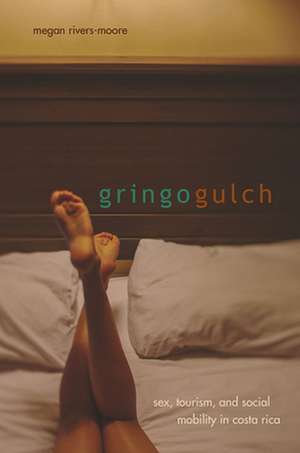
Gringo Gulch: Sex, Tourism, and Social Mobility in Costa Rica
Autor Megan Rivers-Mooreen Limba Engleză Hardback – 4 aug 2016
The story of sex tourism in the Gringo Gulch neighborhood of San José, Costa Rica could be easily cast as the exploitation of poor local women by privileged North American men—men who are in a position to take advantage of the vast geopolitical inequalities that make Latin American women into suppliers of low-cost sexual labor. But in Gringo Gulch, Megan Rivers-Moore tells a more nuanced story, demonstrating that all the actors intimately entangled in the sex tourism industry—sex workers, sex tourists, and the state—use it as a strategy for getting ahead.
Rivers-Moore situates her ethnography at the intersections of gender, race, class, and national dimensions in the sex industry. Instead of casting sex workers as hapless victims and sex tourists as neoimperialist racists, she reveals each group as involved in a complicated process of class mobility that must be situated within the sale and purchase of leisure and sex. These interactions operate within an almost entirely unregulated but highly competitive market beyond the reach of the state—bringing a distinctly neoliberal cast to the market. Throughout the book, Rivers-Moore introduces us to remarkable characters—Susan, a mother of two who doesn’t regret her career of sex work; Barry, a teacher and father of two from Virginia who travels to Costa Rica to escape his loveless, sexless marriage; Nancy, a legal assistant in the Department of Labor who is shocked to find out that prostitution is legal and still unregulated. Gringo Gulch is a fascinating and groundbreaking look at sex tourism, Latin America, and the neoliberal state.
Rivers-Moore situates her ethnography at the intersections of gender, race, class, and national dimensions in the sex industry. Instead of casting sex workers as hapless victims and sex tourists as neoimperialist racists, she reveals each group as involved in a complicated process of class mobility that must be situated within the sale and purchase of leisure and sex. These interactions operate within an almost entirely unregulated but highly competitive market beyond the reach of the state—bringing a distinctly neoliberal cast to the market. Throughout the book, Rivers-Moore introduces us to remarkable characters—Susan, a mother of two who doesn’t regret her career of sex work; Barry, a teacher and father of two from Virginia who travels to Costa Rica to escape his loveless, sexless marriage; Nancy, a legal assistant in the Department of Labor who is shocked to find out that prostitution is legal and still unregulated. Gringo Gulch is a fascinating and groundbreaking look at sex tourism, Latin America, and the neoliberal state.
Preț: 491.41 lei
Preț vechi: 662.48 lei
-26%
Puncte Express: 737
Preț estimativ în valută:
86.99€ • 101.04$ • 75.36£
86.99€ • 101.04$ • 75.36£
Carte indisponibilă temporar
Doresc să fiu notificat când acest titlu va fi disponibil:
Se trimite...
Preluare comenzi: 021 569.72.76
Specificații
ISBN-13: 9780226373386
ISBN-10: 022637338X
Pagini: 248
Ilustrații: 10 halftones, 1 line drawing, 1 table
Dimensiuni: 152 x 229 x 18 mm
Greutate: 0.43 kg
Ediția:1
Editura: University of Chicago Press
Colecția University of Chicago Press
ISBN-10: 022637338X
Pagini: 248
Ilustrații: 10 halftones, 1 line drawing, 1 table
Dimensiuni: 152 x 229 x 18 mm
Greutate: 0.43 kg
Ediția:1
Editura: University of Chicago Press
Colecția University of Chicago Press
Notă biografică
Megan Rivers-Moore is assistant professor at the Pauline Jewett Institute of Women’s and Gender Studies at Carleton University in Ottawa, Canada.
Cuprins
Acknowledgments
Introduction
1. The Commerce of Sex in Costa Rica
Part I. Sex, Class, and Consumption
2. Almighty Gringos and the Relational Economy of Sex Tourism
3. Selling Sex, Selling Care: Affective Labor in the Tourism Sector
4. Motherhood, Consumption, and the Purchase of Respectability
Part II. Regulating Sex in the Age of Neoliberalism
5. The State and the Sex Industry
6. Good for the State, Bad for the Nation: Race, Space, and Migration
Conclusion: Getting Ahead in Gringo Gulch
Methodological Appendix
Notes
References
Index
Introduction
1. The Commerce of Sex in Costa Rica
Part I. Sex, Class, and Consumption
2. Almighty Gringos and the Relational Economy of Sex Tourism
3. Selling Sex, Selling Care: Affective Labor in the Tourism Sector
4. Motherhood, Consumption, and the Purchase of Respectability
Part II. Regulating Sex in the Age of Neoliberalism
5. The State and the Sex Industry
6. Good for the State, Bad for the Nation: Race, Space, and Migration
Conclusion: Getting Ahead in Gringo Gulch
Methodological Appendix
Notes
References
Index
Recenzii
“Nuancing and unsettling simple binaries between men and women, North and South, rich and poor, agent and victim, Rivers-Moore uses rich ethnography to vividly show how tourist sex workers and their clients are all involved in complex and internally contradictory projects of self-fashioning and class mobility in a context in which sex and affective care are fully commoditized. A major contribution to the literature on sex tourism, the way Rivers-Moore highlights class, while interweaving gender, sex, race, and nation-state, is very impressive and reshapes the agenda.”
“Returning the focus to the dynamics of social class, this detailed ethnographic account tells us more about the meanings of the purchase, sale and regulation of sex and its role in the social mobility of sex workers and their clients. Through exquisite detail of the participants lives and careful sociological analysis, we learn more about the interlinks between sex tourism, labor, race, and the transnational political economy. Gringo Gulch is an important landmark in the studies of sex tourism and the broader context of the globalization of the sex industry.”
“A stellar ethnographic account of the sexual politics of neoliberalism in Costa Rica. Rivers-Moore makes a deft and compelling argument about the diverse ways that sexual commerce has become integral to a broad range of social, political, and economic transformations.”
“Gringo Gulch is an engaging and insightful read, and I would recommend it to anyone seeking to understand or challenge assumptions of sex tourists and sex workers.”