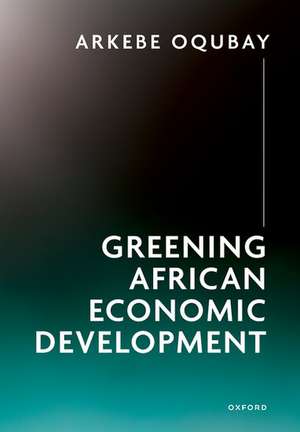
Greening African Economic Development
Autor Arkebe Oqubayen Limba Engleză Hardback – 12 ian 2027
Preț: 392.74 lei
Preț vechi: 491.29 lei
-20% Precomandă
Puncte Express: 589
Carte nepublicată încă
Livrare prin curier în România Precomanda se expediază când titlul devine disponibil.
Transport gratuit de la 400.00 lei Plată online sau ramburs, în funcție de opțiunile comenzii.
Retur gratuit în 14 zile Comandă securizată și suport în română.
Doresc să fiu notificat când acest titlu va fi disponibil:
Se trimite...
Specificații
ISBN-13: 9780197915837
ISBN-10: 0197915833
Pagini: 448
Dimensiuni: 156 x 234 mm
Editura: OUP OXFORD
Colecția OUP Oxford
Locul publicării:Oxford, United Kingdom
ISBN-10: 0197915833
Pagini: 448
Dimensiuni: 156 x 234 mm
Editura: OUP OXFORD
Colecția OUP Oxford
Locul publicării:Oxford, United Kingdom
Recenzii
Far too often, the needs of productive transformation and industrialization are presented in opposition to the need for decarbonization. Oqubay argues persuasively that bringing the two together is not just necessary but also possible, through a pragmatic strategy for energy security, industrial capability, and competitive advantage. Assessments of specific sectoral pathways in different countries in Africa highlight the importance of aligning policy across industrial hubs and enterprises (including farms) - an insight that is relevant for many other regions of the developing world.
I have always been of the opinion that we never had an economic miracle in Mauritius. The economy grew through strategic decisions being taken and in a close partnership with the private sector. The manufacturing sector has been instrumental in creating jobs and prosperity. Arkebe Oqubay reframes the question of how Africa has been industrializing while decarbonizing. He draws his conclusions from original primary fieldwork across several economies including Mauritius. He also discusses and challenges the usefulness of the concepts of "just transition" and the "energy transition" frameworks for Africa. His analysis deepens our appreciationunderstanding of the manufacturing and industrial landscapes with the understanding that a green and productive Africa is within reach.
This book addresses a major challenge for Africa, namely achieving both industrializing and greening. Written by a global authority on this issue, it looks at six strategic sectors in five countries of Ethiopia, Mauritius, Morocco, Nigeria, and South Africa. Its key argument is that such transformation should be pursued through context-specific and divergent national and sectoral pathways
It is my great pleasure to endorse Greening African Economic Development by Arkebe Oqubay. Industrialization is the core of Africas structural transformation to boost productivity, raise incomes and eradicate poverty, yet it must advance alongside economic greening and decarbonization. Backed by in-depth African country and sector research, this book abandons the outdated "grow first, clean later" model. It illustrates how aligned policies, industrial clusters, and capable firms can integrate industrial growth and green transition. Packed with practical insights, this valuable work offers vital guidance for Africa to pursue inclusive, low-carbon, and sustainable development.
A bold and vital book. It rejects the false choice between industrializing and decarbonizing, showing that African economies can - and must - do both at once. Drawing on original fieldwork across five economies and six strategic sectors, Dr. Oqubay dismantles the imported orthodoxies of "just transition" and "energy transition" and replaces them with something far more useful: a theory of green productive transformation grounded in the developmental role of the state, courageous industrial policy, and the strategic alignment of firms, industrial hubs, and government. It reframes how we think about late development in a warming world - essential reading for anyone serious about shaping economies to be sustainable and inclusive.
Can Africa's economies advance a successful green transition while also raising well-being and life opportunities for the continent's people? In Greening African Economic Development, Arkebe Oqubay draws on his decades of experience as both a researcher and policymaker to show how both these ends can be accomplished. Oqubay's writing is, at once, rigorous, lucid, visionary and fully grounded in Africa's reality today. This book is a major contribution that should quickly become a standard reference.
No book makes a better case for green industrialization in Africa. Building on detailed case studies from around the continent and challenging conventional wisdom from all sides of the development debate, Arkebe Oqubay shows how carbon-neutral growth is not just an imperative but a viable path forward with the right set of policies.
Few books on African development combine theoretical ambition and empirical grounding. This one does both. Drawing from structural transformation theory, evolutionary economics, and the political economy of late development, it constructs a framework capable of addressing the dual challenge of industrialization and decarbonization. Sector-level case studies illuminate pathways that are contingent on the national context rather than reducible to universal prescriptions. Its concluding critique of prevailing just transition frameworks, argued with clarity and intellectual honesty, exposes their limits for Africa's green development. This is a book that development economists, industrial policy scholars, and African policymakers have long needed.
Oqubay brings his vast experience as a political leader, policy maker, and scholar to the challenge of economic development in African countries. He is deeply familiar with past cases of development across several continents. Many African countries are relatively late starters: previous development paths will not work without modification. Development is a multi-decade process. Sustainability of the growth models is crucial. Oqubay argues persuasively that integrated development strategies for African countries need to be supported by industrial policies with a heavy focus on energy, on efficiency, and green energy. The industry case studies amply support the argument. It is a brave and useful contribution to unlocking African countries' enormous potential.
I have always been of the opinion that we never had an economic miracle in Mauritius. The economy grew through strategic decisions being taken and in a close partnership with the private sector. The manufacturing sector has been instrumental in creating jobs and prosperity. Arkebe Oqubay reframes the question of how Africa has been industrializing while decarbonizing. He draws his conclusions from original primary fieldwork across several economies including Mauritius. He also discusses and challenges the usefulness of the concepts of "just transition" and the "energy transition" frameworks for Africa. His analysis deepens our appreciationunderstanding of the manufacturing and industrial landscapes with the understanding that a green and productive Africa is within reach.
This book addresses a major challenge for Africa, namely achieving both industrializing and greening. Written by a global authority on this issue, it looks at six strategic sectors in five countries of Ethiopia, Mauritius, Morocco, Nigeria, and South Africa. Its key argument is that such transformation should be pursued through context-specific and divergent national and sectoral pathways
It is my great pleasure to endorse Greening African Economic Development by Arkebe Oqubay. Industrialization is the core of Africas structural transformation to boost productivity, raise incomes and eradicate poverty, yet it must advance alongside economic greening and decarbonization. Backed by in-depth African country and sector research, this book abandons the outdated "grow first, clean later" model. It illustrates how aligned policies, industrial clusters, and capable firms can integrate industrial growth and green transition. Packed with practical insights, this valuable work offers vital guidance for Africa to pursue inclusive, low-carbon, and sustainable development.
A bold and vital book. It rejects the false choice between industrializing and decarbonizing, showing that African economies can - and must - do both at once. Drawing on original fieldwork across five economies and six strategic sectors, Dr. Oqubay dismantles the imported orthodoxies of "just transition" and "energy transition" and replaces them with something far more useful: a theory of green productive transformation grounded in the developmental role of the state, courageous industrial policy, and the strategic alignment of firms, industrial hubs, and government. It reframes how we think about late development in a warming world - essential reading for anyone serious about shaping economies to be sustainable and inclusive.
Can Africa's economies advance a successful green transition while also raising well-being and life opportunities for the continent's people? In Greening African Economic Development, Arkebe Oqubay draws on his decades of experience as both a researcher and policymaker to show how both these ends can be accomplished. Oqubay's writing is, at once, rigorous, lucid, visionary and fully grounded in Africa's reality today. This book is a major contribution that should quickly become a standard reference.
No book makes a better case for green industrialization in Africa. Building on detailed case studies from around the continent and challenging conventional wisdom from all sides of the development debate, Arkebe Oqubay shows how carbon-neutral growth is not just an imperative but a viable path forward with the right set of policies.
Few books on African development combine theoretical ambition and empirical grounding. This one does both. Drawing from structural transformation theory, evolutionary economics, and the political economy of late development, it constructs a framework capable of addressing the dual challenge of industrialization and decarbonization. Sector-level case studies illuminate pathways that are contingent on the national context rather than reducible to universal prescriptions. Its concluding critique of prevailing just transition frameworks, argued with clarity and intellectual honesty, exposes their limits for Africa's green development. This is a book that development economists, industrial policy scholars, and African policymakers have long needed.
Oqubay brings his vast experience as a political leader, policy maker, and scholar to the challenge of economic development in African countries. He is deeply familiar with past cases of development across several continents. Many African countries are relatively late starters: previous development paths will not work without modification. Development is a multi-decade process. Sustainability of the growth models is crucial. Oqubay argues persuasively that integrated development strategies for African countries need to be supported by industrial policies with a heavy focus on energy, on efficiency, and green energy. The industry case studies amply support the argument. It is a brave and useful contribution to unlocking African countries' enormous potential.
Notă biografică
Arkebe Oqubay is British Academy Global Professor at SOAS University of London. He is a former Senior Minister and former Mayor of Addis Ababa, and served as a Special Advisor to three successive Prime Ministers of Ethiopia. He also holds affiliated professorships at the University of Cape Town, the University of Johannesburg, Nanyang Technological University, and Fudan University, and serves on multiple international boards, including UNU-WIDER and the Trade and Industrial Policy Advisory Council of the AfCFTA, appointed by the African Union. His many publications with OUP include The Oxford Handbook on the Greening of Economic Development (co-edited with John A. Mathews; 2025), African Economic Development: Evidence, Theory, Policy (with Christopher Cramer and John Sender; 2020), and The Oxford Handbook of Industrial Hubs and Economic Development (co-edited with Justin Yifu Lin; 2020).