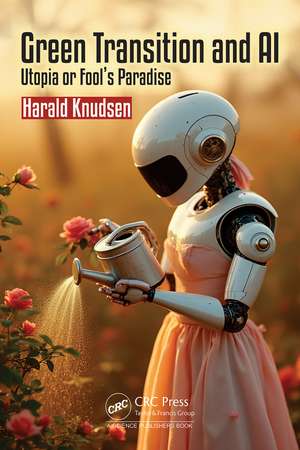
Green Transition and AI: Utopia or Fool’s Paradise
Autor Harald Knudsenen Limba Engleză Hardback – 27 apr 2026
Preț: 1069.56 lei
Preț vechi: 1304.35 lei
-18%
Puncte Express: 1604
Carte tipărită la comandă
Livrare economică 03-17 decembrie
Livrare prin curier în România Termenul estimat este afișat lângă disponibilitate.
Transport gratuit pentru acest produs Plată online sau ramburs, în funcție de opțiunile comenzii.
Retur gratuit în 14 zile Comandă securizată și suport în română.
Specificații
ISBN-13: 9781032844800
ISBN-10: 1032844809
Pagini: 342
Ilustrații: 6
Dimensiuni: 178 x 254 mm
Greutate: 0.79 kg
Ediția:1
Editura: CRC Press
Colecția CRC Press
ISBN-10: 1032844809
Pagini: 342
Ilustrații: 6
Dimensiuni: 178 x 254 mm
Greutate: 0.79 kg
Ediția:1
Editura: CRC Press
Colecția CRC Press
V-ar putea interesa
-
 Grand Transitions: How the Modern World Was MadeVaclav Smil-13%Preț: 124.62 lei143.60 lei
 -
 Positive Tipping Points: How to Fix the Climate CrisisTim Lenton OBE-17%Preț: 120.59 lei145.83 lei
 -
 The Means of Prediction: How AI Really Works (and Who Benefits)Maximilian Kasy-20%Preț: 121.37 lei151.71 lei
 -
 Taming Silicon ValleyGary F. Marcus-16%Preț: 97.57 lei116.15 lei
 -
 Against the MachinePaul KingsnorthPreț: 194.17 lei
 -
 AI 2041Kai-Fu Lee-28%Preț: 77.62 lei108.27 lei
 -
 Moonshot MomentsMilan KordestaniPreț: 95.10 lei
 -
 Societies at an AI Crossroads: Choices and Value ConflictsIgnas Kalpokas-15%Preț: 524.77 lei617.38 lei
 -
 Just Earth: How a Fairer World Will Save the PlanetTony Juniper-25%Preț: 92.78 lei123.79 lei
 -
 -41%Preț: 57.96 lei99.07 lei
 -
 -20%Preț: 79.40 lei99.25 lei
 -
 -19%Preț: 99.80 lei122.50 lei
 -
 The Progress TrapBen CobleyPreț: 165.76 lei
 -
 -29%Preț: 147.08 lei206.17 lei
 -
 Preț: 122.79 lei
 -
 Digital SustainabilityTheo LynnPreț: 325.69 lei
 -
 -19%Preț: 128.13 lei157.98 lei
 -
 Transcend: Unlocking Humanity in the Age of AIFaisal Hoque-18%Preț: 128.32 lei157.10 lei
Public țintă
Academic and PostgraduateNotă biografică
Harald Knudsen is professor emeritus of international management at the University of Agder, Norway. He is also a public speaker, outdoorsman and jazz trumpet-player. He is known for his live “leadership jazz” sessions, including nearly 15 years as an Oxford University fellow at the Egrove Park executive education venue.
Cuprins
Foreword. Preface. Introduction. PART ONE - WHAT IS THE PROBLEM? 1. The Greenhouse Effect and Extreme Weather. 2. Nature Depletion and the 6th Extinction. 3. Environmental Toxins and New Entities. 4. Energy and Feedstock “Stickiness”. 5. Technology and Energy Gaps. 6. The Promise of Artificial Intelligence. 7. AI Singularity and Agency. PART TWO - WHY ISN'T IT SOLVED? 8. From Denials to Sense of Urgency. 9. From Progress to Resentment. 10. From lock-in to Possibilism. 11. From BAU Growth to Genuine Progress. 12. From Inequality to Redistribution. 13. From AI Conundrum to Economic Security. PART THREE - IS THERE HOPE? 14. The War-economy Metaphor and Commands From Above. 15. The World Music Metaphor and Engagement from Below. 16. The “dugnad” Metaphor and the Promise of Hope. References. Index.
Descriere
How do we handle the green transition and the transition to a world governed by AI? Harald Knudsen's “Green Transition and AI: Utopia or Fool's Paradise”, offers guidance for overview and integration, asking three questions: First, what is the problem? Second, why aren’t the problems solved? Thirdly, Knudsen asks about hope and human agency.