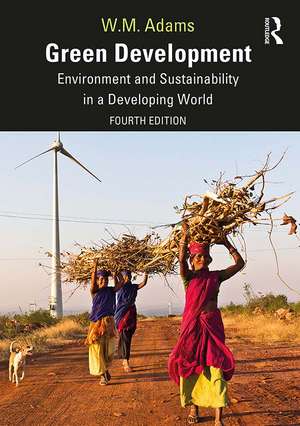
Green Development: Environment and Sustainability in a Developing World
Autor Bill Adamsen Limba Engleză Paperback – 23 dec 2019
Green Development explores the origins and evolution of mainstream thinking about sustainable development and offers a critique of the ideas behind them. It draws a link between theory and practice by discussing the nature of the environmental degradation and the impacts of development. It argues that, ultimately, ‘green’ development has to be about political economy, about the distribution of power, and not about environmental quality. Its focus is strongly on the developing world.
The fourth edition retains the broad structure of previous editions, but has been updated to reflect advances in ideas and changes in international policy. Greater attention has been given to the political ecology of development, market-based and neoliberal environmentalism, and degrowth. This fully revised edition discusses:
- the origins of thinking about sustainability and sustainable development, and its evolution to the present day;
- the ideas that dominate mainstream sustainable development (including natural capital, the green economy, market environmentalism and ecological modernisation);
- critiques of mainstream ideas and of neoliberal framings of sustainability, and alternative ideas about sustainability that challenge ‘business as usual’ thinking, such as arguments about limits to growth and calls for degrowth;
- the dilemmas of sustainability in the context of forests, desertification, food and farming, biodiversity conservation and dam construction;
- the challenge of policy choices about sustainability, particularly between reformist and radical responses to the contemporary global dilemmas.
Preț: 393.98 lei
Puncte Express: 591
Carte disponibilă
Livrare economică 16-30 noiembrie
Livrare express 30 octombrie-05 noiembrie pentru 57.48 lei
Livrare prin curier în România Termenul estimat este afișat lângă disponibilitate.
Transport gratuit de la 400.00 lei Plată online sau ramburs, în funcție de opțiunile comenzii.
Retur gratuit în 14 zile Comandă securizată și suport în română.
Specificații
ISBN-13: 9780415820721
ISBN-10: 0415820723
Pagini: 428
Ilustrații: 19 Tables, black and white; 27 Line drawings, black and white; 55 Halftones, black and white; 82 Illustrations, black and white
Dimensiuni: 174 x 246 x 21 mm
Greutate: 0.96 kg
Ediția:4 ed
Editura: Taylor & Francis
Colecția Routledge
Locul publicării:Oxford, United Kingdom
ISBN-10: 0415820723
Pagini: 428
Ilustrații: 19 Tables, black and white; 27 Line drawings, black and white; 55 Halftones, black and white; 82 Illustrations, black and white
Dimensiuni: 174 x 246 x 21 mm
Greutate: 0.96 kg
Ediția:4 ed
Editura: Taylor & Francis
Colecția Routledge
Locul publicării:Oxford, United Kingdom
Public țintă
Postgraduate and UndergraduateCuprins
1. The dilemma of sustainability 2. The roots of sustainable development 3. Mainstream sustainable development 4. Sustainability and Natural Capital 5. Neoliberalism and the Green Economy 6. Corporations and sustainability 7. Sustainability and Degrowth 8. The political forest 9. Desertification 10. Famine, Food and Farming 11. The Political Ecology of Biodiversity 12. Engineering Development 13. Green development: reformism or radicalism?
Notă biografică
Professor Bill Adams has worked for over forty years on the problematic interactions between nature and human society, mostly in Africa and the UK. He holds the Moran Chair of Conservation and Development in the Department of Geography at the University of Cambridge. He was awarded the Busk Medal by the Royal Geographical Society with the Institute of British Geographers in 2004. He blogs at Thinking Like a Human (www.thinkinglikeahuman.com).
Descriere
The book provides a clear and coherent analysis of sustainable development and explores the origins and evolution of mainstream thinking about it. It critiques of the ideas behind them and draws a link between theory and practice by discussing the nature of the environmental degradation and the impacts of development.