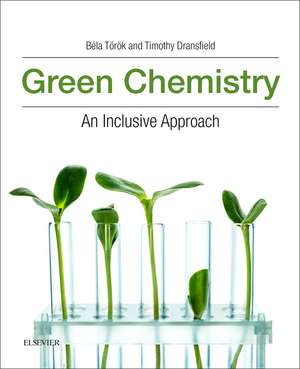
Green Chemistry: An Inclusive Approach
Editat de Bela Torok, Timothy Dransfielden Limba Engleză Paperback – 23 noi 2017
În contextul actual al programelor de studii superioare, unde sustenabilitatea a devenit un pilon central în științele naturii, Green Chemistry: An Inclusive Approach se poziționează ca o resursă academică de referință. Considerăm că această lucrare, publicată sub egida ELSEVIER SCIENCE, reușește să pună bazele teoretice necesare studenților, oferind în același timp profunzimea solicitată de cercetătorii din domeniul mediului. Structura volumului este riguros organizată pe trei paliere: o introducere istorică și conceptuală, o analiză a problemelor chimice ale societății moderne — incluzând politici globale și toxicologie — și o secțiune extinsă de aplicații practice.
Această abordare progresivă permite cititorului să navigheze de la compoziția naturală a atmosferei și a solului către provocări complexe precum depletarea stratului de ozon, contaminanții emergenți (nanomateriale și reziduuri farmaceutice) sau cataliza omogenă. Comparabil cu Green Chemistry Approaches to Environmental Sustainability de Vinod Kumar Garg în rigurozitate, volumul de față este actualizat pentru noile dinamici ale crizei climatice, punând un accent deosebit pe integrarea principiilor toxicologice direct în curriculumul de chimie.
Editorul Bela Torok, cunoscut pentru lucrări precum Heterogeneous Catalysis in Sustainable Synthesis, își extinde aici aria de expertiză de la sinteza sustenabilă la o viziune panoramică asupra disciplinei. Dacă în lucrările sale anterioare se concentra pe metode specifice de activare (microunde, ultrasunete), în acest volum coordonează o echipă multidisciplinară pentru a oferi ceea ce noi numim o „enciclopedie aplicată”. Textul transformă concepte abstracte în soluții pentru industrii diverse, de la parfumerie la producția de energie regenerabilă, fiind un instrument esențial pentru tranziția către o economie circulară.
Preț: 822.39 lei
Preț vechi: 1155.62 lei
-29%
Carte tipărită la comandă
Livrare economică 23 noiembrie-07 decembrie
Specificații
ISBN-10: 012809270X
Pagini: 1058
Dimensiuni: 191 x 235 x 56 mm
Greutate: 2.2 kg
Editura: ELSEVIER SCIENCE
V-ar putea interesa
-
 Environmental Chemistry: A global perspectiveGary W. vanLoon-20%Preț: 494.36 lei620.12 lei
 -
 Elements of a Sustainable WorldJohn Evans-10%Preț: 344.19 lei384.04 lei
 -
 Organic SynthesisMichael Smith-32%Preț: 826.99 lei1208.85 lei
 -
 Organic Laboratory Experiments of the Future: Doing Chemistry in WaterBruce H. Lipshutz-32%Preț: 523.96 lei769.00 lei
 -
 Understanding the Chemistry of the EnvironmentFg Calvo-Flores-19%Preț: 535.71 lei661.37 lei
 -
 Environmental ChemistryColin Baird-39%Preț: 570.83 lei938.35 lei
 -
 50 Chemistry Ideas You Really Need to KnowHayley Birch-27%Preț: 52.23 lei71.42 lei
 -
 Advances in Environmental Research: Volume 18Justin A Daniels-26%Preț: 730.58 lei992.26 lei
 -
 Green ChemistryRafael Luque-26%Preț: 1225.57 lei1664.84 lei
 -
 Green ChemistryMike LancasterPreț: 363.94 lei
 -
 Green Chemistry ApplicationsMurat Eyvaz-23%Preț: 802.92 lei1042.76 lei
 -
 Going NuclearTim GregoryPreț: 124.00 lei
 -
 Preț: 386.06 lei
 -
 -14%Preț: 1123.53 lei1306.43 lei
 -
 Catalysis 2e – Concepts and Green ApplicationsG Rothenberg-11%Preț: 432.10 lei485.50 lei
 -
 Green Chemical Synthesis with Microwaves and UltrasoundDakeshwar Kumar Verma-14%Preț: 922.21 lei1072.34 lei
 -
 Zeolites in Sustainable ChemistryFeng-Shou Xiao-15%Preț: 742.71 lei873.78 lei
 -
 Green ChemistryVinod K. Tiwari-24%Preț: 647.35 lei851.78 lei
 -
 Emerging Trends in Synthesis and Catalysis in ChemistrySunita Rattan-18%Preț: 1159.79 lei1414.38 lei
 -
 -24%Preț: 1211.11 lei1593.56 lei
De ce să citești această carte
Recomandăm această lucrare studenților și profesioniștilor care doresc să înțeleagă chimia nu doar ca proces industrial, ci ca soluție ecologică. Cititorul câștigă o perspectivă integrată asupra modului în care sinteza chimică poate coexista cu protecția atmosferei, apei și solului. Este un manual complet care face legătura între cercetarea fundamentală și politicile de mediu, oferind soluții concrete pentru gestionarea gazelor cu efect de seră și a deșeurilor farmaceutice.
Descriere scurtă
By bringing together experts in multiple subdisciplines of green chemistry, the editors have curated a single central resource for an introduction to the discipline as a whole. Topics include a broad array of research fields, including the chemistry of Earth’s atmosphere, water and soil, the synthesis of fine chemicals, and sections on pharmaceuticals, plastics, energy related issues (energy storage, fuel cells, solar, and wind energy conversion etc., greenhouse gases and their handling, chemical toxicology issues of everyday products (from perfumes to detergents or clothing), and environmental policy issues.
- Introduces the topic of green chemistry with an overview of key concepts
- Expands upon presented concepts with the latest research and applications, providing both the breadth and depth researchers need
- Includes a broad range of application based problems to make the content accessible for professional researchers and undergraduate and graduate students
- Authored by experts in a broad range of fields, providing insider information on the aspects or challenges of a given field that are most important and urgent
Cuprins
1.1 Green Chemistry: Historical Perspectives and Basic Concepts
2. Chemical Issues of Modern Society
2.1 Environmental Chemistry, Renewable Energy and Global Policy
2.2 Sustainable Synthesis
2.3. Integrating the Principles of Toxicology Into a Chemistry Curriculum
2.4 Effects of Environmental Factors on DNA: damage and mutations
3. Green Chemistry in Practice
3.1. The Natural Atmosphere
3.2. Air Pollution and Air Quality
3.3. Stratospheric Ozone Depletion and Recovery
3.4. The Greenhouse Effect, Aerosols, and Climate Change
3.5. The Chemistry of Natural Waters
3.6. Water Contamination and Pollution
3.7. Contaminants of Emerging Concern, with an Emphasis on Nanomaterials and Pharmaceuticals
3.8. Pollution in the Coastal Zone: A Case Study of Wastewater on Cape Cod, MA
3.9. The Composition of Soils and Sediments
3.10. Heavy Metal Pollution and Remediation
3.11. Application of Green Chemistry in Homogeneous Catalysis
3.12. Heterogeneous Catalysis: A Fundamental Pillar of Sustainable Synthesis
3.13. Phase Transfer Catalysis: a Tool for Environmentally Benign Synthesis
3.14. Biocatalysis: Nature’s Chemical Toolbox
3.15. Organic Solvents in Sustainable Synthesis and Engineering by
3.16. Ionic liquids as novel media and catalysts for electrophilic/onium ion chemistry and metal-mediated reactions
3.17. Solvent-free synthesis of nanoparticles
3.18. Application of Microwaves in Sustainable Organic Synthesis
3.19. Application of Sonochemical Activation in Green Synthesis
3.20. Principles of Electrocatalysis
3.21. Principles of Photochemical Activation toward Artificial Photosynthesis and Organic Transformations
3.22. Biopolymers: biodegradable alternatives to traditional plastics
3.23. Modern Applications of Green Chemistry: Renewable Energy
3.24. From ethanol to biodiesel: a survey of green fuels
3.25. Solar Energy Conversion
3.26. Towards a Sustainable Carbon Cycle: the Methanol Economy
3.27. Natural and Nature-Inspired Synthetic Small Molecule Antioxidants in the Context of Green Chemistry
3.28. The Value-adding Connections between the Management of Eco-innovation and the Principles of Green Chemistry and Engineering
3.29. The International Chemicals Regime: Protecting Health and the Environment