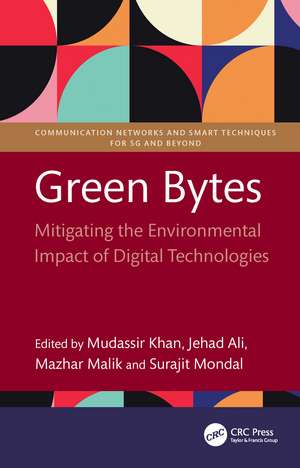
Green Bytes: Mitigating the Environmental Impact of Digital Technologies: Communication Networks and Smart Techniques for 5G and beyond
Editat de Mudassir Khan, Jehad Ali, Mazhar Malik, Surajit Mondalen Limba Engleză Hardback – 5 noi 2026
Primarily written for senior undergraduates, graduate students, and academic researchers in electrical engineering, communications engineering, computer science, environmental engineering, and information technology, this text serves as a critical resource for understanding and addressing the environmental implications of digital innovation.


Preț: 1447.11 lei
Preț vechi: 1764.77 lei
-18% Precomandă
Puncte Express: 2171
Carte nepublicată încă
Livrare prin curier în România Precomanda se expediază când titlul devine disponibil.
Transport gratuit pentru acest produs Plată online sau ramburs, în funcție de opțiunile comenzii.
Retur gratuit în 14 zile Comandă securizată și suport în română.
Doresc să fiu notificat când acest titlu va fi disponibil:
Se trimite...
Specificații
ISBN-13: 9781041160939
ISBN-10: 1041160933
Pagini: 482
Ilustrații: 140
Dimensiuni: 156 x 234 mm
Greutate: 0.85 kg
Ediția:1
Editura: CRC Press
Colecția CRC Press
Seria Communication Networks and Smart Techniques for 5G and beyond
ISBN-10: 1041160933
Pagini: 482
Ilustrații: 140
Dimensiuni: 156 x 234 mm
Greutate: 0.85 kg
Ediția:1
Editura: CRC Press
Colecția CRC Press
Seria Communication Networks and Smart Techniques for 5G and beyond
Public țintă
Academic, Postgraduate, and Undergraduate AdvancedCuprins
1. Integration of Geothermal and Wind Speed System for a Sustainable Clean Energy Transition. 2. The Green Paradox of Digital Growth: Assessing Consumption and Sustainability. 3. Policy and Regulation: Driving Metrics for E-Waste and Energy Efficiency. 4. Governance and compliance strategies for a secure and innovative IoT ecosystem. 5. Circular Informatics: Aligning E-Waste Management with the 2030 Agenda for Sustainable Development. 6. Cross-Cutting Benefits of Cloud Adoption: Education, Healthcare, and Energy Systems. 7. E-waste: The economical aspect and possible wealth. 8. Digital Consumption and Ecological Responsibility: Media, Culture, and Sustainability in the Digital Age. 9. Circular Pathways for Sustainable Electronic Waste Systems. 10. Environmental and Health Impacts of Digital Consumption: Challenges from Electronic Waste. 11. Sustainable AI Pipelines: Cloud- and Blockchain-Driven Efficiency in Object Detection Systems. 12. GreenXchange: Revolutionizing Green Credit Trading and Exchange in Business using Blockchain. 13. Innovations in cooling and power management. 14. Towards Smart Water Infrastructure: Integration of IoT Sensors and Cloud Platforms. 15. Smart Consumer Behavior and the Spread of Viral Marketing Campaigns in Digital Environments. 16. The Dark Flow: Digitizing and Decarbonizing the Informal E-Waste Ecosystem via Blockchain and IoT. 17. Smart Pathways to Net Zero - Transitioning Carbon Capture and Sequestration Using AI Technologies. 18. Governing digital technologies: Policies and regulations to mitigate environmental impact. 19. Environmental Impact of Digital Consumption. 20. Role of Blockchain in Green Technology.
Notă biografică
Mudassir Khan is a distinguished academician, researcher, author, and consultant in computer science and Artificial intelligence and currently associated with King Khalid University, Saudi Arabia. He holds an MCA from Gautam Budh Technical University, India, and a Ph.D. in Big Data Analytics using Deep Learning from Noida International University, India. He is currently pursuing a postdoctoral fellowship at Multimedia University, Malaysia, and serves as Co-Supervisor for Postgraduate Studies at Lincoln University College, Malaysia. With over 13 years of teaching and research experience, his expertise includes Big Data, Deep Learning, Machine Learning, Data Science, IoT, Artificial Intelligence, and medical imaging. He has published 140+ research articles in SCI, SCIE, and SCOPUS-indexed journals, edited books with reputed international publishers, and authored four computer science books.
Jehad Ali (PhD, Computer Science and Engineering, Senior Member IEEE) is currently working as a professor at the Department of Artificial Intelligence Convergence Network, Ajou University, South Korea. Previously, he worked as an assistant professor at the Department of Computer Science and Engineering, Sejong University, South Korea. He has published more than 60 peer-reviewed papers in various journals such as IEEE Transactions on Industrial Informatics, IEEE Transactions on Intelligent Transportation Systems, IEEE Internet of Things Journal, IEEE Internet-of-Things magazine, IEEE Access, Sensors, Electronics, Applied Sciences, PLOS One, etc., with a cumulative impact factor of more than 150 according to JCR 2021. His research interests include, but are not limited to, Software-Defined Networking, extending it for 5G/6G issues, and improving QoS with SDN, Internet of Things, wireless sensor networks, and applications of machine learning in communication, networking, and healthcare.
Mazhar Malik (SFHEA, SMIEEE, CEng, FBCS, CITP) currently serves as the Associate Director/Head of Intelligent Systems at the School of Computing and Creative Technologies, University of the West of England, Bristol, United Kingdom. He brings a wealth of experience and expertise in the fields of IoT, cybersecurity, and digital forensics. Before this role, he was Programme Director and Senior Lecturer in Cyber Security and Digital Forensics at the Cardiff School of Technologies, Cardiff Metropolitan University, United Kingdom. He is actively involved in the accreditation of programs by the British Computer Society (BCS) and he reviews programs for accreditation by MOHERI and OAAA in Oman, China, Pakistan, and Malaysia. Beyond his academic commitments, he serves on the editorial boards of several international peer-reviewed journals.
Surajit Mondal is currently associated with Amity University, Bengaluru, India. He is a certified ISO 50001:2018 Lead Auditor for Energy Management Systems by CQI and IRCA and has over 10 years of experience in teaching, research, research management, project management, and academic activities. He has published 65 research articles, including 50 papers in Scopus- and SCI-indexed journals, and is involved in several edited books with international academic publishers. He has also contributed significantly to innovation and technology development, with 98 patents, including 46 granted patents. His research interests include energy management, renewable energy, sustainability, energy-efficient technologies, digital technologies, smart systems, and emerging interdisciplinary engineering applications.
Jehad Ali (PhD, Computer Science and Engineering, Senior Member IEEE) is currently working as a professor at the Department of Artificial Intelligence Convergence Network, Ajou University, South Korea. Previously, he worked as an assistant professor at the Department of Computer Science and Engineering, Sejong University, South Korea. He has published more than 60 peer-reviewed papers in various journals such as IEEE Transactions on Industrial Informatics, IEEE Transactions on Intelligent Transportation Systems, IEEE Internet of Things Journal, IEEE Internet-of-Things magazine, IEEE Access, Sensors, Electronics, Applied Sciences, PLOS One, etc., with a cumulative impact factor of more than 150 according to JCR 2021. His research interests include, but are not limited to, Software-Defined Networking, extending it for 5G/6G issues, and improving QoS with SDN, Internet of Things, wireless sensor networks, and applications of machine learning in communication, networking, and healthcare.
Mazhar Malik (SFHEA, SMIEEE, CEng, FBCS, CITP) currently serves as the Associate Director/Head of Intelligent Systems at the School of Computing and Creative Technologies, University of the West of England, Bristol, United Kingdom. He brings a wealth of experience and expertise in the fields of IoT, cybersecurity, and digital forensics. Before this role, he was Programme Director and Senior Lecturer in Cyber Security and Digital Forensics at the Cardiff School of Technologies, Cardiff Metropolitan University, United Kingdom. He is actively involved in the accreditation of programs by the British Computer Society (BCS) and he reviews programs for accreditation by MOHERI and OAAA in Oman, China, Pakistan, and Malaysia. Beyond his academic commitments, he serves on the editorial boards of several international peer-reviewed journals.
Surajit Mondal is currently associated with Amity University, Bengaluru, India. He is a certified ISO 50001:2018 Lead Auditor for Energy Management Systems by CQI and IRCA and has over 10 years of experience in teaching, research, research management, project management, and academic activities. He has published 65 research articles, including 50 papers in Scopus- and SCI-indexed journals, and is involved in several edited books with international academic publishers. He has also contributed significantly to innovation and technology development, with 98 patents, including 46 granted patents. His research interests include energy management, renewable energy, sustainability, energy-efficient technologies, digital technologies, smart systems, and emerging interdisciplinary engineering applications.
Descriere
The book offers a comprehensive examination of the environmental impact throughout the entire lifecycle of digital devices, from resource extraction to disposal. It gives an in-depth focus on mining, manufacturing, and e-waste.