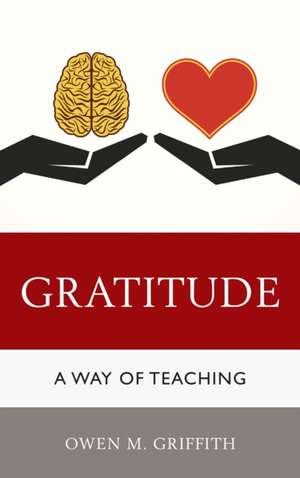
Gratitude: A Way of Teaching
Autor Owen M. Griffithen Limba Engleză Paperback – 8 apr 2016
| Toate formatele și edițiile | Preț | Express |
|---|---|---|
| Paperback (1) | 207.46 lei 43-57 zile | |
| Bloomsbury Publishing – 8 apr 2016 | 207.46 lei 43-57 zile | |
| Hardback (1) | 359.07 lei 43-57 zile | |
| Bloomsbury Publishing – 8 apr 2016 | 359.07 lei 43-57 zile |
Preț: 207.46 lei
Preț vechi: 265.03 lei
-22%
Puncte Express: 311
Preț estimativ în valută:
36.73€ • 42.77$ • 31.91£
36.73€ • 42.77$ • 31.91£
Carte tipărită la comandă
Livrare economică 23 februarie-09 martie
Preluare comenzi: 021 569.72.76
Specificații
ISBN-13: 9781475820638
ISBN-10: 1475820631
Pagini: 148
Dimensiuni: 153 x 226 x 12 mm
Greutate: 0.23 kg
Editura: Bloomsbury Publishing
Colecția Rowman & Littlefield Publishers
Locul publicării:New York, United States
ISBN-10: 1475820631
Pagini: 148
Dimensiuni: 153 x 226 x 12 mm
Greutate: 0.23 kg
Editura: Bloomsbury Publishing
Colecția Rowman & Littlefield Publishers
Locul publicării:New York, United States
V-ar putea interesa
-
 The Demands of Liberal EducationMeira Levinson-18%Preț: 347.52 lei426.12 lei
 -
 Preț: 267.13 lei
 -
 Education and the Social OrderBertrand RussellPreț: 126.65 lei
 -
 Chomsky on Democracy and EducationNoam ChomskyPreț: 392.94 lei
 -
 Education Studies: Essential IssuesSteve BartlettPreț: 454.10 lei
 -
 Global Trends in Educational PolicyDavid P. Baker-9%Preț: 738.68 lei811.74 lei
 -
 The Ignorant Schoolmaster: Five Lessons in Intellectual EmancipationJacques RancièrePreț: 211.67 lei
 -
 The Salmon of KnowledgeNick OwenPreț: 149.56 lei
 -
 Preț: 444.11 lei
 -
 The Magic of MetaphorNick OwenPreț: 98.61 lei
Cuprins
Dedication
Foreword- Dr. Jeff Froh, Hofstra University
Preface
Introduction
Part I - Overview of Gratitude
Chapter 1: The Roots of Gratitude: Positive Psychology
Chapter 2: Challenge the Culture of Complaining
Chapter 3: Gratitude vs. Materialism and Entitlement
Chapter 4: Overcoming Barriers to Gratitude
Chapter 5: Gratitude and Loss
Chapter 6: Gratitude and Technology
Part II - Applying Gratitude
Chapter 7: Giving Students the Gift of Gratitude
Chapter 8: Gratitude and Mindfulness
Chapter 9: Gratitude and Teenagers
Chapter 10: Enlisting the Support of Family
Chapter 11: Keeping Gratitude Fresh and Energized over the School Year
Chapter 12: Remaining Teachable with Gratitude
References
Gratitude Resources
Index
About the Author
Acknowledgments
Foreword- Dr. Jeff Froh, Hofstra University
Preface
Introduction
Part I - Overview of Gratitude
Chapter 1: The Roots of Gratitude: Positive Psychology
Chapter 2: Challenge the Culture of Complaining
Chapter 3: Gratitude vs. Materialism and Entitlement
Chapter 4: Overcoming Barriers to Gratitude
Chapter 5: Gratitude and Loss
Chapter 6: Gratitude and Technology
Part II - Applying Gratitude
Chapter 7: Giving Students the Gift of Gratitude
Chapter 8: Gratitude and Mindfulness
Chapter 9: Gratitude and Teenagers
Chapter 10: Enlisting the Support of Family
Chapter 11: Keeping Gratitude Fresh and Energized over the School Year
Chapter 12: Remaining Teachable with Gratitude
References
Gratitude Resources
Index
About the Author
Acknowledgments
Recenzii
This book is a must-read for teachers and parents who want to tap into the transformative power of gratitude for themselves and for the young people in their lives. Owen M. Griffith provides us with a variety of challenges and stories from his personal experiences as an elementary school teacher that not only help fend off anxiety and complaining, but that help bring out the unexpected resourcefulness and goodwill in us all. In an age of limitless information and choices, this book shows us how to make grateful choices that will simply make life more memorable and fulfilling at home and at school.
This book is an excellent tool for educators and parents to transform the students' disposition from victim to advocate. It addresses how to model behavior in order to combat the denial of accountability, treat the cancer of complaining, and reverse the effects of emotional atrophy. Each chapter provides activities ("Let's talk about it") to instill skills in our students to become a valuable contributor in our society. Gratitude: A Way of Teaching is about future-proofing by investing in our future one gratitude at a time.
In a time of tests, accountability, and burnout, Gratitude: A Way of Teaching beautifully encourages teachers and students to connect to their own and each other's humanity by stopping for a moment and asking, 'What is wonderful about life?'
In Gratitude: A Way of Teaching, Mr. Griffith does a superb job at giving teachers practical strategies for making their students grateful. Following these strategies, and with patience and persistence, we can significantly influence the children in our own personal worlds. And, if we do, that will influence programs, clubs, schools, and other institutions in the community, too. Our society needs this book more than ever. With teachers like Mr. Griffith in the classroom waving the "gratitude flag," we parents have yet another reason to be grateful.
Gratitude is a difference-maker. With the power to heal, energize, and change lives, we need gratitude in the classroom more than ever. Weaving together real world examples, inspirational stories, and the latest science, Owen M. Griffith explains why. Gratitude: A Way of Teaching should be required reading for teachers, administrators, parents, and anyone else who has a stake in our children's future. You will be challenged, edified, and stirred to take a fresh look at this timeless virtue and see why we owe our children the gift of gratitude.
Exciting new research has shown that gratitude may play a vital role in our schools. In Gratitude: A Way of Teaching, Owen M. Griffith writes about how he has used this research in his classroom. I believe that this book will help many people. In a very practical way, Griffith shows how gratitude can be incorporated into the schools. Filled with inspiring examples and many practical suggestions, this book can be used to improve the gratitude of students in your classroom, and perhaps more importantly, it should help teachers generate a more grateful attitude toward their students. My hope is that this book will provide the spark to develop new ways to incorporate gratitude into the school setting.
This is an important book that inspires us to revitalize our classrooms through the lenses of gratitude, calling for teachers, parents, and students to create a joyful and kind environment so that we all may thrive.
This book is an excellent tool for educators and parents to transform the students' disposition from victim to advocate. It addresses how to model behavior in order to combat the denial of accountability, treat the cancer of complaining, and reverse the effects of emotional atrophy. Each chapter provides activities ("Let's talk about it") to instill skills in our students to become a valuable contributor in our society. Gratitude: A Way of Teaching is about future-proofing by investing in our future one gratitude at a time.
In a time of tests, accountability, and burnout, Gratitude: A Way of Teaching beautifully encourages teachers and students to connect to their own and each other's humanity by stopping for a moment and asking, 'What is wonderful about life?'
In Gratitude: A Way of Teaching, Mr. Griffith does a superb job at giving teachers practical strategies for making their students grateful. Following these strategies, and with patience and persistence, we can significantly influence the children in our own personal worlds. And, if we do, that will influence programs, clubs, schools, and other institutions in the community, too. Our society needs this book more than ever. With teachers like Mr. Griffith in the classroom waving the "gratitude flag," we parents have yet another reason to be grateful.
Gratitude is a difference-maker. With the power to heal, energize, and change lives, we need gratitude in the classroom more than ever. Weaving together real world examples, inspirational stories, and the latest science, Owen M. Griffith explains why. Gratitude: A Way of Teaching should be required reading for teachers, administrators, parents, and anyone else who has a stake in our children's future. You will be challenged, edified, and stirred to take a fresh look at this timeless virtue and see why we owe our children the gift of gratitude.
Exciting new research has shown that gratitude may play a vital role in our schools. In Gratitude: A Way of Teaching, Owen M. Griffith writes about how he has used this research in his classroom. I believe that this book will help many people. In a very practical way, Griffith shows how gratitude can be incorporated into the schools. Filled with inspiring examples and many practical suggestions, this book can be used to improve the gratitude of students in your classroom, and perhaps more importantly, it should help teachers generate a more grateful attitude toward their students. My hope is that this book will provide the spark to develop new ways to incorporate gratitude into the school setting.
This is an important book that inspires us to revitalize our classrooms through the lenses of gratitude, calling for teachers, parents, and students to create a joyful and kind environment so that we all may thrive.