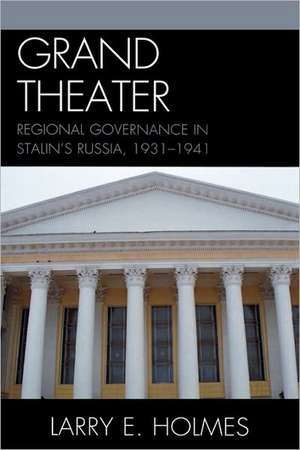
Grand Theater: Regional Governance in Stalin's Russia, 1931-1941
Autor Larry E. Holmesen Limba Engleză Hardback – 16 aug 2009
Grand Theater provides novel insights into the functioning of Stalinist bureaucracy, brings to the forefront a new understanding of center-periphery relations, and reveals the important role of individuals in what has heretofore been largely regarded, when beyond the Kremlin's inner circle, as a highly impersonal system. It also examines in unprecedented ways the reciprocal relationship between ideology and policy formation, on the one hand, and actual administrative practices, on the other, a relationship that more often than not had negative and dysfunctional consequences for both the governed and governing. Holmes argues that the Soviet administrative system during the 1930s was much like grand theater. The documents produced for and by that system were the script for a discursive theatrical reality that inspired neither a careful appraisal of problems nor a dispassionate search for workable solutions.
Preț: 659.03 lei
Preț vechi: 1053.42 lei
-37%
Puncte Express: 989
Carte tipărită la comandă
Livrare economică 07-21 decembrie
Livrare prin curier în România Termenul estimat este afișat lângă disponibilitate.
Transport gratuit pentru acest produs Plată online sau ramburs, în funcție de opțiunile comenzii.
Retur gratuit în 14 zile Comandă securizată și suport în română.
Specificații
ISBN-13: 9780739135914
ISBN-10: 0739135910
Pagini: 257
Dimensiuni: 164 x 238 x 24 mm
Greutate: 0.52 kg
Editura: Bloomsbury Publishing
Colecția Lexington Books
Locul publicării:New York, United States
ISBN-10: 0739135910
Pagini: 257
Dimensiuni: 164 x 238 x 24 mm
Greutate: 0.52 kg
Editura: Bloomsbury Publishing
Colecția Lexington Books
Locul publicării:New York, United States
Cuprins
Chapter 1 Preface
Chapter 2 Note on Transliteration and Abbreviation
Chapter 3 Districts in the Kirov Region, 1935
Chapter 4 Introduction
Chapter 5 1. A Script of Perfection, Failure, Blame
Chapter 6 2. Ascent into Darkness: Escalating Negativity, 1931-1941
Chapter 7 3. A Symbiosis of Errors: The Personal, Professional, and Political, 1931-1941
Chapter 8 4. The Art of Complaint, 1931-1938
Chapter 9 5. Power to the People and to the State: Great Performances by V. P. Bulygina and E. T. Chernykh
Chapter 10 6. "My Friend, I've Hit Rock Bottom": Politics and Friendship
Chapter 11 7. A Tragedy: The Terror
Chapter 12 8. Degeneration of the Symbiosis of Errors, 1938-1941
Chapter 13 9. "Stop This Petty Tyranny": The Administration of Schools in Falenki, 1940-1941
Chapter 14 10. Proprietary Professionalism: Mine by Right, 1938-1941
Chapter 15 Conclusion
Chapter 2 Note on Transliteration and Abbreviation
Chapter 3 Districts in the Kirov Region, 1935
Chapter 4 Introduction
Chapter 5 1. A Script of Perfection, Failure, Blame
Chapter 6 2. Ascent into Darkness: Escalating Negativity, 1931-1941
Chapter 7 3. A Symbiosis of Errors: The Personal, Professional, and Political, 1931-1941
Chapter 8 4. The Art of Complaint, 1931-1938
Chapter 9 5. Power to the People and to the State: Great Performances by V. P. Bulygina and E. T. Chernykh
Chapter 10 6. "My Friend, I've Hit Rock Bottom": Politics and Friendship
Chapter 11 7. A Tragedy: The Terror
Chapter 12 8. Degeneration of the Symbiosis of Errors, 1938-1941
Chapter 13 9. "Stop This Petty Tyranny": The Administration of Schools in Falenki, 1940-1941
Chapter 14 10. Proprietary Professionalism: Mine by Right, 1938-1941
Chapter 15 Conclusion
Recenzii
The grand theater to which the title refers rests upon the 'scripts' assembled by Holmes from letters, meeting transcripts, administrative reports, legal records, personnel dossiers, and similar materials that he painstakingly analyzed in the archives of the Kirov region. The book's narrative thus mainly consists of detailed discourses among teachers, civil bureaucrats, and party officials that the author interprets as the scripts of his theater. Nearly every chapter also benefits from a carefully assembled conclusion that advances the main arguments of the book....this book is worthy of the attention of specialists.
This is an important book for anyone interested in schools, educational policy, microhistory, and Stalinism of the 1930s. Holmes's book does what the best local studies should do: while providing a personal and penetrating look at real people on the ground, it also makes important larger interpretive points and suggests new frameworks for bigger pictures.
The book claims a wider relevance for this approach to the study of the Stalinist system at the province level.
Holmes's book is full of insights into how the Stalinist system really operated, exploring the complete mismatch between what was supposed to happen and what could actually happend.....In giving due consideration to those forgotten years, 1940-1941, Holmes has perhaps opened up the next phase of research for those wishing to make sense of Stalin's Russia.
Larry Holmes is rightly recognized as one of the leading historians on the Soviet education system in the 1920s and 1930s. His latest monograph, Grand Theater, will only reinforce this status. Working on a tip from a Russian education scholar, Holmes departed the more familiar Moscow archives for the city of Kirov, in the Volga-Vyatka region, where a treasure trove of material on the regional administration of education in the 1930s supposedly awaited discovery. The tip paid off, and the result is a terrific book that takes the reader into the day-to-day tasks, worries, and affairs (business and otherwise) of the Kirov district's education establishment.
Holmes produces a detailed, nuanced, and largely persuasive picture of the operations of power in a Soviet province under the highly centralized, yet often chaotic, Stalinist system. ... This book is to be highly commended for its subtle analysis of Soviet governance in action at regional and local levels and of how power was experienced, rehearsed, and reproduced by social actors in everyday life on the periphery. The author's prose is simple, direct, lucid, and jargon-free. This is a lively and intellectually stimulating work, which will be of greatest interest to all scholars and students of Stalinist Russia and of modern European history.
Larry Holmes, our leading expert on Soviet schools, has turned his attention from Moscow to the provinces. In this lively and well-researched book, he focuses not on grand theories of bureaucracy but rather on daily practice. The result is a lively and fascinating close-to-the-ground account in which we meet real people as they live their lives and perform their roles in Soviet schools.
This is an important book for anyone interested in schools, educational policy, microhistory, and Stalinism of the 1930s. Holmes's book does what the best local studies should do: while providing a personal and penetrating look at real people on the ground, it also makes important larger interpretive points and suggests new frameworks for bigger pictures.
The book claims a wider relevance for this approach to the study of the Stalinist system at the province level.
Holmes's book is full of insights into how the Stalinist system really operated, exploring the complete mismatch between what was supposed to happen and what could actually happend.....In giving due consideration to those forgotten years, 1940-1941, Holmes has perhaps opened up the next phase of research for those wishing to make sense of Stalin's Russia.
Larry Holmes is rightly recognized as one of the leading historians on the Soviet education system in the 1920s and 1930s. His latest monograph, Grand Theater, will only reinforce this status. Working on a tip from a Russian education scholar, Holmes departed the more familiar Moscow archives for the city of Kirov, in the Volga-Vyatka region, where a treasure trove of material on the regional administration of education in the 1930s supposedly awaited discovery. The tip paid off, and the result is a terrific book that takes the reader into the day-to-day tasks, worries, and affairs (business and otherwise) of the Kirov district's education establishment.
Holmes produces a detailed, nuanced, and largely persuasive picture of the operations of power in a Soviet province under the highly centralized, yet often chaotic, Stalinist system. ... This book is to be highly commended for its subtle analysis of Soviet governance in action at regional and local levels and of how power was experienced, rehearsed, and reproduced by social actors in everyday life on the periphery. The author's prose is simple, direct, lucid, and jargon-free. This is a lively and intellectually stimulating work, which will be of greatest interest to all scholars and students of Stalinist Russia and of modern European history.
Larry Holmes, our leading expert on Soviet schools, has turned his attention from Moscow to the provinces. In this lively and well-researched book, he focuses not on grand theories of bureaucracy but rather on daily practice. The result is a lively and fascinating close-to-the-ground account in which we meet real people as they live their lives and perform their roles in Soviet schools.