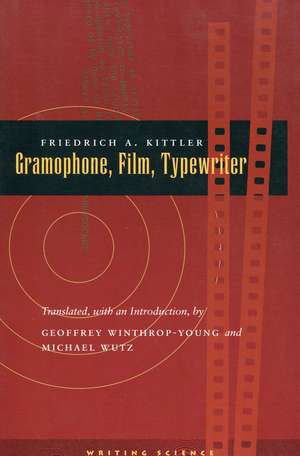
Gramophone, Film, Typewriter: Writing Science
Autor Friedrich Kittler Traducere de Geoffrey Winthrop Young, Michael Wutzen Limba Engleză Paperback – apr 1999
Analiza modului în care hegemonia cuvântului tipărit a fost zdruncinată la sfârșitul secolului al XIX-lea reprezintă nucleul acestei lucrări fundamentale. Reținem argumentul central al lui Friedrich Kittler: spre deosebire de scris, care operează prin mediere simbolică, noile tehnologii precum gramofonul și filmul au început să stocheze direct efectele fizice ale realului — undele sonore și lumina. Această schimbare de paradigmă nu a modificat doar stocarea datelor, ci a recalibrat întreaga chestiune a referențialității în cultura modernă.
Structura volumului Gramophone, Film, Typewriter îmbină istoria tehnologică cu analiza discursului, oferind perspective inedite asupra modului în care inovațiile lui Edison sau Bell au influențat gândirea unor autori precum Kafka sau Heidegger. Observăm cum introducerea mașinii de scris a depersonalizat actul scrierii, transformându-l într-o procesare mecanică de semne, un concept pe care Friedrich Kittler îl explorează prin prisma psihanalizei lacaniene. Cartea servește ca o extensie detaliată a temelor din Discourse Networks, 1800/1900, făcând trecerea de la analiza literară a anilor '80 către studiile sale despre mediile digitale din deceniul următor.
Ca alternativă la Scripts, Grooves, and Writing Machines de Lisa Gitelman pentru cursurile de arheologia media, lucrarea lui Kittler aduce avantajul unei sinteze teoretice mai dense, legând direct dispozitivele de înregistrare de structura aparatului psihic uman. În timp ce Literature, Print Culture, and Media Technologies, 1880–1900 se concentrează pe piața editorială și contextul literar, Gramophone, Film, Typewriter propune o viziune mai radicală, în care tehnologia determină însăși constituția subiectului modern. Este o lectură densă, cu un ton academic riguros, esențială pentru înțelegerea rădăcinilor erei informaționale.
Din seria Writing Science
-
 Preț: 216.43 lei
 - 19%
 Preț: 677.14 lei
 -
 Preț: 292.54 lei
 - 19%
 Preț: 603.29 lei
 -
 Preț: 177.94 lei
 -
 Preț: 262.56 lei
 -
 Preț: 291.22 lei
 -
 Preț: 221.11 lei
 -
 Preț: 166.26 lei
 -
 Preț: 181.42 lei
 - 19%
 Preț: 462.60 lei
 -
 Preț: 296.98 lei
 -
 Preț: 284.44 lei
 -
 Preț: 221.52 lei
 -
 Preț: 222.18 lei
 -
 Preț: 500.19 lei
 - 20%
 Preț: 163.90 lei
 -
 Preț: 334.54 lei
 -
 Preț: 299.77 lei
 -
 Preț: 245.04 lei
 -
 Preț: 497.41 lei
 -
 Preț: 186.70 lei
 - 19%
 Preț: 516.76 lei
 -
 Preț: 112.31 lei
 -
 Preț: 182.17 lei
 -
 Preț: 264.71 lei
 -
 Preț: 244.82 lei
 - 19%
 Preț: 460.65 lei
 - 20%
 Preț: 234.25 lei
 -
 Preț: 163.27 lei
 -
 Preț: 219.20 lei
 -
 Preț: 184.17 lei
Preț: 223.78 lei
Carte disponibilă
Livrare economică 16-30 mai
Livrare express 02-08 mai pentru 46.45 lei
Specificații
ISBN-10: 0804732337
Pagini: 360
Dimensiuni: 152 x 226 x 23 mm
Greutate: 0.52 kg
Ediția:First Edition
Editura: Stanford University Press
Colecția Stanford University Press
Seria Writing Science
V-ar putea interesa
-
 Activism on the Web: Everyday Struggles against Digital CapitalismVeronica Barassi-18%Preț: 1195.34 lei1457.73 lei
 -
 Personal Connections in the Digital AgeNancy K BaymPreț: 135.33 lei
 -
 The Reality of the Mass MediaNiklas LuhmannPreț: 138.75 lei
 -
 Telepopulism: Media and Politics in IsraelYoram Peri-19%Preț: 628.42 lei775.82 lei
 -
 Telepopulism: Media and Politics in IsraelYoram PeriPreț: 205.95 lei
 -
 Files: Law and Media TechnologyCornelia VismannPreț: 186.56 lei
 -
 Preț: 107.25 lei
 -
 Video Game Narrative and CriticismT. ThabetPreț: 432.59 lei
 -
 Media Management: A Casebook ApproachAnn Hollifield-18%Preț: 660.43 lei805.39 lei
 -
 Preț: 370.98 lei
 -
 Law and Popular CultureMichael AsimowPreț: 401.12 lei
 -
 Media and Translation: An Interdisciplinary ApproachDr Dror Abend-David-25%Preț: 269.10 lei360.58 lei
 -
 Preț: 204.16 lei
 -
 Infinite DistractionDominic PettmanPreț: 163.55 lei
 -
 Understanding Media EthicsDavid Sanford HornerPreț: 409.67 lei
De ce să citești această carte
Recomandăm această carte cercetătorilor și studenților la studii media sau filosofie care doresc să înțeleagă cum tehnologia modelează gândirea umană. Cititorul va câștiga o perspectivă critică asupra modului în care gramofonul, filmul și mașina de scris au pus bazele culturii digitale actuale, depășind simpla istorie a invențiilor pentru a explora transformările profunde ale limbajului și memoriei.
Despre autor
Friedrich Kittler a fost unul dintre cei mai influenți teoreticieni media germani, cunoscut pentru abordările sale care combină arheologia sistemelor de gândire ale lui Foucault cu tehnologia hardware. Opera sa investighează modul în care rețelele de discurs sunt condiționate de suporturile tehnice de transmitere a informației. În lucrări precum Zwischen Rauschen und Offenbarung, el explorează vocea ca mediu al ordinii sociale, în timp ce în Optical Media analizează istoria percepției vizuale de la Renaștere la grafica computerizată. Gramophone, Film, Typewriter rămâne lucrarea sa de referință care a definit domeniul arheologiei media.
Descriere scurtă
Part technological history of the emergent new media in the late nineteenth century, part theoretical discussion of the responses to these media—including texts by Rilke, Kafka, and Heidegger, as well as elaborations by Edison, Bell, Turing, and other innovators—Gramophone, Film, Typewriter analyzes this momentous shift using insights from the work of Foucault, Lacan, and McLuhan. Fusing discourse analysis, structuralist psychoanalysis, and media theory, the author adds a vital historical dimension to the current debates over the relationship between electronic literacy and poststructuralism, and the extent to which we are constituted by our technologies. The book ties the establishment of new discursive practices to the introduction of new media technologies, and it shows how both determine the ways in which psychoanalysis conceives of the psychic apparatus in terms of information machines.
Gramophone, Film, Typewriter is, among other things, a continuation as well as a detailed elaboration of the second part of the author's Discourse Networks, 1800/1900 (Stanford, 1990). As such, it bridges the gap between Kittler's discourse analysis of the 1980's and his increasingly computer-oriented work of the 1990's.